

Loading...
Loading...
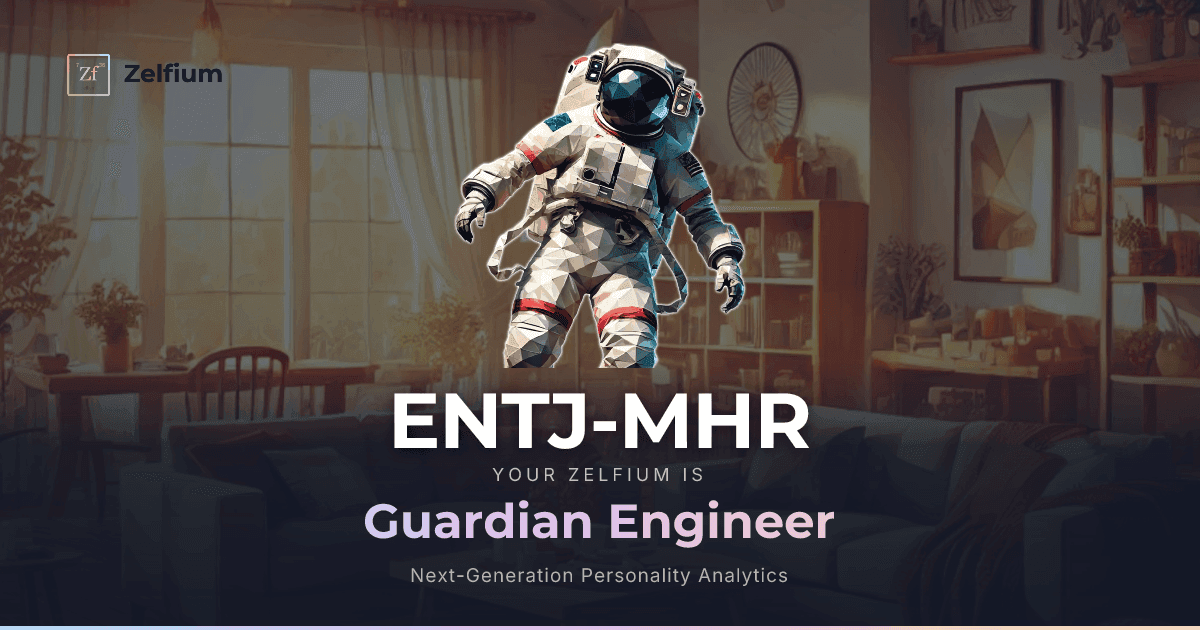
The Guardian Engineer
The ENTJ-MHR is the leader who builds not to disrupt but to protect — and protects not by standing still but by building what endures. The ENTJ's commanding drive toward strategic vision, decisive execution, and large-scale impact meets the MHR's guardian nature, where a deep commitment to stability, empathic attunement to others, and acute sensitivity to emerging threats fuse into a vigilant devotion to the people and systems already in place. The result is a leader of unusual depth: one who can see far into the future while remaining profoundly rooted in the present, who drives ambitious change while never losing sight of what should not change, who commands with authority while quietly monitoring the emotional well-being of every person in the room. Where many ENTJs build toward what could be, the ENTJ-MHR also builds around what already matters — and the structures that result carry a solidity that purely visionary leaders rarely achieve.
The ENTJ's extraversion and openness create a forward-driving, possibility-seeking mind, while the MHR's maintaining dimension pulls in the opposite direction — toward preserving what has been built, honoring continuity, and respecting the value of what already exists. This is not a contradiction but a creative tension. The ENTJ-MHR does not simply innovate or simply conserve — this type evaluates every proposed change against the question the MHR always asks: what are we risking of what already works? The result is a strategic leader with an unusually honest assessment of both the cost and the benefit of every move.
The MHR's harmonious dimension adds a layer of relational intelligence to the ENTJ's natural command presence. Where a pure ENTJ might drive change and expect people to keep up, the ENTJ-MHR feels when someone is falling behind — not through reports or metrics but through the same emotional radar that registers a colleague's unspoken anxiety or a team's quiet demoralization. This sensitivity does not slow the Engineer. It informs the command, producing leadership that adjusts its pace and communication to protect the people carrying out the strategy.
The most consequential interaction lives between the ENTJ's judging dimension and the MHR's responsiveness. Judging craves resolution and forward momentum. Responsiveness keeps detecting risks — not the obvious, quantifiable risks that any strategist would catch, but the subtle, human risks: the team member whose silence signals burnout, the organizational tradition whose removal would damage trust more than any efficiency gain could justify. The ENTJ-MHR learns to read both kinds of data, and the decisions that emerge reflect a strategic sophistication that accounts for what spreadsheets cannot measure.
The ENTJ-MHR possesses a rare ability to lead change without casualties. This is the leader who can restructure an organization and somehow leave morale intact — not by avoiding hard decisions but by making them with a sensitivity to human impact that the guardian dimension provides. People trust this type not because the changes are easy, but because they sense that their well-being was genuinely considered before the decision was made.
There is also an exceptional capacity for institutional stewardship. The ENTJ's strategic vision looks forward; the MHR's maintaining dimension looks backward and holds steady. Together, they produce a leader who can modernize without destroying — who understands that organizations are not just systems of processes but living communities held together by shared history, trust, and ritual. The ENTJ-MHR preserves the social fabric even as the technical infrastructure evolves.
Finally, the MHR's responsive dimension gives this type an early warning system that most strategic leaders lack. The ENTJ-MHR does not wait for problems to become crises. The guardian's sensitivity catches the first tremor — the shift in team dynamics, the subtle resistance to a new policy, the growing distance between departments — and the Engineer's execution capability addresses it before it metastasizes.
The deepest tension in the ENTJ-MHR is between the drive to transform and the instinct to preserve. The ENTJ sees what could be better and wants to build it now. The MHR sees what is valuable and wants to ensure it survives the building. These two impulses can create a painful internal debate before every significant decision — a debate that neither dimension can win cleanly, because both are correct. The ENTJ-MHR may sometimes feel paralyzed not by indecision but by the genuine difficulty of honoring two equally valid commitments.
A second tension lives between extraversion's outward confidence and responsiveness's inward vigilance. The ENTJ-MHR projects decisive authority in public while privately running a continuous threat assessment — scanning for risks to the team, the relationships, the carefully maintained equilibrium. This dual operation is exhausting, and the gap between the composed exterior and the watchful interior can grow wide enough to feel isolating. The leader everyone leans on may be the person with no one to lean on themselves.
There is also a tension between the ENTJ's high performance standards and the MHR's protective instinct. The Engineer demands excellence; the Guardian wants no one to be harmed by that demand. When these two forces collide — when pushing someone harder is the strategically correct move but the emotionally risky one — the ENTJ-MHR experiences a conflict that pure strategists and pure guardians never face, because they each inhabit only one side of it.
Growth for the ENTJ-MHR is not about choosing between building forward and protecting what exists. It is about developing the wisdom to recognize which mode serves the moment — and trusting that the other mode will remain available when needed. There will be seasons when the Engineer must drive change that the Guardian finds uncomfortable, and seasons when the Guardian must slow a pace that the Engineer finds frustrating. The ENTJ-MHR who learns to honor both rhythms discovers a form of leadership that is both powerful and enduring — one that builds structures strong enough to shelter the people inside them, and communities resilient enough to survive the structures' evolution.
The ENTJ-MHR portrait drawn here is the "pure form" — what emerges when every pole swings fully in this direction. In reality, each of your dimensions carries a different intensity, and at every intersection, a unique chemistry unfolds. Even a slight tilt in one dimension creates an entirely different internal dynamic — that is the resolution of Zelfium's 7-dimension model.
Zelfium measures each of 36 facets on a 6-point scale. The number of possible patterns:
6³⁶
possible patterns
vs all humans ever born
880 trillion ×
~117 billion humans have ever lived — repeat that 880 trillion times and you still can't fill every pattern
vs stars in the observable universe
~50,000 ×
~200 sextillion stars in the observable universe — still not enough
vs grains of sand on Earth
~1 billion ×
~7.5 quintillion grains of sand — multiply by a billion
vs current world population
~1.3 quintillion ×
Line up 1.3 quintillion copies of today's 8 billion people to fill every type
More than 50,000 times the number of every star in the observable universe. That is the resolution of your personality.
So don't fit yourself into this description too tightly. ENTJ-MHR is a compass showing the direction your personality leans — not a box that defines everything you are. The pattern woven by your 36 facets is singular in this universe. To discover that one-of-a-kind blend — to find your own ENTJ-MHR — take the assessment.