

Loading...
Loading...
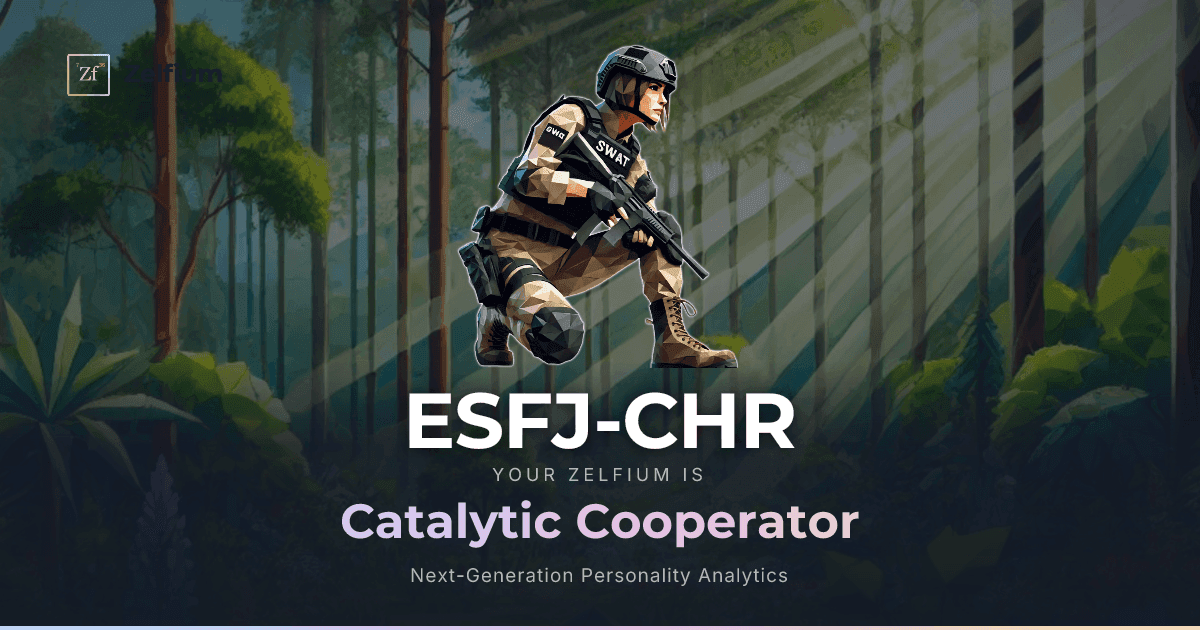
The Catalytic Cooperator
Most caregivers sustain. The ESFJ-CHR sustains and transforms. This is what happens when the ESFJ's community-weaving warmth — a personality that holds groups together through practical devotion and emotional attunement — meets the CHR's catalytic inner life, where curiosity, empathy, and acute sensitivity fuse into a restless drive toward meaningful change. The result is someone who does not simply maintain the social fabric but actively improves it, detecting where relationships have grown stale, where unspoken needs have calcified into resentment, and where a community's habits no longer serve its members. Where a pure ESFJ might preserve traditions because they provide comfort, the ESFJ-CHR interrogates those traditions with genuine love — asking whether they still nourish the people they were created for. The CHR's curiosity ensures that caregiving never becomes mechanical, that every act of service carries the weight of real understanding. This is a person whose warmth is not passive but searching — always looking for a better way to love the people in front of them.
The ESFJ's four dimensions — extraversion, sensory awareness, feeling, and judging — create someone who naturally gravitates toward the center of human communities, organizing life around the needs of others with remarkable practical skill. The CHR's three dimensions — curiosity, harmony, and responsiveness — create an inner world that is perpetually growing, deeply attuned to emotional undercurrents, and sensitized to a degree that borders on clairvoyance. When these two layers coexist, something unexpected emerges: the steady caregiver develops a revolutionary instinct.
Extraversion still governs the rhythm. The ESFJ-CHR draws energy from people, from shared meals and collaborative projects and the hum of a well-functioning group. But the CHR's curiosity dimension means that comfort with the familiar never hardens into complacency. Even in the most established relationships, there is always another layer to understand, another conversation to have, another way that care might be offered more precisely. The ESFJ provides the structure; the CHR ensures that structure keeps evolving.
The CHR's harmonious dimension amplifies the ESFJ's already extraordinary empathy, but it also adds an ethical spine that prevents people-pleasing from becoming the default. The ESFJ wants everyone to feel welcome; the CHR's harmony dimension demands that welcome be genuine — not performative warmth but authentic inclusion. When these two forms of care meet, the result is a presence that people trust at a level that politeness alone could never reach.
The most distinctive interaction, however, is between the ESFJ's sensory groundedness and the CHR's responsiveness. The ESFJ notices the concrete details — the empty seat, the untouched plate, the colleague who has been quieter than usual. The CHR's responsiveness floods those observations with emotional meaning, transforming practical noticing into visceral understanding. A shift in someone's tone is not merely registered but felt, not merely felt but analyzed, not merely analyzed but acted upon — with the ESFJ's characteristic reliability ensuring that the response comes not once but consistently, for as long as the need persists.
The ESFJ-CHR possesses an extraordinary capacity to detect what a community actually needs — not what its members say they need, and not what convention dictates they should need, but the real, often unspoken requirements for genuine flourishing. This type reads a room with both the ESFJ's practical eye and the CHR's emotional radar, producing a dual-layered awareness that misses almost nothing.
There is also an unusual ability to make growth feel safe. The CHR's curiosity drives a desire to push boundaries and explore new territory, but the ESFJ's warmth ensures that this push never feels threatening. People around this type find themselves becoming braver — not because they are pressured but because the ESFJ-CHR has created conditions where risk feels supported. The catalytic function operates through care rather than challenge.
Finally, the CHR's responsiveness gives the ESFJ's acts of service a precision that elevates them from thoughtful to transformative. The birthday remembered, the meal prepared, the logistics handled — these are not generic gestures but calibrated responses to specific, deeply understood needs. The ESFJ-CHR does not just care — this type cares in a way that changes people.
The deepest tension in the ESFJ-CHR is between the desire to preserve and the desire to improve. The ESFJ finds genuine comfort in established patterns — traditions, routines, the familiar rhythms of community life. The CHR's curiosity and responsiveness, however, constantly surface problems with those patterns, detecting where habit has replaced genuine connection and where comfort has drifted into stagnation. The ESFJ-CHR may find themselves simultaneously defending a tradition they love and recognizing that it no longer serves its purpose — a painful ambivalence that requires real courage to resolve.
A second tension lives between the ESFJ's need for social harmony and the CHR's responsiveness, which detects dissonance everywhere. The ESFJ wants the room to feel good; the CHR cannot stop sensing when the room only looks good while something beneath the surface is wrong. This creates an internal pull between smoothing over tensions and naming them — between maintaining the peace and pursuing the truth. The ESFJ-CHR must learn that genuine harmony sometimes requires temporary disruption, and that the courage to speak honestly is its own form of caregiving.
There is also a tension around depletion. The ESFJ gives through action, the CHR's harmonious dimension gives through emotional presence, and the CHR's responsiveness absorbs the pain of everyone nearby. Three channels of giving, all running simultaneously, can drain reserves faster than any single dimension would alone. The ESFJ-CHR must learn that protecting their own energy is not selfishness but sustainability — the prerequisite for the long-term care they were made to provide.
Growth for the ESFJ-CHR is not about caring less or questioning less. It is about developing the discernment to know when preservation serves love and when transformation does — and trusting that the people being cared for can handle the honest version. The ESFJ's reliability anchors the community; the CHR's catalytic nature ensures that anchor does not become a chain. The art is learning to hold both impulses at once — to be the person who remembers the birthday and also the person who gently asks whether the celebration still brings joy. When the ESFJ-CHR trusts that love can survive honesty, and that change can be an act of devotion rather than betrayal, something rare emerges: a caregiver who does not merely sustain communities but helps them become what they were always capable of being.
The ESFJ-CHR portrait drawn here is the "pure form" — what emerges when every pole swings fully in this direction. In reality, each of your dimensions carries a different intensity, and at every intersection, a unique chemistry unfolds. Even a slight tilt in one dimension creates an entirely different internal dynamic — that is the resolution of Zelfium's 7-dimension model.
Zelfium measures each of 36 facets on a 6-point scale. The number of possible patterns:
6³⁶
possible patterns
vs all humans ever born
880 trillion ×
~117 billion humans have ever lived — repeat that 880 trillion times and you still can't fill every pattern
vs stars in the observable universe
~50,000 ×
~200 sextillion stars in the observable universe — still not enough
vs grains of sand on Earth
~1 billion ×
~7.5 quintillion grains of sand — multiply by a billion
vs current world population
~1.3 quintillion ×
Line up 1.3 quintillion copies of today's 8 billion people to fill every type
More than 50,000 times the number of every star in the observable universe. That is the resolution of your personality.
So don't fit yourself into this description too tightly. ESFJ-CHR is a compass showing the direction your personality leans — not a box that defines everything you are. The pattern woven by your 36 facets is singular in this universe. To discover that one-of-a-kind blend — to find your own ESFJ-CHR — take the assessment.