
Loading...
Loading...
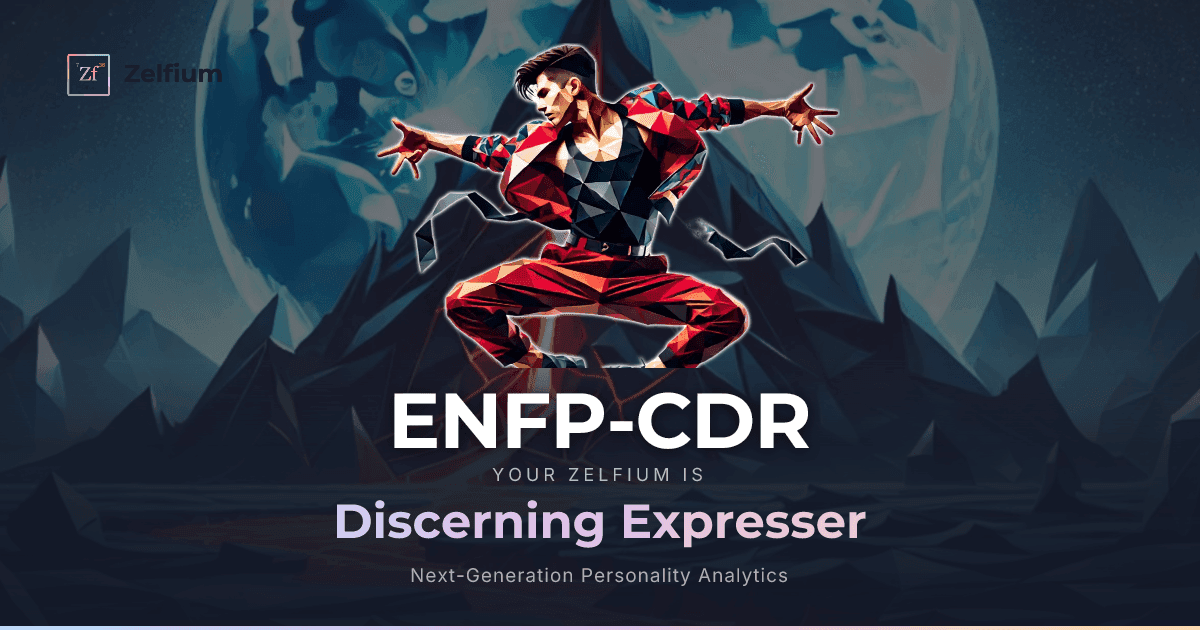
The Discerning Expresser
The ENFP-CDR is what happens when the heart that believes in everyone meets the eye that sees through everything. The ENFP's radiant warmth — a personality that champions human potential with almost reckless generosity — collides with the CDR's discerning inner architecture, where curiosity, intellectual independence, and acute perceptual sensitivity combine into an unflinching capacity to see the world as it actually is. The result is a person who holds two truths simultaneously: the vision of what people could become and the clear-eyed awareness of every obstacle, flaw, and hidden cost standing in the way. Where a pure ENFP might sometimes champion a cause without fully examining its foundations, the CDR ensures that every act of faith has been tested against reality. And where a pure CDR might see the flaws clearly but lack the warmth to mobilize anyone toward change, the ENFP's campaigning spirit provides the emotional fuel to turn discernment into action. This is advocacy that has been stress-tested — not less passionate for being precise, but more trustworthy because of it.
The ENFP's four dimensions — extraversion, openness, feeling, and pioneering — create a personality magnetized by human connection, animated by possibility, guided by values, and allergic to rigidity. The CDR's three dimensions — curiosity, detachment, and responsiveness — create an inner world that is fiercely independent in its thinking, relentlessly growth-oriented, and perceptually sharp enough to catch what most people miss entirely. When these layers coexist, a productive paradox emerges: the warmest person in the room is also the most analytically honest.
The most striking interaction is between the ENFP's feeling dimension and the CDR's detachment. Feeling navigates by values, empathy, and moral conviction — decisions carry emotional weight and human consequence. Detachment insists on seeing situations without the distortion of wishful thinking, social pressure, or sentimental attachment. In many personality configurations, these forces would neutralize each other. In the ENFP-CDR, they create an unusual oscillation that is ultimately productive: feeling opens the door to caring, and detachment ensures that the caring is aimed accurately rather than scattered indiscriminately.
The CDR's responsiveness adds a third layer to this dynamic. Where the ENFP's openness generates expansive visions and the detachment tests them against logic, responsiveness scans the environment for what both of those faculties might miss — the person whose body language contradicts their words, the risk that has not yet been articulated, the internal misalignment between the ENFP-CDR's public enthusiasm and private doubt. This triple awareness — imaginative, analytical, and perceptual — makes the ENFP-CDR's judgments unusually comprehensive.
The CDR's curiosity intersects with the ENFP's openness to produce an intellectual hunger of remarkable range and depth. But where the ENFP's openness tends toward creative synthesis — connecting ideas across domains, seeing metaphorical relationships — the CDR's curiosity has a more surgical quality: it wants to understand the mechanism, find the flaw in the argument, identify what has been assumed without evidence. Together, these create a mind that can imagine a beautiful possibility and then immediately subject it to rigorous examination, without losing the beauty or the rigor.
The ENFP-CDR possesses a rare credibility that comes from pairing passion with precision. This is the person who champions a cause and has done the homework — who can inspire a room with a vision and then answer the hardest skeptic's question with evidence rather than deflection. The combination of the ENFP's emotional persuasiveness with the CDR's analytical rigor creates advocacy that even natural skeptics find difficult to dismiss.
There is also a distinctive capacity for honest encouragement. The ENFP's warmth is genuine, but the CDR's detachment prevents it from becoming flattery. When the ENFP-CDR tells someone they have real talent, that assessment has been arrived at independently — not because it is what the person wanted to hear, but because it is what the evidence shows. This makes the encouragement far more powerful than indiscriminate praise: people sense that they are receiving something earned, not merely offered.
Finally, the CDR's responsiveness gives the ENFP's campaigning a tactical intelligence it would not otherwise possess. The ENFP inspires movement toward a goal; the CDR constantly reads the terrain for obstacles, resistance, and hidden risks. The result is a leadership presence that advances with both conviction and awareness — the rare capacity to charge forward with eyes wide open.
The central tension in the ENFP-CDR is between the desire to believe in people and the inability to stop seeing their limitations. The ENFP's feeling dimension wants to see the best in everyone — wants to champion, encourage, and affirm. The CDR's detachment and responsiveness deliver a constant stream of data about inconsistencies, flaws, and gaps between what people say and what they do. Living with both of these streams simultaneously creates an inner experience that can be genuinely painful: loving the potential while clearly seeing the distance still to travel.
A second tension arises from the collision between the ENFP's need for social warmth and the CDR's instinct for intellectual independence. The ENFP comes alive in groups, generating energy through connection and shared excitement. The CDR needs periods of solitary analytical work and resists the pull of consensus that can distort thinking. The ENFP-CDR may find themselves torn between the room that energizes them and the solitude that clarifies them — between being the person everyone gathers around and the person who needs to step outside to see the situation truthfully.
The CDR's responsiveness also amplifies a vulnerability that already exists in the ENFP: the gap between how much is perceived and how much can be processed. The ENFP absorbs emotional information from every direction; the CDR's responsiveness adds perceptual detail to that already high volume. The sheer density of input — emotional, analytical, and sensory — can create moments of cognitive overload where the mind is simultaneously inspired, critical, and overwhelmed.
Growth for the ENFP-CDR is not about choosing between warmth and honesty — both are essential, and both are genuine. It is about developing the internal architecture to hold them simultaneously without the holding becoming unbearable. The discerning eye does not need to be silenced to protect the caring heart, and the caring heart does not need to be dampened to protect the discerning eye. The integration point is trust — trust that seeing someone clearly is itself a form of love, and that loving someone honestly is itself a form of seeing. The ENFP-CDR who learns to offer both truth and warmth in the same breath, without apology for either, discovers a form of influence that is vanishingly rare: the ability to make people feel seen exactly as they are and still inspired to become more.
The ENFP-CDR portrait drawn here is the "pure form" — what emerges when every pole swings fully in this direction. In reality, each of your dimensions carries a different intensity, and at every intersection, a unique chemistry unfolds. Even a slight tilt in one dimension creates an entirely different internal dynamic — that is the resolution of Zelfium's 7-dimension model.
Zelfium measures each of 36 facets on a 6-point scale. The number of possible patterns:
6³⁶
possible patterns
vs all humans ever born
880 trillion ×
~117 billion humans have ever lived — repeat that 880 trillion times and you still can't fill every pattern
vs stars in the observable universe
~50,000 ×
~200 sextillion stars in the observable universe — still not enough
vs grains of sand on Earth
~1 billion ×
~7.5 quintillion grains of sand — multiply by a billion
vs current world population
~1.3 quintillion ×
Line up 1.3 quintillion copies of today's 8 billion people to fill every type
More than 50,000 times the number of every star in the observable universe. That is the resolution of your personality.
So don't fit yourself into this description too tightly. ENFP-CDR is a compass showing the direction your personality leans — not a box that defines everything you are. The pattern woven by your 36 facets is singular in this universe. To discover that one-of-a-kind blend — to find your own ENFP-CDR — take the assessment.