

Loading...
Loading...
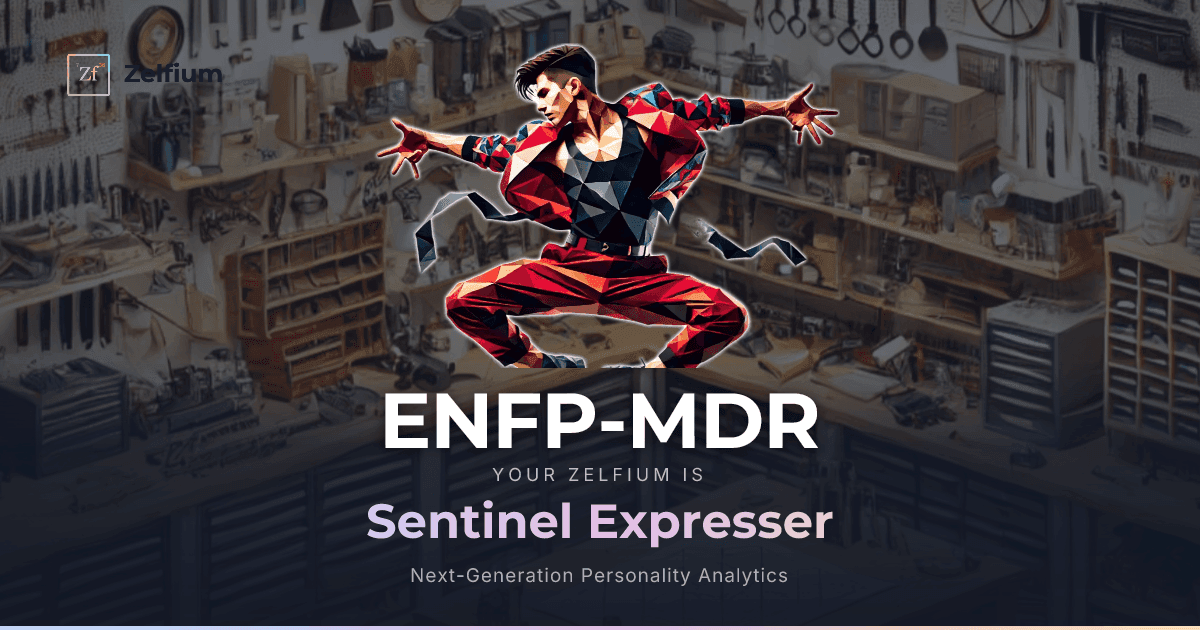
The Sentinel Expresser
The ENFP-MDR is the paradox of fire in a fortress. This is what emerges when the ENFP's radiant enthusiasm and imaginative openness meet the MDR's sentinel nature — where a commitment to proven methods, intellectual independence, and acute perceptual sensitivity combine into a watchful, exacting inner critic that misses nothing. The result is a person who inspires others with passionate vision while simultaneously running a precision audit on every detail of that vision's execution. Where a pure ENFP might launch a dozen initiatives with joyful abandon, the MDR background forces each initiative through a filter of rigorous evaluation: Is this structurally sound? What could go wrong? Who is not being honest about the risks? And where a pure MDR might see every flaw without feeling moved to build anything new, the ENFP's creative fire provides the motivation that transforms vigilance from passive observation into purposeful action. This is not a comfortable combination — it is a powerful one.
The ENFP's four dimensions — extraversion, openness, feeling, and pioneering — create a personality that craves connection, sees possibility everywhere, navigates by values, and resists confinement. The MDR's three dimensions — maintaining, detachment, and responsiveness — create an inner world that values what has been proven, evaluates without sentimentality, and perceives threats with unsettling accuracy. When these two layers share a life, the resulting chemistry is volatile and productive: the visionary acquires a truth-detector.
The most dramatic interaction is between the ENFP's openness and the MDR's maintaining dimension. Openness generates possibilities — new frameworks, new interpretations, new connections between ideas. Maintaining insists that the old framework be fully understood before it is discarded, that proven methods not be abandoned for unproven novelties. In the ENFP-MDR, this creates an internal negotiation that can feel like an argument between two equally convincing selves: one who wants to imagine what could be and another who wants to protect what has already been earned. The tension is real, but it also produces ideas of unusual quality — visions that have been tempered by respect for what already works.
The MDR's detachment interacts with the ENFP's feeling dimension in a way that creates perhaps the most unusual inner experience of any ENFP combination. Feeling says: care about people, let values guide action, trust emotional intelligence. Detachment says: evaluate honestly, resist the pull of sentiment, see the situation as it is rather than as one wishes it were. The ENFP-MDR lives with both of these voices — caring deeply and seeing clearly — and the oscillation between them can be exhausting but produces a form of judgment that is both compassionate and unflinching.
The MDR's responsiveness amplifies the ENFP's emotional receptivity in a particular direction: toward what is hidden, broken, or failing. The ENFP naturally attends to potential — what people could become, what situations could yield. The MDR's responsiveness adds detection of what is going wrong — the cracks beneath the surface, the unspoken tensions, the patterns that predict failure. Together, they produce a dual awareness: seeing both the promise and the peril of every situation simultaneously.
The ENFP-MDR possesses a quality that might be called rigorous inspiration. This is the person who can paint a compelling picture of a better future and then immediately identify every structural weakness in the plan to get there. The ENFP's visionary warmth draws people in; the MDR's analytical precision ensures they are not led astray. Proposals from the ENFP-MDR have a distinctive robustness — they have already survived an internal stress test more demanding than most external critics could impose.
There is also an unusual capacity for detecting and addressing problems that others would rather ignore. The ENFP's warmth creates a relational safety that makes difficult truths easier to hear. The MDR's detachment ensures those truths are delivered with accuracy rather than softened into meaninglessness. The combination produces a person who can say "This is not working" in a way that motivates change rather than creating defensiveness — because the critique comes wrapped in genuine care for the people involved.
Finally, the MDR's maintaining dimension gives the ENFP's projects an unusual staying power. Where many ENFPs are gifted starters who struggle with the unglamorous middle, the MDR's respect for sustained effort and proven methods provides an internal counterweight to the pioneering impulse to move on. The ENFP-MDR is more likely than most ENFP combinations to finish what was started — not because the hunger for novelty has been suppressed, but because the maintaining dimension provides a genuine satisfaction in mastery that the pioneering spirit alone cannot supply.
The deepest tension in the ENFP-MDR is between the desire to inspire and the compulsion to critique. The ENFP wants to champion, encourage, and believe in the best possible outcome. The MDR cannot stop seeing what is wrong, what is risky, what has been overlooked. When both operate at full intensity, the ENFP-MDR may experience a painful internal contradiction: passionately advocating for something while simultaneously cataloging its flaws. This is not hypocrisy — it is the cost of being someone who cares enough to dream and honest enough to audit the dream.
A second tension arises from the collision between the ENFP's social warmth and the MDR's emotional independence. The ENFP is energized by connection, draws strength from community, and processes thoughts and feelings through conversation. The MDR prefers to process internally, values solitude, and distrusts conclusions that were shaped by social influence rather than independent analysis. The ENFP-MDR may feel pulled between the people who energize them and the private analytical space that produces their best thinking — wanting to be with others and needing to be alone, sometimes within the same hour.
There is also a particular vulnerability to self-criticism. The ENFP's feeling dimension holds high ethical standards. The MDR's responsiveness and detachment provide an unsparing lens through which personal performance is evaluated. Together, they can produce an inner critic of formidable intensity — one that judges by the standards of both emotional integrity and analytical rigor. The ENFP-MDR may hold themselves to standards that no human could consistently meet, and the gap between the self that is imagined and the self that is observed can become a source of quiet, persistent pain.
Growth for the ENFP-MDR is not about silencing either the dreamer or the sentinel — both serve essential functions, and the personality would be diminished without either. It is about developing kindness toward the inner contradiction itself. The dreamer and the sentinel will never fully agree — that is by design, not by defect. The ENFP-MDR who learns to regard their internal debate as a creative partnership rather than a civil war discovers something remarkable: the fire of vision and the steel of scrutiny, when allowed to work together rather than against each other, produce something stronger than either could forge alone. The invitation is not to choose a side but to build a self large enough to contain both — and to extend to oneself the same compassionate honesty that this combination naturally offers to everyone else.
The ENFP-MDR portrait drawn here is the "pure form" — what emerges when every pole swings fully in this direction. In reality, each of your dimensions carries a different intensity, and at every intersection, a unique chemistry unfolds. Even a slight tilt in one dimension creates an entirely different internal dynamic — that is the resolution of Zelfium's 7-dimension model.
Zelfium measures each of 36 facets on a 6-point scale. The number of possible patterns:
6³⁶
possible patterns
vs all humans ever born
880 trillion ×
~117 billion humans have ever lived — repeat that 880 trillion times and you still can't fill every pattern
vs stars in the observable universe
~50,000 ×
~200 sextillion stars in the observable universe — still not enough
vs grains of sand on Earth
~1 billion ×
~7.5 quintillion grains of sand — multiply by a billion
vs current world population
~1.3 quintillion ×
Line up 1.3 quintillion copies of today's 8 billion people to fill every type
More than 50,000 times the number of every star in the observable universe. That is the resolution of your personality.
So don't fit yourself into this description too tightly. ENFP-MDR is a compass showing the direction your personality leans — not a box that defines everything you are. The pattern woven by your 36 facets is singular in this universe. To discover that one-of-a-kind blend — to find your own ENFP-MDR — take the assessment.