

Loading...
Loading...
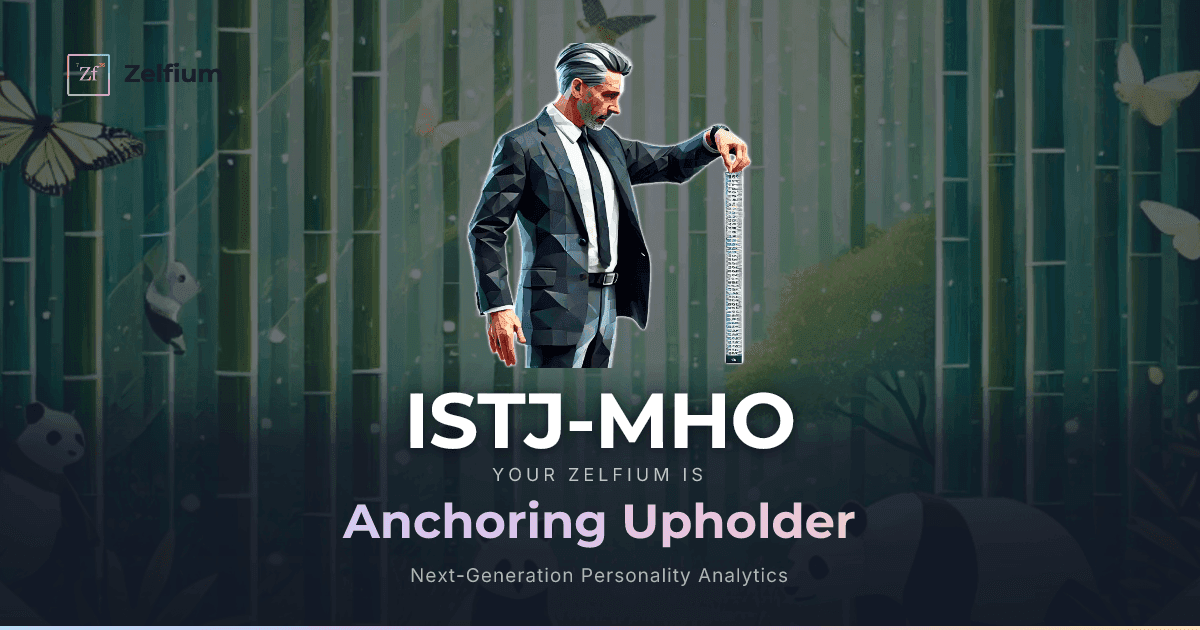
The Anchoring Upholder
The ISTJ-MHO may be the most stabilizing personality combination the Zelfium framework can describe. The ISTJ's architecture — introverted, sensory, thinking, judging — provides the disciplined scaffolding that holds systems, standards, and commitments firmly in place. The MHO's inner world — maintaining, harmonious, optimistic — fills that scaffolding with warmth, faith in people, and a resilient confidence that makes the whole structure feel not just reliable but genuinely nourishing. Where a pure ISTJ maintains order because disorder is inefficient, the ISTJ-MHO maintains it because order is the gift this person gives to the people who depend on it — and the optimistic dimension adds the quiet assurance that the effort will be worthwhile, that the people will come through, and that the steady work of maintenance is building something that will endure. This is the anchor — not because the world is heavy, but because someone has chosen to be the still point others can hold onto when it is.
The ISTJ and MHO share a deep structural affinity. Both layers prize stability, value what has been built over time, and orient toward sustaining rather than disrupting. The effect is not redundancy but resonance — the ISTJ's methodical reliability gains emotional depth, and the MHO's caring steadiness gains procedural rigor.
The MHO's maintaining dimension amplifies the ISTJ's sensory respect for proven approaches into something approaching reverence. This is not rigidity — it is the understanding that continuity has a compounding value that constant reinvention never achieves. Traditions are maintained not out of sentimentality but out of a clear-eyed recognition that they carry the accumulated wisdom of everyone who came before.
The harmonious dimension softens the ISTJ's thinking-driven objectivity into something more relational without compromising its accuracy. Standards are held — firmly — but the communication of those standards is informed by empathy. The ISTJ-MHO does not merely inform someone that they have fallen short. This type helps them understand why the standard exists and then offers the support needed to meet it next time. The correction is real; the kindness around it is equally real.
The most transformative interaction is between the ISTJ's judging dimension and the MHO's optimism. Judging wants certainty, completion, and control. Optimism says "And you will have it — not because everything is perfect, but because patient effort always finds a way." This partnership creates an emotional resilience that is genuinely unusual for the ISTJ pattern. Disruptions that might derail another ISTJ are absorbed by the ISTJ-MHO with steady composure — not because the disruption is minimized, but because there is a deep, practiced trust that the system will hold and the people within it will be alright.
The ISTJ-MHO's greatest strength is the ability to sustain morale over the long haul without drama, without speeches, without any visible effort at all. This type simply shows up — day after day, with the same reliability, the same quiet warmth, the same practical competence — and the cumulative effect is an environment where people feel held. Not entertained, not inspired, but genuinely held. The combination of procedural rigor and emotional generosity creates a trust that deepens with every year rather than fading.
There is also an unusual capacity to absorb setbacks without passing the emotional cost onto others. The ISTJ's discipline keeps the response structured, and the MHO's optimism keeps it constructive. Mistakes are met with problem-solving rather than blame, disruptions are met with calm adaptation rather than panic, and the people around the ISTJ-MHO learn that turbulence does not fundamentally alter the landscape — it is simply weather, and it passes.
Finally, the ISTJ-MHO is someone people return to. The consistency, the warmth, the practical dependability — these qualities create a gravitational pull that others feel even years later. Relationships with this type do not expire, because the maintaining dimension on both layers ensures that connection is tended long after the initial reason for it has passed.
The primary tension in the ISTJ-MHO is the risk of comfortable stagnation. When the ISTJ's sensory attachment to the proven meets the MHO's maintaining orientation and optimistic confidence that everything is fine, the result can be a life so well-maintained that necessary change is perpetually deferred. The harmony is real. The stability is genuine. But occasionally, the very qualities that make things comfortable are also preventing them from becoming what they need to become next. The ISTJ-MHO's greatest danger is not failure — it is succeeding at staying the same when evolution is required.
A second tension exists between the harmonious dimension's desire to care for others and the thinking dimension's emotional economy. The ISTJ-MHO feels a great deal — the harmonious nature ensures this — but expressing that feeling can feel inefficient or vulnerable, so care is channeled into actions: maintaining routines, remembering details, showing up consistently. These are genuine expressions of love, but they can leave the people closest to this type longing for something more direct — a word, a conversation, a moment of emotional visibility that the action-oriented care does not provide.
There is also the accumulated cost of being the anchor. Anchors do not move, even when they want to. The ISTJ-MHO can become so identified with the role of the stable center that personal desires — for change, for adventure, for something different — are suppressed in service of the people who depend on that stability. The self-sacrifice is not always visible, even to the person making it.
Growth for the ISTJ-MHO is not about becoming less stable or less devoted. It is about discovering that stability does not require self-erasure. The anchor can hold its ground and still grow. The foundation can be solid and still develop new rooms. Learning to articulate personal needs — not as complaints, but as information that the people who love this type genuinely want to have — is the growth edge. The ISTJ-MHO's instinct is to maintain harmony by absorbing all disruption personally, but true harmony includes the harmony of the self. A community that functions only because one member perpetually sacrifices is not genuinely stable — it is dependent. The ISTJ-MHO who learns to include themselves in the circle of people being cared for does not weaken the anchor. The anchor becomes more complete, more whole, and paradoxically, even more reliable — because it is finally being maintained with the same devotion given to everything else.
The ISTJ-MHO portrait drawn here is the "pure form" — what emerges when every pole swings fully in this direction. In reality, each of your dimensions carries a different intensity, and at every intersection, a unique chemistry unfolds. Even a slight tilt in one dimension creates an entirely different internal dynamic — that is the resolution of Zelfium's 7-dimension model.
Zelfium measures each of 36 facets on a 6-point scale. The number of possible patterns:
6³⁶
possible patterns
vs all humans ever born
880 trillion ×
~117 billion humans have ever lived — repeat that 880 trillion times and you still can't fill every pattern
vs stars in the observable universe
~50,000 ×
~200 sextillion stars in the observable universe — still not enough
vs grains of sand on Earth
~1 billion ×
~7.5 quintillion grains of sand — multiply by a billion
vs current world population
~1.3 quintillion ×
Line up 1.3 quintillion copies of today's 8 billion people to fill every type
More than 50,000 times the number of every star in the observable universe. That is the resolution of your personality.
So don't fit yourself into this description too tightly. ISTJ-MHO is a compass showing the direction your personality leans — not a box that defines everything you are. The pattern woven by your 36 facets is singular in this universe. To discover that one-of-a-kind blend — to find your own ISTJ-MHO — take the assessment.