

Loading...
Loading...
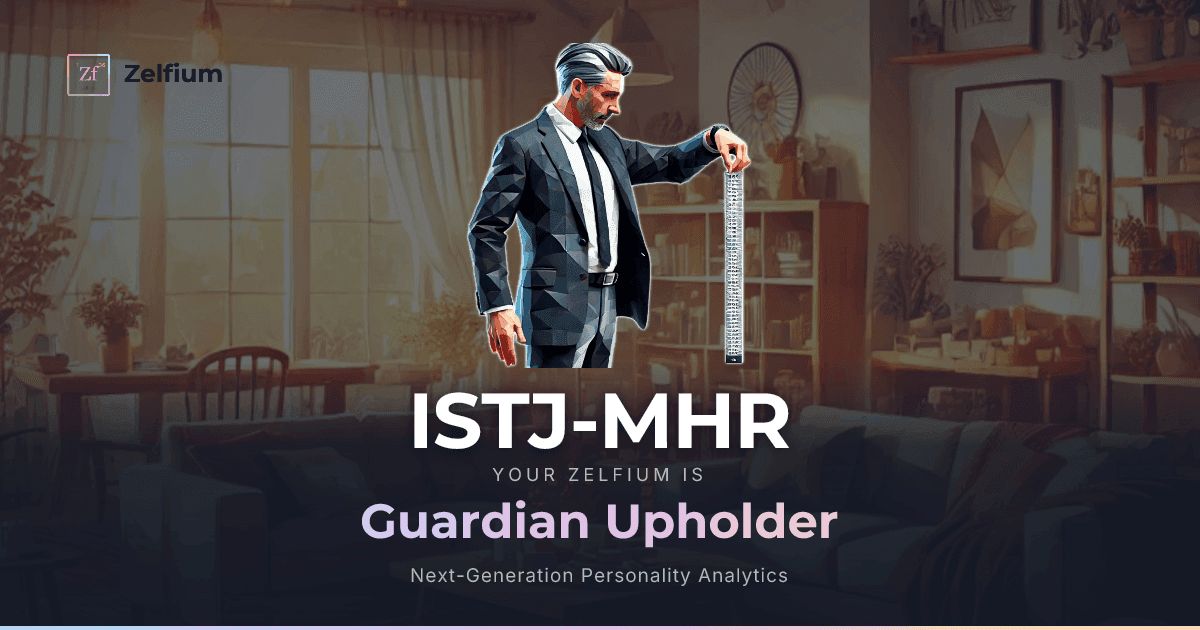
The Guardian Upholder
The ISTJ-MHR is the most protective combination the Zelfium framework can construct. The ISTJ's architecture — introverted, sensory, thinking, judging — already excels at maintaining systems, upholding standards, and ensuring that nothing important slips through the cracks. The MHR's inner world — maintaining, harmonious, responsive — deepens this into something more personal: a fierce, quiet devotion to the people those systems are meant to protect. Where a pure ISTJ might maintain a process because it is correct, the ISTJ-MHR maintains it because someone depends on it — and because the responsive dimension has already detected the first hairline fracture that no one else has noticed. This is not bureaucratic diligence. It is love expressed through thoroughness — the care of someone who has decided that the best way to protect the people who matter is to ensure that absolutely nothing goes wrong on their watch.
The ISTJ's four dimensions and the MHR's three dimensions share an unusual degree of natural alignment. Both layers value stability, consistency, and careful attention to what already exists. When they coexist, they do not create tension so much as amplification — the ISTJ's methodical nature becomes even more deliberate, and the MHR's protective instinct becomes even more precise.
The MHR's maintaining dimension reinforces the ISTJ's sensory attachment to proven methods. Where other background types might push the ISTJ toward experimentation, the MHR says "Stay. Deepen. Protect what has already been built." The result is someone with an extraordinarily deep relationship with established systems — not because change is feared, but because the accumulated value of what has been carefully maintained is understood at a level most people cannot access.
The harmonious dimension transforms the ISTJ's thinking-driven accountability into something warmer without making it softer. Standards are still high — perhaps higher than ever — but the motivation shifts from "This is the correct way" to "This protects the people I care about." An ISTJ-MHR managing a team does not enforce procedures for the sake of order. Procedures are enforced because every deviation represents a potential risk to someone, and the harmonious nature cannot tolerate that risk.
The most distinctive interaction occurs between the ISTJ's judging dimension and the MHR's responsiveness. Both want stability, but they pursue it differently. Judging achieves stability through planning, scheduling, and completing. Responsiveness monitors stability by scanning for threats — the slight shift in atmosphere, the small irregularity that signals something is beginning to go wrong. Together, they create a person who both builds stable structures and stands guard over them with an almost preternatural alertness, catching disruptions at their earliest, most preventable stage.
The ISTJ-MHR is the person others trust with what matters most. Financial records, medical procedures, safety protocols, the welfare of vulnerable people — wherever the stakes are real and the margin for error is narrow, this type operates with a reliability that goes beyond competence into something closer to devotion. The combination of the ISTJ's procedural precision with the MHR's emotional attunement means that both the technical and human dimensions of responsibility are covered simultaneously.
There is also an exceptional ability to create environments where people feel genuinely safe. The ISTJ-MHR's daily consistency — showing up, following through, remembering, maintaining — builds a foundation of trust that accumulates over years and becomes irreplaceable. People near this type may not always articulate what makes them feel secure, but if the ISTJ-MHR were absent, the absence would be felt immediately and acutely.
Finally, the combination of responsiveness and sensory attention produces an early-warning system of remarkable sensitivity. Problems are detected at the stage where they are still solvable, because the ISTJ-MHR is always watching — not with anxiety, but with the steady attentiveness of someone who understands that prevention is the highest form of care.
The deepest tension in the ISTJ-MHR is hypervigilance. When the ISTJ's judging dimension, the sensory dimension's attention to detail, and the MHR's responsive sensitivity all orient toward threat detection, the result can be a person who is always bracing for something to go wrong. The scanner runs constantly — checking procedures, monitoring people's states, anticipating disruptions — and the combined weight of the ISTJ's need for control and the MHR's need to protect means that relaxation feels irresponsible. The fortress built to keep everyone safe can become exhausting to patrol.
A second tension lives between the harmonious dimension's desire to care for others and the ISTJ's thinking dimension's emotional reserve. The ISTJ-MHR feels deeply — the harmonious and responsive dimensions ensure that — but the expression of that feeling is filtered through introversion and thinking, emerging as practical action rather than emotional warmth. The gap between how much is felt and how much is shown can be painfully wide, leaving the ISTJ-MHR wondering why the care poured into maintaining everything seems invisible to the very people it is meant to serve.
There is also the risk of over-identification with the guardian role. When stability, harmony, and responsiveness all point toward protecting others, personal needs can vanish from the priority list entirely. The ISTJ-MHR may give so completely to the role of keeper and protector that the question "What do I need?" is never genuinely asked — or if asked, is immediately dismissed as less important than what others need.
Growth for the ISTJ-MHR is not about becoming less vigilant or less devoted. It is about extending the same quality of care inward. The guardian who watches over everyone else deserves someone watching over them — and the only person who can do that job with the necessary thoroughness is themselves. Learning to treat personal rest, personal boundaries, and personal fulfillment with the same seriousness given to every other responsibility is the growth edge. Not every crack needs immediate repair. Not every scan needs to run at full resolution. The ISTJ-MHR who learns to lower the vigilance occasionally — not because nothing matters, but because the foundations are genuinely strong — discovers that the people being protected do not need a perfect guardian. They need a present one. And presence requires the guardian to be rested, whole, and willing to receive the same care so generously given to everyone else.
The ISTJ-MHR portrait drawn here is the "pure form" — what emerges when every pole swings fully in this direction. In reality, each of your dimensions carries a different intensity, and at every intersection, a unique chemistry unfolds. Even a slight tilt in one dimension creates an entirely different internal dynamic — that is the resolution of Zelfium's 7-dimension model.
Zelfium measures each of 36 facets on a 6-point scale. The number of possible patterns:
6³⁶
possible patterns
vs all humans ever born
880 trillion ×
~117 billion humans have ever lived — repeat that 880 trillion times and you still can't fill every pattern
vs stars in the observable universe
~50,000 ×
~200 sextillion stars in the observable universe — still not enough
vs grains of sand on Earth
~1 billion ×
~7.5 quintillion grains of sand — multiply by a billion
vs current world population
~1.3 quintillion ×
Line up 1.3 quintillion copies of today's 8 billion people to fill every type
More than 50,000 times the number of every star in the observable universe. That is the resolution of your personality.
So don't fit yourself into this description too tightly. ISTJ-MHR is a compass showing the direction your personality leans — not a box that defines everything you are. The pattern woven by your 36 facets is singular in this universe. To discover that one-of-a-kind blend — to find your own ISTJ-MHR — take the assessment.