

Loading...
Loading...
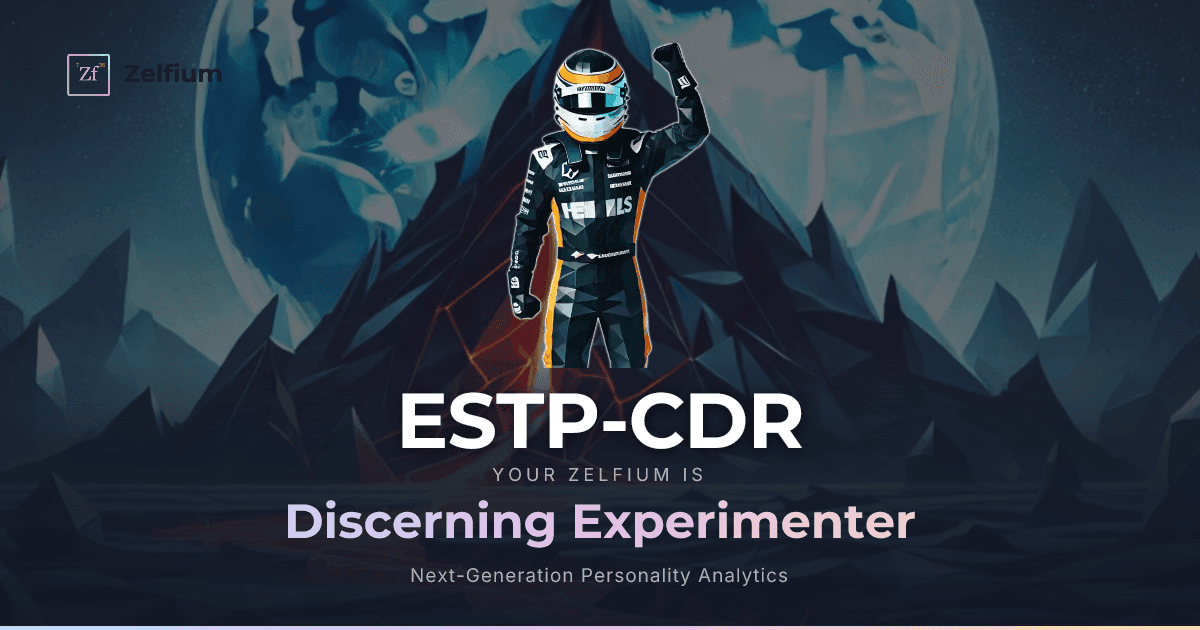
The Discerning Experimenter
Speed without discernment is recklessness. Discernment without speed is paralysis. The ESTP-CDR possesses both, and the tension between them is precisely what makes this combination so formidable. This is what happens when the ESTP's tactical brilliance — a mind built to read situations instantly and act with fluid precision — meets the CDR's discerning inner world, where restless curiosity, intellectual independence, and acute sensitivity to risk converge into a perceptual instrument of extraordinary resolution. The result is a person who moves fast and sees deep — someone who can walk into a room, diagnose the real problem beneath the surface problem, and execute a solution before most people have finished processing their discomfort. Where a pure ESTP might act on the most visible signal, the ESTP-CDR has an additional layer of analysis running — one that catches the subtleties, the contradictions, the things that do not quite add up. This combination does not just react to what is happening. It discerns what is actually happening.
The ESTP's four dimensions — extraversion, sensory awareness, thinking, and pioneering flexibility — create a person who thrives in the active center of events, processing reality through direct engagement rather than abstract reflection. The CDR's three dimensions — curiosity, detachment, and responsiveness — create an inner world that is intellectually fearless, emotionally self-governed, and perceptually attuned to signals most people never register. When these two layers share the same person, the operator acquires a scanner.
Extraversion provides the social access point; the CDR's detachment ensures that access does not compromise independence. The ESTP-CDR engages fully with people and situations but retains a part of the mind that refuses to be swept along. There is a watcher inside the participant — evaluating, cross-referencing, noting the gap between what is said and what is meant. This dual mode of engagement gives the ESTP-CDR an unusual advantage: the ability to be in the room without being of the room.
The CDR's curiosity takes the ESTP's sensory acuity and pushes it into deeper territory. The ESTP naturally registers what is happening on the surface — movement, change, opportunity. The CDR's curiosity asks why. Why did the negotiation shift at that particular moment? What unseen pressure caused someone to change their position? This partnership between observation and investigation produces a form of situational intelligence that is both immediate and penetrating.
The sharpest interaction, however, is between the ESTP's pioneering flexibility and the CDR's responsiveness. Pioneering says "adapt, move, improvise." Responsiveness says "wait — did anyone else notice that signal?" The pioneering dimension wants to stay loose and fast; the responsive dimension insists on scanning for threats before committing. In the ESTP-CDR, this creates a distinctive rhythm: rapid movement punctuated by moments of sudden, intense alertness — like a fighter pilot who accelerates through open sky and then locks focus when the instruments show something the eye has not yet confirmed.
The ESTP-CDR can see through things that stop other people cold. Social performances, flawed strategies, reassuring narratives that paper over structural problems — this type penetrates all of them with a speed that can appear almost intuitive. The combination of the ESTP's real-time processing with the CDR's analytical independence means that conclusions are reached quickly and are based on what is actually happening rather than what everyone wants to believe is happening.
There is also a rare form of courage here. The CDR's intellectual independence means this type will say what others are thinking but afraid to voice, and the ESTP's social confidence provides the platform from which to say it. The result is a truth-teller who does not retreat into anonymity but delivers the uncomfortable insight face to face, in the moment, with the kind of directness that is unsettling but ultimately respected.
Finally, the responsiveness dimension gives the ESTP's action orientation a quality-control mechanism. Where a pure ESTP might move too fast and miss the hidden flaw, the CDR's perceptual sensitivity catches it — the early tremor, the data point that does not fit, the risk that has not been factored in. This built-in early-warning system makes the ESTP-CDR's decisions more robust than their speed would suggest.
The central tension in the ESTP-CDR is between the ESTP's instinct to engage and the CDR's instinct to stand apart. The ESTP is social by nature — energized by interaction, comfortable in groups, drawn to the kinetic center of events. The CDR's detachment, however, creates a simultaneous pull toward independence — a need to process things on its own terms without being influenced by the emotional temperature of the group. The ESTP-CDR can find itself oscillating between intense social engagement and sudden withdrawal, as the detached dimension periodically demands space to evaluate what the extraverted dimension has just absorbed.
A second tension exists between the ESTP's optimistic action orientation and the CDR's responsiveness. The ESTP's default is to move forward — solve the problem, take the opportunity, deal with consequences later. Responsiveness operates on a different clock: it wants to ensure that all threats have been scanned before commitment. This produces an internal push-and-pull that can feel like arguing with oneself — one voice saying "go now," the other saying "you have not looked closely enough."
There is also a tension around trust. The CDR's detachment and perceptual acuity make the ESTP-CDR extraordinarily good at reading people — but this same ability can make genuine trust difficult. When the gap between what people say and what they actually mean is always visible, the impulse to remain guarded becomes strong. The ESTP's social warmth keeps the exterior accessible, but the CDR's internal watchfulness can create a private distance that even close associates may never fully bridge.
Growth for the ESTP-CDR is not about lowering the perceptual resolution or suppressing the analytical independence. It is about learning that the scanner does not need to run at full capacity in every interaction. Some situations call for the full CDR — the penetrating insight, the independent assessment, the refusal to accept the surface. Others call for something the ESTP offers naturally but the CDR can inhibit: the willingness to simply be present with another person without evaluating what is beneath. When the ESTP-CDR learns to toggle between these modes deliberately — choosing when to discern and when to simply connect — the combination acquires a flexibility that makes it not just powerful, but wise.
The ESTP-CDR portrait drawn here is the "pure form" — what emerges when every pole swings fully in this direction. In reality, each of your dimensions carries a different intensity, and at every intersection, a unique chemistry unfolds. Even a slight tilt in one dimension creates an entirely different internal dynamic — that is the resolution of Zelfium's 7-dimension model.
Zelfium measures each of 36 facets on a 6-point scale. The number of possible patterns:
6³⁶
possible patterns
vs all humans ever born
880 trillion ×
~117 billion humans have ever lived — repeat that 880 trillion times and you still can't fill every pattern
vs stars in the observable universe
~50,000 ×
~200 sextillion stars in the observable universe — still not enough
vs grains of sand on Earth
~1 billion ×
~7.5 quintillion grains of sand — multiply by a billion
vs current world population
~1.3 quintillion ×
Line up 1.3 quintillion copies of today's 8 billion people to fill every type
More than 50,000 times the number of every star in the observable universe. That is the resolution of your personality.
So don't fit yourself into this description too tightly. ESTP-CDR is a compass showing the direction your personality leans — not a box that defines everything you are. The pattern woven by your 36 facets is singular in this universe. To discover that one-of-a-kind blend — to find your own ESTP-CDR — take the assessment.