

Loading...
Loading...
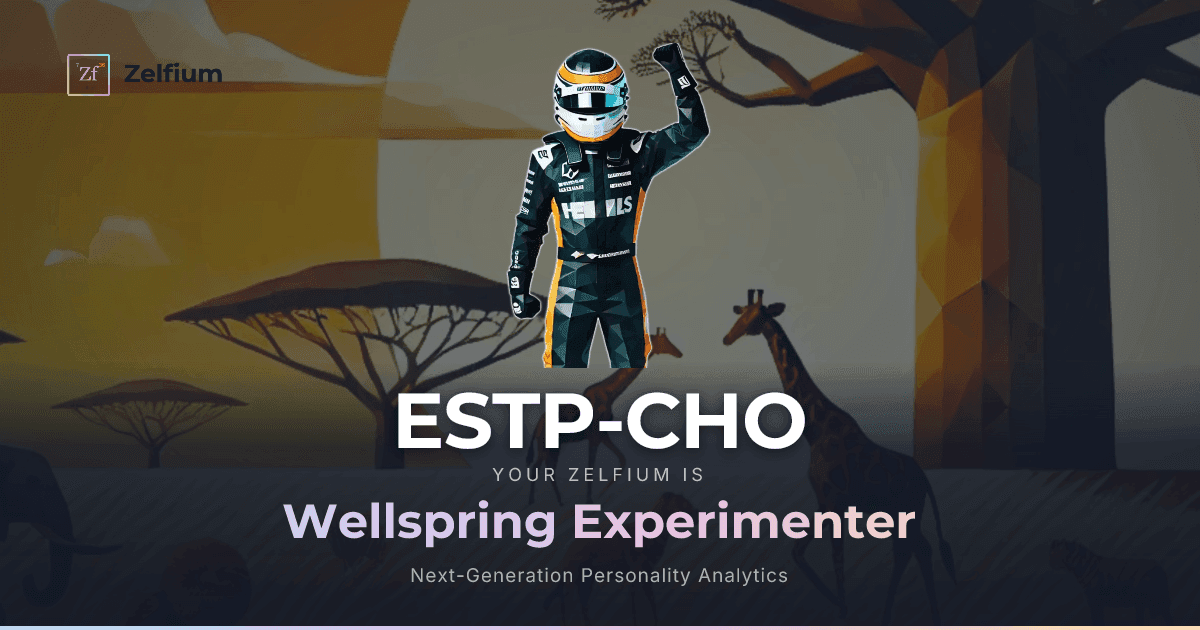
The Wellspring Experimenter
Action without joy is labor. Joy without action is daydream. The ESTP-CHO lives at the intersection where both become one. This is what happens when the ESTP's tactical brilliance — a mind that reads rooms in seconds, acts under pressure with uncanny precision, and thrives in the kinetic center of unfolding events — meets the CHO's wellspring nature, where curiosity, warmth, and deep emotional resilience merge into an almost contagious sense of possibility. The result is a person who does not merely solve problems but turns the process of solving them into something others genuinely want to be part of. Where a pure ESTP might deliver results and leave the emotional atmosphere to fend for itself, the ESTP-CHO cannot. The CHO background adds a question that recalibrates everything: "Who wants to come along?" That invitation transforms solitary excellence into shared adventure — and the adventure, for this type, is the whole point.
The ESTP's four dimensions — extraversion, sensory awareness, thinking, and pioneering flexibility — produce someone who navigates high-velocity situations with a fluency that borders on artistry. The CHO's three dimensions — curiosity, harmony, and optimism — produce an inner world that is exploratory, relationally generous, and emotionally buoyant in ways that most people find difficult to sustain. When these two layers share the same person, a distinctive alchemy occurs: the pragmatic performer develops an instinct for collective joy.
Extraversion finds a new partner in harmony. The ESTP naturally draws energy from being in the room; the CHO's harmonious dimension ensures that energy flows outward rather than pooling around the self. Social engagement becomes less about personal charge and more about creating an atmosphere — a sense that something good is happening and everyone present is part of it. People leave interactions with this type feeling not just entertained but included, which is a subtle but significant shift from the ESTP's usual magnetic pull.
The CHO's curiosity amplifies the ESTP's sensory awareness along an unexpected axis. The ESTP scans for tactical advantage — who holds power, where the opportunity lives, what needs to happen next. The CHO's curiosity adds a layer of genuine wonder: what is this person passionate about? What would happen if the usual approach were turned inside out? This pairing produces someone who is simultaneously street-smart and open-hearted, combining the ESTP's nose for what works with the CHO's appetite for what might.
The most transformative interaction is between the ESTP's thinking dimension and the CHO's optimism. Thinking strips situations to their logical bones; optimism infuses those bones with expectation of a good outcome. Together, they create a remarkable problem-solving temperament: the ESTP-CHO diagnoses with precision and prescribes with confidence, and the people around them believe in the prescription not because it is sold to them but because the genuine warmth behind it is unmistakable.
The ESTP-CHO possesses a rare ability to make difficult undertakings feel like adventures. Crisis management, challenging negotiations, high-stakes pivots — situations that drain most people energize this type, and the energy radiates outward. Teams around the ESTP-CHO find themselves performing at levels they did not know they had, not because they are pushed but because the atmosphere makes excellence feel natural.
There is also an extraordinary social resilience. Setbacks that would send others into analysis paralysis are processed by the ESTP-CHO at remarkable speed: thinking diagnoses what went wrong, optimism reframes it as useful data, curiosity immediately begins exploring the next approach, and the whole cycle completes before most people have finished worrying. This recovery speed is infectious — it teaches the people nearby that failure is not a verdict but a pivot point.
Finally, the CHO's warmth gives the ESTP's natural directness a quality of invitation rather than command. The ESTP-CHO tells the truth, but the truth arrives wrapped in genuine care and the optimistic assumption that the listener can handle it and grow from it. This makes the type unusually effective in mentoring, coaching, and any role where honest feedback must land without damaging the relationship.
The primary tension in the ESTP-CHO is between depth and momentum. The ESTP thrives on speed and variety — new problems, new people, new contexts. The CHO's harmonious dimension genuinely values the people encountered along the way and wants to invest in them. But investing takes time, and time is the one currency the ESTP's pioneering spirit is reluctant to spend in one place. The result can be a pattern of intense, magnetic connection followed by abrupt departure toward the next horizon — leaving people feeling dazzled but also slightly abandoned.
A second tension exists between the CHO's optimism and the ESTP's sensory realism. Optimism says "this will work out." Sensory awareness says "here is exactly what is happening right now, and some of it is not good." When these two perspectives collide, the ESTP-CHO can oscillate between clear-eyed assessment and an almost reflexive reassurance that glosses over genuine problems. The challenge is learning to let the realistic reading stand long enough for others to absorb it, rather than immediately cushioning it with confidence.
There is also a subtler tension around emotional processing. The CHO's optimism is a genuine strength, but it can function as a bypass — moving past difficult emotions before they have been fully felt. The ESTP's action orientation amplifies this tendency: if something hurts, the instinct is to do something about it rather than sit with it. The combination can produce a person who appears endlessly resilient on the surface while carrying unprocessed weight underneath that occasionally surfaces in unexpected ways.
Growth for the ESTP-CHO is not about becoming less optimistic or less action-oriented. It is about learning that some of the richest experiences this combination can access require a willingness to stay — in a conversation, in a relationship, in an uncomfortable emotion — longer than the pioneering instinct prefers. The wellspring runs deep, and its deepest waters are reached not by racing across the surface but by standing still long enough to feel the current beneath. When someone as dynamic as the ESTP-CHO discovers that stillness is not the opposite of adventure but a different form of it, the generosity and warmth that already define this type acquire a gravity that makes them truly unforgettable.
The ESTP-CHO portrait drawn here is the "pure form" — what emerges when every pole swings fully in this direction. In reality, each of your dimensions carries a different intensity, and at every intersection, a unique chemistry unfolds. Even a slight tilt in one dimension creates an entirely different internal dynamic — that is the resolution of Zelfium's 7-dimension model.
Zelfium measures each of 36 facets on a 6-point scale. The number of possible patterns:
6³⁶
possible patterns
vs all humans ever born
880 trillion ×
~117 billion humans have ever lived — repeat that 880 trillion times and you still can't fill every pattern
vs stars in the observable universe
~50,000 ×
~200 sextillion stars in the observable universe — still not enough
vs grains of sand on Earth
~1 billion ×
~7.5 quintillion grains of sand — multiply by a billion
vs current world population
~1.3 quintillion ×
Line up 1.3 quintillion copies of today's 8 billion people to fill every type
More than 50,000 times the number of every star in the observable universe. That is the resolution of your personality.
So don't fit yourself into this description too tightly. ESTP-CHO is a compass showing the direction your personality leans — not a box that defines everything you are. The pattern woven by your 36 facets is singular in this universe. To discover that one-of-a-kind blend — to find your own ESTP-CHO — take the assessment.