

Loading...
Loading...
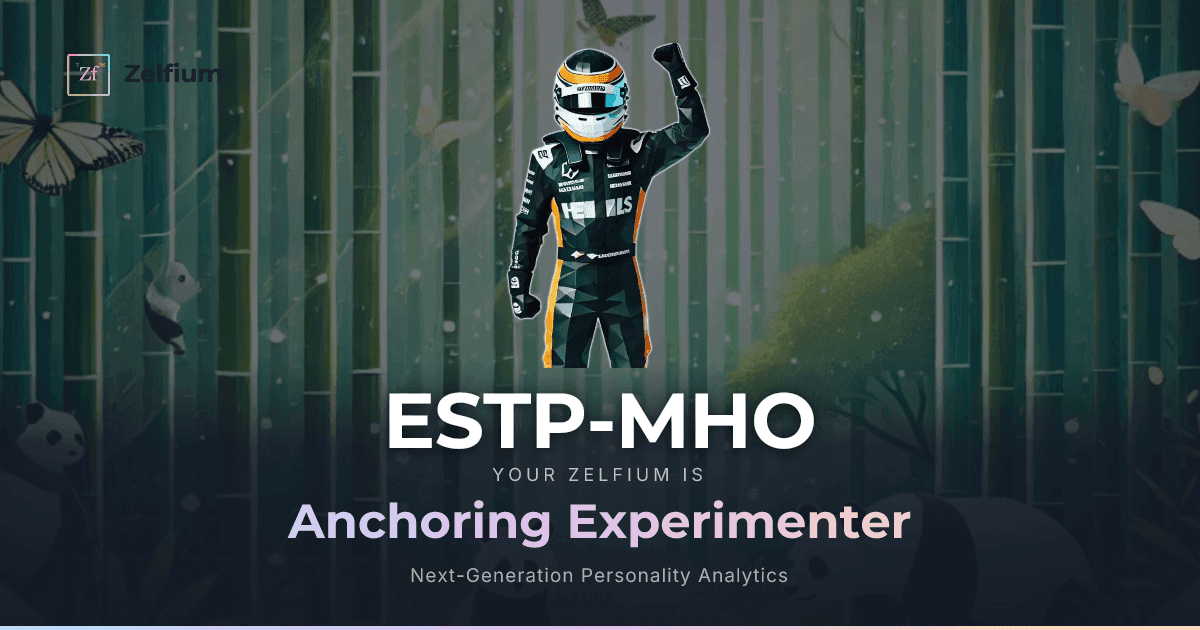
The Anchoring Experimenter
Most people who move fast leave chaos behind them. The ESTP-MHO moves fast and somehow leaves stability. This is the distinctive gift of a combination in which the ESTP's tactical brilliance — a mind that reads situations at speed, acts under pressure with fluid precision, and thrives in the kinetic center of events — meets the MHO's anchoring nature, where deep commitment to what has been built, genuine warmth toward people, and resilient optimism converge into an unshakable steadiness. The result is an action-oriented stabilizer — someone who can handle a crisis at full speed while simultaneously reassuring everyone present that things are going to be alright, and meaning it. Where a pure ESTP might solve the problem and charge toward the next one, the MHO background ensures that each solution lands gently, that the people affected feel cared for, and that the foundations of what matters most remain undisturbed. This type does not just fix things. It fixes things in a way that makes everything feel more solid afterward.
The ESTP's four dimensions — extraversion, sensory awareness, thinking, and pioneering flexibility — create someone who engages the world with confidence, directness, and remarkable adaptability. The MHO's three dimensions — maintaining, harmony, and optimism — create an inner world that values continuity, feels other people's emotional states deeply, and carries a resilient belief that difficulties are temporary. When these two layers coexist, the energetic improviser develops an anchor.
The interaction between extraversion and harmony creates a social presence of unusual quality. The ESTP naturally commands attention and energizes groups. The MHO's harmonious dimension ensures that energy does not only flow outward as performance but returns as connection. People around the ESTP-MHO do not just feel excited — they feel held. There is a warmth to the social engagement that transforms the ESTP's natural dynamism from entertainment into emotional nourishment.
The ESTP's sensory awareness partners with the MHO's maintaining dimension in a way that produces a remarkable operational memory. The ESTP notices everything happening in the present moment; the MHO remembers everything that worked in the past. Together, they create someone who can improvise brilliantly when needed but always returns to the methods, routines, and relationships that have proven their worth over time. Innovation serves tradition rather than replacing it.
The most distinctive interaction is between the ESTP's pioneering flexibility and the MHO's optimism. Both dimensions orient toward forward movement, but with fundamentally different energies. Pioneering moves forward by adapting to new circumstances; optimism moves forward by trusting that circumstances will resolve favorably. In the ESTP-MHO, these two forces merge into a uniquely calming form of action — movement that carries confidence rather than anxiety, and adaptability that never feels frantic.
The ESTP-MHO possesses a rare ability to stabilize situations while remaining fully in motion. This is the person who manages a high-pressure project deadline while also being the one others come to for reassurance — who handles the logistics and the emotions simultaneously without either suffering. The ESTP provides the speed and tactical intelligence; the MHO provides the warmth and the unshakable belief that everything will work out. Together, they create an atmosphere of competent calm that is genuinely contagious.
There is also an exceptional capacity for sustaining morale over the long haul. The ESTP's energy and confidence prevent the MHO's steadiness from becoming passivity, and the MHO's warmth and loyalty prevent the ESTP's dynamism from becoming exhausting. The result is a person whose presence is simultaneously energizing and comforting — a rare combination that makes others feel both motivated and safe.
Finally, the ESTP-MHO excels at making transitions feel seamless. When change is necessary — and the ESTP's pioneering nature ensures it often is — the MHO's maintaining and harmonious dimensions ensure the change is communicated with care, implemented with respect for what came before, and received by those affected as evolution rather than disruption. This type does not bulldoze the old to make room for the new. The old is honored, the new is introduced warmly, and the people in between feel guided rather than displaced.
The primary tension in the ESTP-MHO is between the desire for novelty and the need for continuity. The ESTP's pioneering spirit is restless — it craves new challenges, new environments, new stimulation. The MHO's maintaining dimension is rooted — it wants to stay, to deepen, to build on what already exists. These two forces negotiate constantly inside the ESTP-MHO, creating a person who may appear paradoxical from the outside: someone who loves adventure but keeps returning to the same home, the same people, the same foundations.
A second tension exists between the ESTP's directness and the MHO's impulse to harmonize. The thinking dimension sees the truth of a situation clearly and wants to communicate it efficiently. The harmonious dimension knows that truth delivered without softness can wound, and the maintaining dimension fears that wounds might damage relationships that took years to build. The result can be a tendency to soften honest assessments to the point where they lose their usefulness — or, conversely, moments when the ESTP's bluntness breaks through the MHO's careful management and lands harder than intended.
There is also a tension around self-advocacy. The MHO's combination of other-focus and optimism creates a person who is exceptionally good at deferring personal needs: the harmonious dimension prioritizes others, and the optimistic dimension trusts that personal needs will eventually be met. The ESTP's action orientation adds to this by channeling energy outward rather than inward. Over time, this pattern can produce a person who is so busy stabilizing everything and everyone else that the question of what they themselves actually need goes unasked for far too long.
Growth for the ESTP-MHO is not about becoming less optimistic or less action-oriented. It is about learning that the anchor serves best when it is itself well-maintained. The steadiness that others depend on is not inexhaustible — it is a resource that must be replenished. The ESTP-MHO who learns to turn some of the care offered to others inward, who recognizes that asking for support is not a disruption of harmony but an extension of it, discovers that the stability given to others becomes even more reliable when it flows from a place that is itself nourished. The anchor holds. The growth edge is making sure the chain is strong enough to hold it.
The ESTP-MHO portrait drawn here is the "pure form" — what emerges when every pole swings fully in this direction. In reality, each of your dimensions carries a different intensity, and at every intersection, a unique chemistry unfolds. Even a slight tilt in one dimension creates an entirely different internal dynamic — that is the resolution of Zelfium's 7-dimension model.
Zelfium measures each of 36 facets on a 6-point scale. The number of possible patterns:
6³⁶
possible patterns
vs all humans ever born
880 trillion ×
~117 billion humans have ever lived — repeat that 880 trillion times and you still can't fill every pattern
vs stars in the observable universe
~50,000 ×
~200 sextillion stars in the observable universe — still not enough
vs grains of sand on Earth
~1 billion ×
~7.5 quintillion grains of sand — multiply by a billion
vs current world population
~1.3 quintillion ×
Line up 1.3 quintillion copies of today's 8 billion people to fill every type
More than 50,000 times the number of every star in the observable universe. That is the resolution of your personality.
So don't fit yourself into this description too tightly. ESTP-MHO is a compass showing the direction your personality leans — not a box that defines everything you are. The pattern woven by your 36 facets is singular in this universe. To discover that one-of-a-kind blend — to find your own ESTP-MHO — take the assessment.