Loading...
Loading...
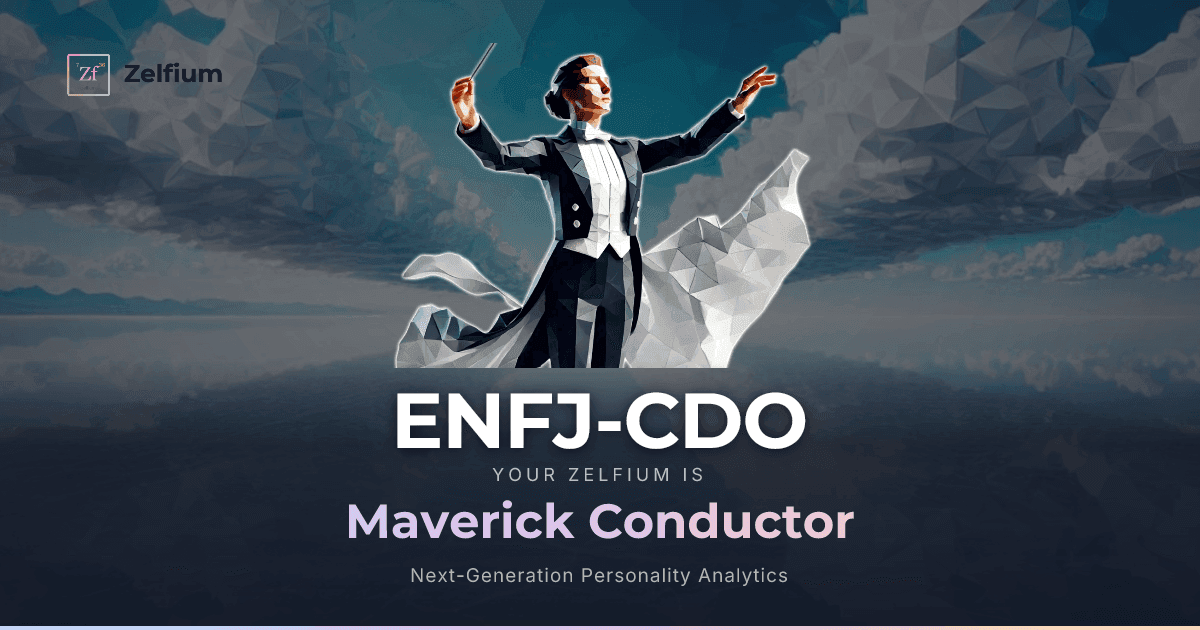
The Maverick Conductor
Most mentors work within the system. The ENFJ-CDO builds a new one and invites everyone into it. This is what happens when the ENFJ's deep calling to develop human potential meets the CDO's maverick nature — that rare fusion of intellectual curiosity, self-governing independence, and unshakable optimism that turns convention into suggestion and boundaries into starting points. The result is a mentor who does not guide people toward existing paths but creates entirely new ones, carrying an infectious confidence that the uncharted territory ahead is not only safe but precisely where everyone needs to be. Where a pure ENFJ might work within established frameworks of growth and development, the CDO background introduces a restless independence that asks: why follow this map when the territory itself is calling for a different one? This is not rebellion for its own sake. It is a genuinely original approach to human development — one that combines the ENFJ's relational genius with the CDO's refusal to accept that the current way is the only way.
The ENFJ's four dimensions — Extraversion, Openness, Feeling, and Judging — create a person who engages people with visionary warmth and structured purpose. The CDO's three dimensions — Curiosity, Detachment, and Optimism — create an inner world that is perpetually exploring, fiercely self-directed, and emotionally buoyant in the face of uncertainty. When these two layers occupy the same person, the mentor becomes a trailblazer.
The most generative interaction is between the ENFJ's Extraversion and the CDO's Detachment. Extraversion drives energy outward toward people and relationships; Detachment provides the internal independence to engage those relationships on genuinely original terms. The ENFJ-CDO does not mirror social expectations or defer to conventional wisdom about how mentoring should work. Instead, a unique relational style emerges — deeply warm but entirely self-authored, caring intensely about people while refusing to care about whether the approach looks normal.
The CDO's curiosity interacts with the ENFJ's Openness to produce a particularly expansive vision. Where the ENFJ naturally sees what people could become, the CDO's curiosity asks: what could they become if the constraints everyone takes for granted were removed? This creates a mentor who challenges not just individuals but the structures around them — seeing limiting environments as clearly as they see limiting beliefs.
The CDO's optimism and the ENFJ's Feeling dimension combine to produce an almost magnetic confidence in people. The ENFJ believes in human potential because it is felt deeply; the CDO believes in it because the alternative — giving up — simply does not register as a viable option. Together, these create a conviction about others' possibilities that can be genuinely transformative for people who have internalized limitations.
The ENFJ-CDO possesses an extraordinary ability to liberate people from constraints they did not know they had accepted. The ENFJ's emotional intelligence detects where someone is held back; the CDO's independent thinking identifies which of those constraints are real and which are merely inherited assumptions. This combination makes the ENFJ-CDO a uniquely powerful mentor for people who are stuck — not because they lack ability but because they have never questioned the framework they are operating within.
There is also a remarkable resilience in this type's approach to mentoring. The CDO's optimism means setbacks do not accumulate as emotional weight, and the CDO's detachment means criticism of unconventional methods does not land as personal rejection. The ENFJ-CDO can sustain bold, innovative mentoring over the long term because the internal fuel source — confidence in one's own judgment plus trust in positive outcomes — is self-replenishing.
Finally, the CDO's independence gives the ENFJ's structured care a creative freedom. Plans are made not from templates but from first principles, customized to each individual with an originality that makes the mentoring feel personal in a way that standardized approaches never achieve.
The deepest tension in the ENFJ-CDO lives between connection and independence. The ENFJ's nature craves deep, reciprocal relationships — being needed, being trusted, being integral to others' growth. The CDO's detachment values self-sufficiency and resists anything that feels like emotional dependency. The ENFJ-CDO can find themselves simultaneously building profound bonds with people and maintaining an interior distance that those people eventually sense and find confusing.
A second tension exists between the ENFJ's desire for harmony and the CDO's comfort with disruption. The ENFJ wants relationships to feel good; the CDO is willing to shake things up when the current state is not serving growth. When these impulses collide in a mentoring relationship, the ENFJ-CDO may oscillate between pushing someone hard toward unconventional growth and pulling back to preserve the relational warmth that makes that growth feel safe.
There is also a pacing tension unique to this combination. The CDO's forward-leaning optimism and the ENFJ's visionary Openness can together leap so far ahead that the people being mentored cannot follow. The mentor sees the destination with vivid clarity and trusts it completely; the mentee is still standing at the starting line, wondering whether the proposed path is even real.
Growth for the ENFJ-CDO is not about becoming more conventional or less independent. It is about developing the patience to build bridges between the world as it is and the world as this type sees it could be. The ENFJ-CDO's vision is often genuinely ahead of its time, and the people who follow need stepping stones, not leaps. Learning to meet people where they are — not where the vision says they should be — without abandoning the vision itself is the discipline that transforms a brilliant maverick mentor into a lastingly effective one. The bridge between originality and accessibility is the ENFJ-CDO's greatest construction project.
The ENFJ-CDO portrait drawn here is the "pure form" — what emerges when every pole swings fully in this direction. In reality, each of your dimensions carries a different intensity, and at every intersection, a unique chemistry unfolds. Even a slight tilt in one dimension creates an entirely different internal dynamic — that is the resolution of Zelfium's 7-dimension model.
Zelfium measures each of 36 facets on a 6-point scale. The number of possible patterns:
6³⁶
possible patterns
vs all humans ever born
880 trillion ×
~117 billion humans have ever lived — repeat that 880 trillion times and you still can't fill every pattern
vs stars in the observable universe
~50,000 ×
~200 sextillion stars in the observable universe — still not enough
vs grains of sand on Earth
~1 billion ×
~7.5 quintillion grains of sand — multiply by a billion
vs current world population
~1.3 quintillion ×
Line up 1.3 quintillion copies of today's 8 billion people to fill every type
More than 50,000 times the number of every star in the observable universe. That is the resolution of your personality.
So don't fit yourself into this description too tightly. ENFJ-CDO is a compass showing the direction your personality leans — not a box that defines everything you are. The pattern woven by your 36 facets is singular in this universe. To discover that one-of-a-kind blend — to find your own ENFJ-CDO — take the assessment.