

Loading...
Loading...
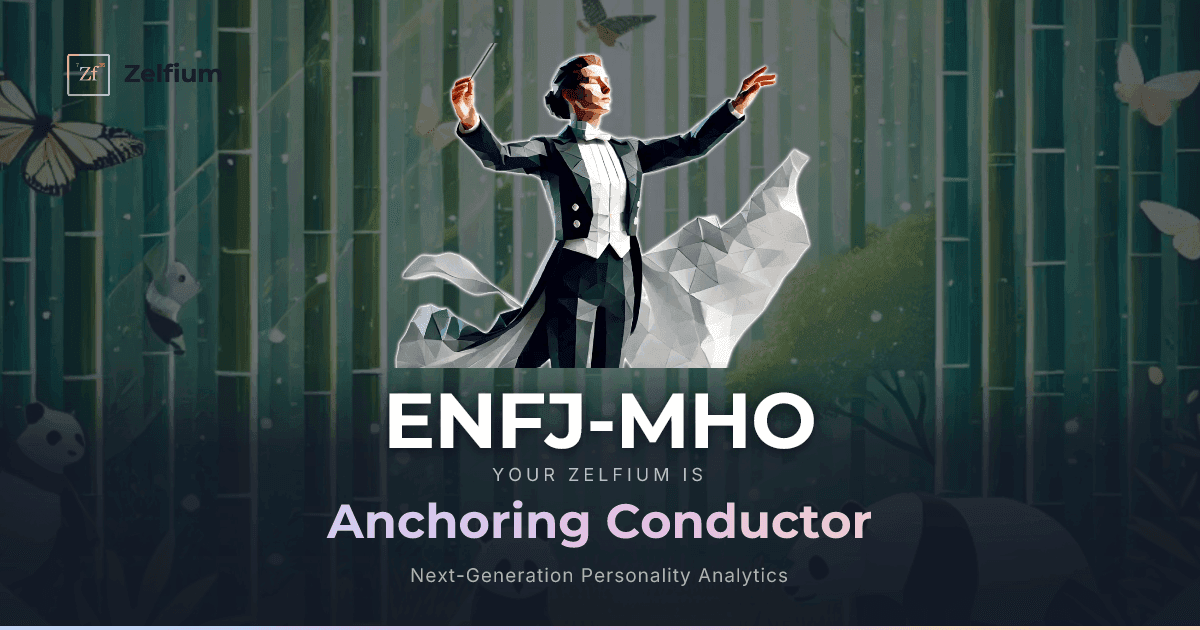
The Anchoring Conductor
Some mentors inspire people to fly. The ENFJ-MHO gives them a place to land. This is what happens when the ENFJ's extraordinary gift for seeing and cultivating human potential meets the MHO's anchor nature — that warm convergence of stability, empathy, and optimism that makes steadfastness feel not like inertia but like home. The result is a mentor who combines visionary aspiration with a groundedness so complete that people feel simultaneously challenged to grow and assured that they will not be abandoned in the process. Where a pure ENFJ might sometimes overwhelm with the intensity of their belief in someone's potential, the MHO background introduces an unhurried patience that communicates: there is no rush, and I will still be here tomorrow. The ENFJ-MHO does not just mentor — they create an ecosystem of trust, continuity, and gentle forward motion that allows growth to happen as naturally as a garden tended over years rather than forced into bloom.
The ENFJ's four dimensions — Extraversion, Openness, Feeling, and Judging — create a person who reaches outward with purpose, warmth, and structured devotion. The MHO's three dimensions — Maintaining, Harmony, and Optimism — create an inner world that prizes continuity, radiates empathy, and meets difficulty with a calm confidence that things will work out. When these two layers coexist, the visionary mentor gains an anchor's unshakable steadiness.
The most distinctive interaction is between the ENFJ's Openness and the MHO's Maintaining dimension. Openness perceives futures and possibilities; Maintaining honors roots and what has been built. In the ENFJ-MHO, these do not oppose each other — they create a uniquely grounded form of vision. This mentor imagines a beautiful future for the people they serve, but imagines it growing from existing soil rather than requiring a transplant. Growth, in this person's hands, feels like deepening rather than disruption.
The ENFJ's Feeling dimension and the MHO's Harmonious dimension create a doubled empathic capacity — two systems of emotional attunement running simultaneously. The warmth this produces is not performative; it is structural. People around the ENFJ-MHO experience a consistency of care that compounds over time, building the kind of deep trust that only relentless reliability can produce.
The MHO's Optimism interacts with the ENFJ's visionary nature in a particularly harmonious way. Where the ENFJ's belief in potential can sometimes carry an urgency that borders on pressure, the MHO's optimism transforms that urgency into patience: not because the vision is less vivid but because there is a genuine trust that good outcomes arrive through steady effort and sustained faith. The mentor who does not panic is the mentor people can truly lean into.
The ENFJ-MHO possesses a gift for long-term mentoring that few other combinations can match. The ENFJ's vision provides direction; the MHO's consistency provides endurance. Where many mentors burn bright and then fade — consumed by their own intensity or distracted by the next person who needs them — the ENFJ-MHO remains. Five years into a mentoring relationship, this type is still showing up, still remembering what was said, still believing in the same potential with undiminished conviction. This longevity is itself a form of mentoring that no single brilliant intervention can replicate.
There is also an exceptional ability to make growth feel safe. The combination of the ENFJ's warmth and the MHO's emotional stability creates an environment where failure is genuinely survivable — not just tolerated but absorbed into a larger narrative of progress that the mentor holds steady even when the mentee cannot. People take risks they would not otherwise take because the ENFJ-MHO has made the cost of failure feel low enough to be worth it.
Finally, the MHO's optimism gives the ENFJ's guidance a lightness that prevents mentoring from becoming a burden for either party. There is a joyfulness to this type's engagement with others that makes the work of growth feel less like work and more like a shared journey between people who genuinely enjoy each other's company.
The primary tension in the ENFJ-MHO lives between the ENFJ's hunger for transformation and the MHO's love of stability. The ENFJ sees what people could become and feels called to facilitate the change; the MHO values what already exists and instinctively protects it from disruption. When these impulses meet inside a mentoring relationship, the result can be a subtle paralysis — the mentor who sees the growth that needs to happen but hesitates to push because pushing might disturb the equilibrium of a relationship that currently feels warm and functional.
A second tension is the risk of comfortable avoidance. The MHO's optimism whispers "everything will be fine" while the MHO's Maintaining dimension prefers not to rock the boat. Together with the ENFJ's desire for relational harmony, these can produce a mentor who avoids difficult conversations — not out of cowardice but out of a genuine, values-driven reluctance to introduce pain into a relationship that has been carefully cultivated.
There is also a tension around self-neglect. The ENFJ gives; the MHO's Harmony doubles down on that giving; and the MHO's Optimism trusts that one's own needs will eventually be met. This triple reinforcement of other-orientation can create a person who defers personal needs so consistently and so patiently that the deferral becomes permanent — an anchor that holds everyone else in place while slowly sinking itself.
Growth for the ENFJ-MHO is not about becoming less steady or less warm. It is about developing the willingness to temporarily disrupt the harmony for the sake of deeper growth — both others' and their own. The hard conversation, the honest feedback, the moment of allowing a mentee to struggle without cushioning the fall — these are the acts that feel like betrayals of the ENFJ-MHO's nature but are actually its highest expression. An anchor that never allows the ship to feel the current has confused comfort with safety. The ENFJ-MHO who learns to hold steady while permitting discomfort discovers that the trust they have built is strong enough to survive honesty — and that relationships forged in that fire become the deepest ones of all.
The ENFJ-MHO portrait drawn here is the "pure form" — what emerges when every pole swings fully in this direction. In reality, each of your dimensions carries a different intensity, and at every intersection, a unique chemistry unfolds. Even a slight tilt in one dimension creates an entirely different internal dynamic — that is the resolution of Zelfium's 7-dimension model.
Zelfium measures each of 36 facets on a 6-point scale. The number of possible patterns:
6³⁶
possible patterns
vs all humans ever born
880 trillion ×
~117 billion humans have ever lived — repeat that 880 trillion times and you still can't fill every pattern
vs stars in the observable universe
~50,000 ×
~200 sextillion stars in the observable universe — still not enough
vs grains of sand on Earth
~1 billion ×
~7.5 quintillion grains of sand — multiply by a billion
vs current world population
~1.3 quintillion ×
Line up 1.3 quintillion copies of today's 8 billion people to fill every type
More than 50,000 times the number of every star in the observable universe. That is the resolution of your personality.
So don't fit yourself into this description too tightly. ENFJ-MHO is a compass showing the direction your personality leans — not a box that defines everything you are. The pattern woven by your 36 facets is singular in this universe. To discover that one-of-a-kind blend — to find your own ENFJ-MHO — take the assessment.