

Loading...
Loading...
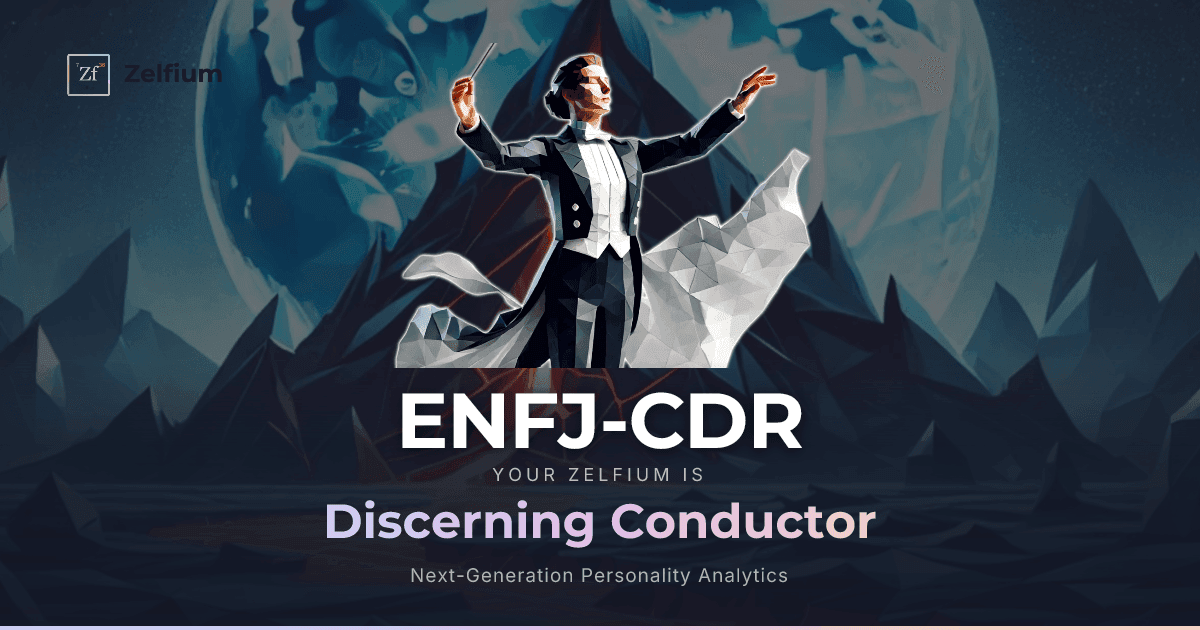
The Discerning Conductor
Most mentors lead with warmth. The ENFJ-CDR leads with warmth and a scalpel. This is what happens when the ENFJ's extraordinary capacity for seeing and nurturing human potential meets the CDR's discerning inner world — where intellectual curiosity, analytical independence, and acute sensitivity converge into an unblinking clarity about how things really are. The result is a mentor who does not just believe in people but understands them with a precision that can be simultaneously liberating and uncomfortable. Where a pure ENFJ might sometimes project more potential than reality warrants, the CDR background introduces a corrective lens that insists on seeing the whole picture — the talent and the blind spot, the strength and the self-deception. This is not a cynical combination. It is a deeply caring one that refuses to let its caring become dishonest. The ENFJ-CDR offers something rare: the safety to be fully seen, combined with the intellectual rigor to ensure that what is seen is accurate.
The ENFJ's four dimensions — Extraversion, Openness, Feeling, and Judging — create a person oriented outward toward people with visionary compassion and structural commitment. The CDR's three dimensions — Curiosity, Detachment, and Responsiveness — create an inner world that is restlessly investigative, intellectually independent, and perceptually sharp to an almost unsettling degree. When these two layers coexist, the mentor gains a discerner's edge.
The most striking interaction is between the ENFJ's Feeling dimension and the CDR's Detachment. Feeling drives decisions through a values-based lens — what matters is what serves human flourishing. Detachment insists on seeing situations and people clearly, without the distortion of wishful thinking or emotional entanglement. In most people, these forces would cancel each other out. In the ENFJ-CDR, they create something more powerful than either alone: a capacity for honest compassion. The caring is real, and it is informed by an unflinching assessment of reality rather than by the version of reality that would be most comfortable.
The CDR's curiosity amplifies the ENFJ's Openness in a particularly human-focused direction — not just sensing what people could become but wanting to understand the full mechanism of why they are where they are now. Why does this talented person keep sabotaging themselves? What structural pattern keeps this team from reaching its potential? The ENFJ sees the destination; the CDR maps the terrain between here and there, including the obstacles everyone else has politely ignored.
Meanwhile, the CDR's responsiveness interacts with the ENFJ's emotional attunement to create a dual-channel perceptual system. The ENFJ registers the emotional content of a situation; the CDR catches the discrepancies — the gap between what someone says and what they mean, the subtle misalignment between a group's stated values and its actual behavior. Together, these create a mentor who misses nothing.
The ENFJ-CDR possesses an exceptional capacity for the kind of mentoring that actually changes lives rather than merely making people feel good. The ENFJ's warmth creates the safety; the CDR's discernment ensures the guidance is accurate. People who spend time with this type discover they cannot hide — but also discover that being fully visible does not result in judgment. It results in help that is startlingly specific and precisely targeted.
There is also a rare ability to earn trust from people who distrust conventional warmth. The CDR's intellectual independence means the ENFJ-CDR does not say what people want to hear — they say what is true, and they say it with enough care that it can be received. This combination of honesty and empathy makes the ENFJ-CDR an exceptional advisor in environments where both rigor and humanity are required.
Finally, the CDR's curiosity gives the ENFJ's vision a diagnostic quality. Rather than simply encouraging people toward their potential, the ENFJ-CDR identifies the specific obstacles with analytical precision and builds strategies around them — mentoring that functions less like cheerleading and more like skilled coaching.
The central tension of the ENFJ-CDR is between the desire to connect and the instinct to stand apart. The ENFJ's Extraversion and Feeling pull powerfully toward immersion in relationships — being fully present, fully emotionally engaged, fully invested in others' outcomes. The CDR's Detachment pulls equally toward independence and clear-eyed observation. The ENFJ-CDR can feel torn between merging with the people they serve and maintaining the analytical distance that makes their guidance valuable.
A second tension lives between the ENFJ's optimistic vision and the CDR's vigilant realism. The ENFJ sees the best possible version of a person; the CDR's Responsiveness detects every crack, every risk, every way things might go wrong. Holding both of these perceptions simultaneously — the luminous potential and the hard reality — creates an inner experience that is richer but more exhausting than either perspective alone.
There is also a relational tension. The ENFJ-CDR's combination of deep warmth and sharp honesty can confuse people who are accustomed to receiving one without the other. Being told a difficult truth by someone who clearly cares deeply is disorienting, and not everyone responds to it with gratitude. The ENFJ-CDR must learn to tolerate being misunderstood by the very people they are trying hardest to help.
Growth for the ENFJ-CDR lies in learning to trust that warmth and honesty do not need to be deployed simultaneously at maximum intensity. There are moments when a person needs the full ENFJ embrace — unconditional positive regard without analytical overlay. There are other moments when the CDR's diagnostic clarity is exactly what is called for, without the additional weight of emotional investment. The art is in the sequencing — learning to lead with whichever faculty the moment requires and trusting that the other will still be there when it is needed. The ENFJ-CDR who masters this becomes something genuinely extraordinary: a mentor whose care is unquestionable and whose insight is surgically precise, offered in the right proportions at the right time.
The ENFJ-CDR portrait drawn here is the "pure form" — what emerges when every pole swings fully in this direction. In reality, each of your dimensions carries a different intensity, and at every intersection, a unique chemistry unfolds. Even a slight tilt in one dimension creates an entirely different internal dynamic — that is the resolution of Zelfium's 7-dimension model.
Zelfium measures each of 36 facets on a 6-point scale. The number of possible patterns:
6³⁶
possible patterns
vs all humans ever born
880 trillion ×
~117 billion humans have ever lived — repeat that 880 trillion times and you still can't fill every pattern
vs stars in the observable universe
~50,000 ×
~200 sextillion stars in the observable universe — still not enough
vs grains of sand on Earth
~1 billion ×
~7.5 quintillion grains of sand — multiply by a billion
vs current world population
~1.3 quintillion ×
Line up 1.3 quintillion copies of today's 8 billion people to fill every type
More than 50,000 times the number of every star in the observable universe. That is the resolution of your personality.
So don't fit yourself into this description too tightly. ENFJ-CDR is a compass showing the direction your personality leans — not a box that defines everything you are. The pattern woven by your 36 facets is singular in this universe. To discover that one-of-a-kind blend — to find your own ENFJ-CDR — take the assessment.