

Loading...
Loading...
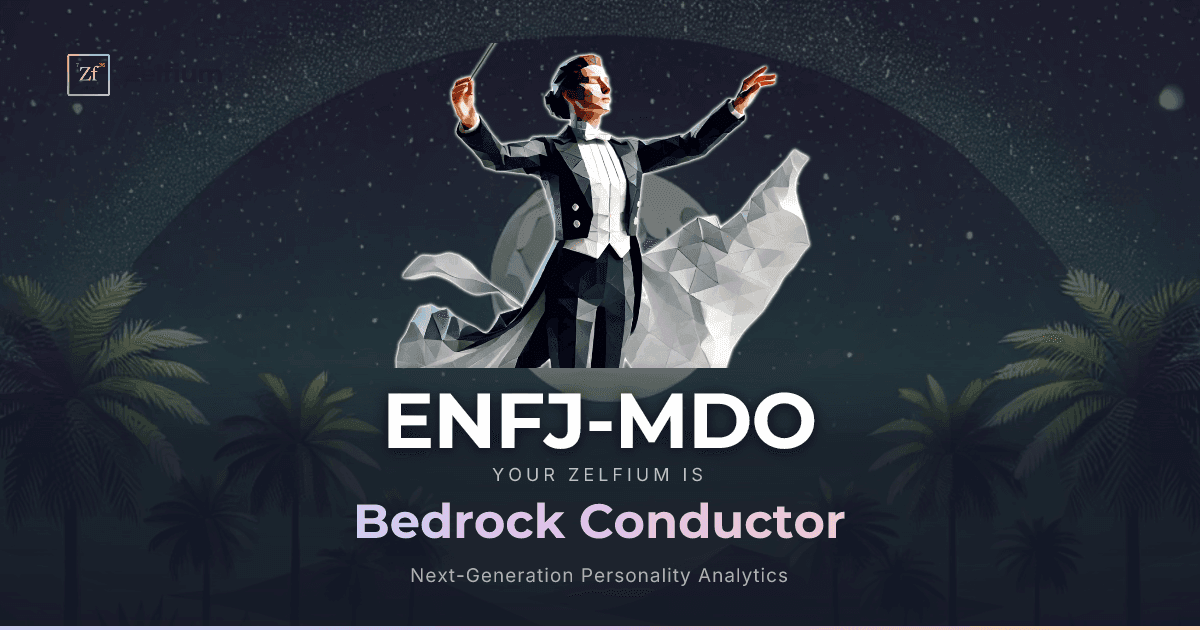
The Bedrock Conductor
Most mentors lead from the front. The ENFJ-MDO leads from the foundation. This is what happens when the ENFJ's extraordinary capacity for seeing and nurturing human potential meets the MDO's bedrock nature — that self-contained convergence of proven methods, independent judgment, and quiet confidence that turns steadiness into a form of strength most people can feel but few can name. The result is a mentor whose influence operates not through charisma or urgency but through an unshakable reliability that accumulates trust over years the way bedrock accumulates the weight of everything built upon it. Where a pure ENFJ might sometimes reach toward people with an intensity that can overwhelm, the MDO background introduces a composure so complete that it recalibrates the mentoring relationship itself — from the urgent rescue of potential to the patient cultivation of capability. The ENFJ-MDO does not rush growth. Growth is trusted to arrive through consistent presence, sound judgment, and the kind of loyalty that expresses itself not in declarations but in showing up, decade after decade, exactly when needed.
The ENFJ's four dimensions — Extraversion, Openness, Feeling, and Judging — create a person who engages others with visionary warmth and structured care. The MDO's three dimensions — Maintaining, Detachment, and Optimism — create an inner world that is methodical, self-reliant, and quietly confident. When these two layers occupy the same person, the visionary mentor gains a bedrock's permanence.
The most complex interaction is between the ENFJ's Feeling dimension and the MDO's Detachment. Feeling navigates through empathy, values, and emotional connection. Detachment navigates through evidence, logic, and independent assessment. In the ENFJ-MDO, these two processing systems run in parallel — not competing but complementing. A problem is simultaneously evaluated for its human impact (Feeling) and its structural reality (Detachment). A person is simultaneously cared for deeply (ENFJ) and assessed honestly (MDO). This dual processing produces advice of unusual quality: warm enough to be received, accurate enough to be useful.
The MDO's Maintaining dimension interacts with the ENFJ's Judging dimension in a powerfully reinforcing way. Both value structure, follow-through, and reliability. Together, they create a mentor whose consistency borders on the legendary — someone who does not just promise to be there but who has been there so reliably that the promise itself has become unnecessary. This structural loyalty is the bedrock upon which the ENFJ-MDO builds every mentoring relationship.
The MDO's Optimism softens what might otherwise be an overly measured approach. Without it, the combination of methodical care (M), analytical distance (D), and structured purpose (J) might feel clinical. With it, the ENFJ-MDO carries a steady, almost paternal confidence that communicates: the standards are high, the assessment is honest, and things will work out because the work will be done.
The ENFJ-MDO possesses a mentoring endurance that is genuinely extraordinary. The ENFJ provides the vision and the relational depth; the MDO provides the emotional resilience and the self-sufficiency that prevent that vision from becoming a source of burnout. Most mentors exhaust themselves because their own emotional needs become entangled with their mentees' progress. The MDO's self-containment protects against this — the ENFJ-MDO can care profoundly without requiring the caring to be reciprocated, creating a mentoring relationship that is genuinely generous rather than subtly transactional.
There is also an exceptional capacity for honest assessment that does not wound. The MDO's detachment ensures that feedback is based on observation rather than projection, while the ENFJ's Feeling ensures it is delivered with sufficient warmth to be received. People who are mentored by the ENFJ-MDO learn to trust the assessments precisely because they have proven accurate over time — the track record itself becomes the basis of trust.
Finally, the MDO's stability gives the ENFJ's mentoring a quality of institutional permanence. The ENFJ-MDO does not represent just an individual relationship — they represent a standard, a set of values, a way of doing things that transcends any single interaction. People leave the ENFJ-MDO's mentoring carrying not just advice but an internalized sense of what excellence looks like in practice.
The deepest tension in the ENFJ-MDO lives between openness and self-containment. The ENFJ's nature craves deep, mutual relationships — the kind where vulnerability is shared, where the mentor is also mentored, where connection flows in both directions. The MDO's nature maintains an emotional self-sufficiency that does not naturally extend invitations for others to enter the inner world. The ENFJ-MDO may build extraordinarily deep mentoring relationships that remain, at some level, one-directional — offering profound care while retaining a core of privacy that even the closest people never quite reach.
A second tension exists between the ENFJ's visionary Openness and the MDO's methodical Maintaining dimension. The ENFJ imagines ambitious futures; the MDO prefers to work with proven approaches. When mentoring someone with unconventional potential, the ENFJ-MDO can feel torn between the intuitive recognition that this person needs a radically different path and the methodical instinct that says: start with what works.
There is also a subtle tension around emotional range. The MDO's optimism and self-sufficiency can combine with the ENFJ's caring nature to create a mentor who is always composed, always supportive, always steady — and who never allows the people they serve to see them struggle. This consistency is a strength, but taken to its extreme it can create an emotional asymmetry that prevents relationships from reaching their deepest possible level.
Growth for the ENFJ-MDO lies in allowing the bedrock to be seen — not just as a foundation others stand upon, but as a landscape with its own weather, its own seasons, its own moments of uncertainty. The ENFJ-MDO's greatest gift is reliability, but the greatest risk is that reliability becomes a fortress that protects the mentor from the very vulnerability that would deepen the mentoring. Allowing a mentee to see a moment of genuine uncertainty, to witness the process of working through difficulty rather than only its polished resolution — this is the act that transforms the ENFJ-MDO from an admired authority into a fully human guide. The bedrock does not need to crack. It simply needs to show, once in a while, that it too is part of the living earth.
The ENFJ-MDO portrait drawn here is the "pure form" — what emerges when every pole swings fully in this direction. In reality, each of your dimensions carries a different intensity, and at every intersection, a unique chemistry unfolds. Even a slight tilt in one dimension creates an entirely different internal dynamic — that is the resolution of Zelfium's 7-dimension model.
Zelfium measures each of 36 facets on a 6-point scale. The number of possible patterns:
6³⁶
possible patterns
vs all humans ever born
880 trillion ×
~117 billion humans have ever lived — repeat that 880 trillion times and you still can't fill every pattern
vs stars in the observable universe
~50,000 ×
~200 sextillion stars in the observable universe — still not enough
vs grains of sand on Earth
~1 billion ×
~7.5 quintillion grains of sand — multiply by a billion
vs current world population
~1.3 quintillion ×
Line up 1.3 quintillion copies of today's 8 billion people to fill every type
More than 50,000 times the number of every star in the observable universe. That is the resolution of your personality.
So don't fit yourself into this description too tightly. ENFJ-MDO is a compass showing the direction your personality leans — not a box that defines everything you are. The pattern woven by your 36 facets is singular in this universe. To discover that one-of-a-kind blend — to find your own ENFJ-MDO — take the assessment.