

Loading...
Loading...
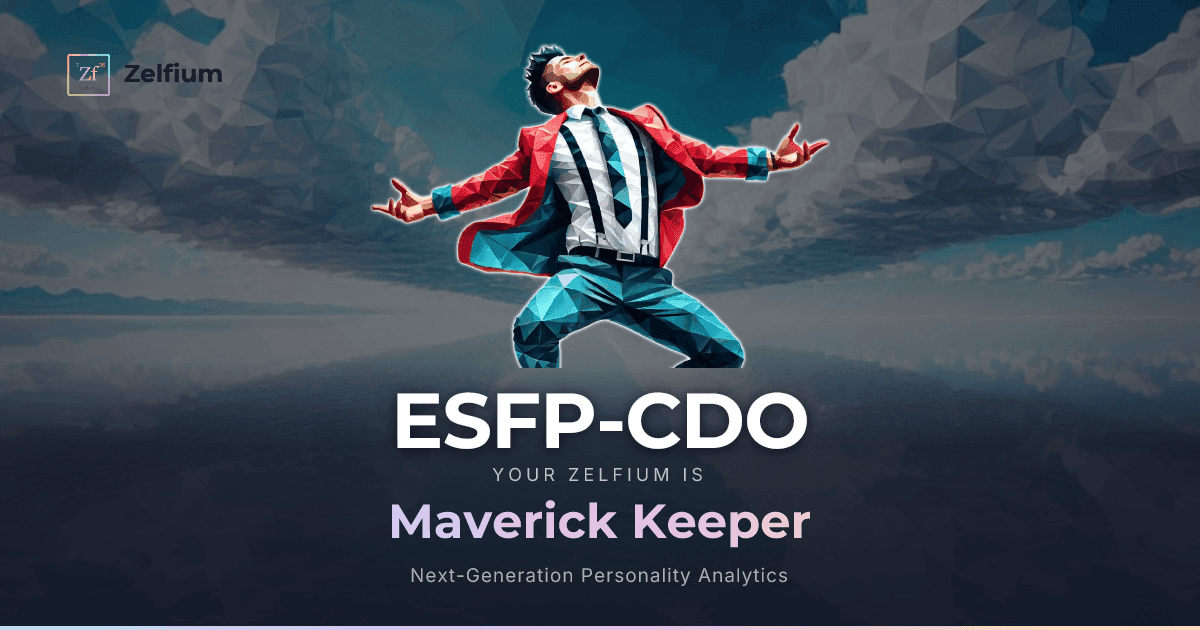
The Maverick Keeper
The ESFP-CDO is the rarest kind of social force — someone who commands a room not by following its rules but by rewriting them in real time. The ESFP's sensory vividness, emotional warmth, and spontaneous presence are all here, fully operational. But the CDO background adds something that most people do not expect from a performer: a fierce intellectual independence, a relentless curiosity that refuses to accept conventional answers, and an unshakable confidence that the unconventional path will prove worthwhile. Where other ESFPs charm within the existing social framework, the ESFP-CDO charms while quietly dismantling it. The warmth is genuine — but it comes with a refusal to participate in anything that feels inauthentic, a willingness to stand alone when necessary, and an optimism about the outcome that makes the maverick stance feel like an invitation rather than a rebellion. The result is someone who makes nonconformity look not just courageous but irresistibly appealing.
The ESFP's extraversion and the CDO's detachment produce a paradox that defines this type. The extraverted dimension genuinely loves people — their energy, their stories, their company. The detached dimension maintains a core of independence that no social situation can penetrate. The ESFP-CDO is simultaneously the life of the gathering and the person least likely to be swept up in its groupthink. This combination creates a social presence that is charismatic without being dependent — someone who draws people in without needing their approval and who can walk away from any social situation with their sense of self fully intact.
The Sensory dimension and the CDO's curiosity create a distinctive relationship with novelty. The ESFP's senses are trained on the immediate world — what is real, tangible, and present. The CDO's curiosity pushes beyond what is familiar toward what has not yet been tried. Together, they produce someone who is both grounded and adventurous — anchored in sensory reality but perpetually scanning the horizon for the next experiment. This is not the abstract curiosity of a theorist. It is the hands-on curiosity of someone who wants to touch, taste, and test every new possibility against the standard of lived experience.
The ESFP's pioneering spontaneity and the CDO's optimism form a particularly potent alliance. Both dimensions resist constraint and favor forward motion, but from complementary angles. Spontaneity responds to the moment; optimism trusts the trajectory. Together, they create a confidence in improvisation that borders on the audacious. The ESFP-CDO does not plan for every contingency — this type trusts the ability to handle whatever emerges, and that trust is usually justified by a combination of quick reflexes, sharp observation, and an unshakable belief that things will work out.
The ESFP-CDO's most striking strength is the ability to lead without appearing to lead. This type does not issue directives or establish hierarchies. Instead, the sheer force of conviction combined with social magnetism creates a gravitational pull that others follow naturally. Innovation that would feel threatening from a more detached personality feels exciting from the ESFP-CDO, because the warmth makes the disruption feel safe and the optimism makes the unknown feel like an adventure.
There is a remarkable freedom from social pressure that gives this type an authenticity most people admire but cannot replicate. The CDO's detachment means external opinions — praise or criticism — land lightly. The ESFP's emotional expressiveness ensures that this independence does not read as coldness. The combination produces someone who is genuinely comfortable in their own skin in a way that gives others permission to be the same.
The CDO's curiosity also prevents the ESFP's love of the immediate from becoming repetitive. Where other sensory-oriented types might settle into comfortable routines of pleasure, the ESFP-CDO is always pushing toward the edge of familiar territory — finding the restaurant no one has heard of, discovering the neighborhood no guidebook mentions, meeting the person everyone else has overlooked. Experience is not just consumed; it is pioneered.
The most significant tension in the ESFP-CDO exists between the warmth that draws people close and the independence that keeps them at a certain distance. The ESFP genuinely values connection — it is energizing, nourishing, essential. But the CDO's detachment creates an inner boundary that even the closest relationships struggle to cross. People are drawn to the ESFP-CDO's magnetic presence, and then confused when the intimacy they expect does not fully materialize. The challenge is not that this type does not care — the feeling dimension ensures deep caring — but that the independence dimension defines its own terms for closeness, and those terms may not match what others are accustomed to.
A second tension lives between the ESFP's desire for emotional harmony and the CDO's willingness to disrupt. The feeling dimension wants people to feel good; the detachment dimension genuinely does not mind if uncomfortable truths make people uncomfortable. When the ESFP-CDO spots something inauthentic in a social situation, the maverick impulse to call it out can override the performer's instinct to keep the atmosphere pleasant. These moments can be electrifying or alienating, depending on the audience and the stakes.
There is also the question of follow-through. The CDO's curiosity generates new interests at speed, the ESFP's spontaneity embraces them eagerly, and the optimism assures that everything will work out. But the CDO's detachment means there is no strong relational accountability to keep commitments alive, and the ESFP's pioneering flexibility makes abandoning what has lost its spark feel natural. The trail of brilliant beginnings without satisfying conclusions is a pattern worth watching.
Growth for the ESFP-CDO is not about conforming or dimming the maverick energy. It is about recognizing that some of the most rewarding territory lies not beyond the horizon but in the depth of what has already been begun. The optimism that fuels forward motion is genuine — but directing a portion of it backward, toward relationships and projects that deserve sustained attention, reveals rewards that novelty alone cannot provide. The hardest lesson for this type is that vulnerability — the willingness to be truly known by someone, including the parts that are uncertain and unfinished — is not a compromise of independence. It is the one frontier that maverick courage has not yet explored, and it may be the most transformative adventure of all.
The ESFP-CDO portrait drawn here is the "pure form" — what emerges when every pole swings fully in this direction. In reality, each of your dimensions carries a different intensity, and at every intersection, a unique chemistry unfolds. Even a slight tilt in one dimension creates an entirely different internal dynamic — that is the resolution of Zelfium's 7-dimension model.
Zelfium measures each of 36 facets on a 6-point scale. The number of possible patterns:
6³⁶
possible patterns
vs all humans ever born
880 trillion ×
~117 billion humans have ever lived — repeat that 880 trillion times and you still can't fill every pattern
vs stars in the observable universe
~50,000 ×
~200 sextillion stars in the observable universe — still not enough
vs grains of sand on Earth
~1 billion ×
~7.5 quintillion grains of sand — multiply by a billion
vs current world population
~1.3 quintillion ×
Line up 1.3 quintillion copies of today's 8 billion people to fill every type
More than 50,000 times the number of every star in the observable universe. That is the resolution of your personality.
So don't fit yourself into this description too tightly. ESFP-CDO is a compass showing the direction your personality leans — not a box that defines everything you are. The pattern woven by your 36 facets is singular in this universe. To discover that one-of-a-kind blend — to find your own ESFP-CDO — take the assessment.