

Loading...
Loading...
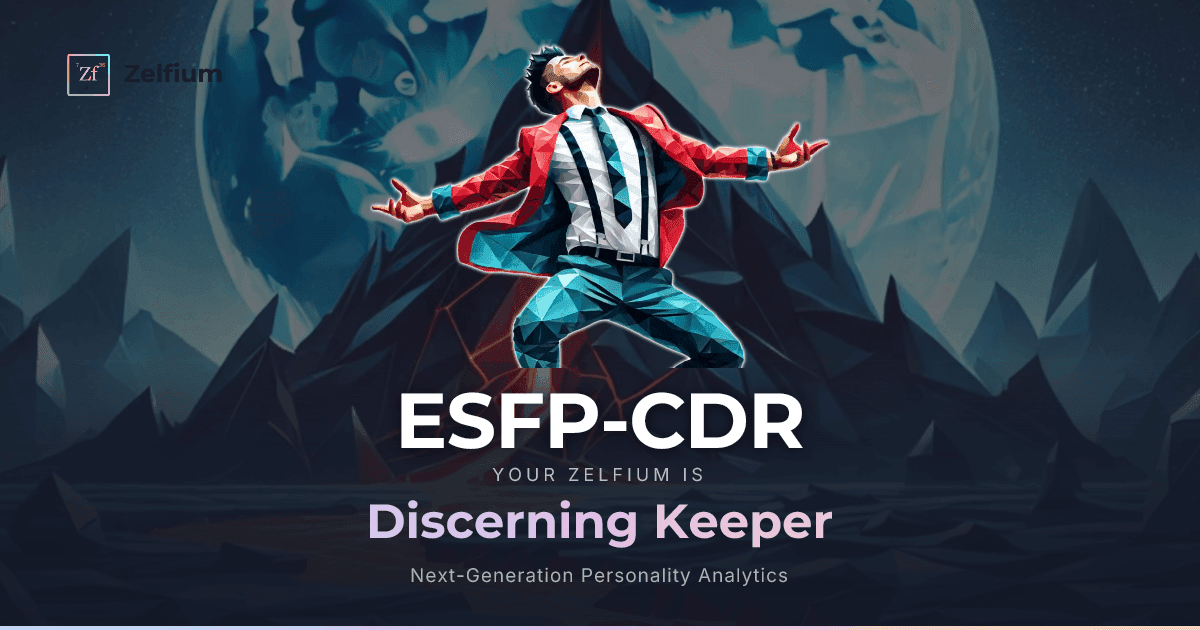
The Discerning Keeper
The ESFP-CDR is what happens when the most socially alive personality in the Zelfium system meets a background that sees through everything. The ESFP's warmth, sensory richness, and spontaneous generosity are all present — but underneath them runs the CDR's relentless curiosity, fierce intellectual independence, and a sensitivity so acute that it catches deceptions, misalignments, and hidden tensions long before they surface. The result is a performer with X-ray vision. Where other ESFPs might take social atmospheres at face value, the ESFP-CDR reads the room and reads through it — sensing who is genuinely enjoying themselves and who is performing enjoyment, detecting the moment a conversation shifts from authentic to rehearsed. This perceptiveness does not kill the joy; it refines it. The ESFP-CDR's presence feels both warmer and more real than most people expect, because the connection being offered is not indiscriminate. It has been tested, quietly, against a standard of authenticity that the CDR background refuses to compromise.
The ESFP's extraversion and the CDR's detachment create an immediately interesting tension. Extraversion moves toward people — openly, generously, with genuine pleasure in connection. Detachment holds a portion of the self back — observing, evaluating, maintaining independence even within intimacy. In the ESFP-CDR, these two forces produce a social style that is simultaneously warm and selective. The door is open, but there is a discerning intelligence watching who walks through it. People sense this quality without being able to name it: the ESFP-CDR feels approachable but not naive, friendly but not foolish.
The Sensory dimension and the CDR's curiosity interact to create an unusually sharp observer. The ESFP notices the concrete details — the shift in someone's posture, the quality of light in a room, the specific words chosen in a conversation. The CDR's curiosity asks what those details mean. This pairing transforms sensory awareness from passive reception into active investigation. The ESFP-CDR does not just see what is happening — this type reads it, interprets it, and files it away for future reference.
The most complex interaction lives between the ESFP's feeling dimension and the CDR's responsiveness. Feeling orients the ESFP toward empathy, harmony, and the emotional needs of others. Responsiveness amplifies all emotional signals to an almost overwhelming volume. But the CDR's detachment acts as a counterweight, providing analytical distance even in the midst of emotional immersion. The result is someone who feels deeply but thinks clearly about what they feel — a combination that produces insights of unusual precision about human behavior and motivation.
The ESFP-CDR possesses a social intelligence that operates on two levels simultaneously. On the surface, there is warmth, humor, and the ESFP's extraordinary ability to make people feel at ease. Beneath that surface, the CDR's perceptual acuity is quietly mapping the real dynamics of every interaction — who holds power, who is uncomfortable, what is being said between the lines. This dual-layer awareness makes the ESFP-CDR exceptional in roles that require both people skills and sharp judgment: negotiation, crisis management, creative leadership, and any environment where reading people accurately has high stakes.
There is also a rare capacity for honest kindness. The CDR's detachment prevents the ESFP's warmth from becoming sycophantic, and the ESFP's feeling dimension prevents the CDR's honesty from becoming cruel. The truth is delivered, but it arrives wrapped in genuine care. People trust the ESFP-CDR's assessments precisely because they sense that this type will not flatter them unnecessarily — and the feedback offered, while sometimes uncomfortable, is almost always accurate.
The CDR's curiosity adds intellectual depth to the ESFP's experiential richness. This type does not just accumulate vivid experiences — it learns from them, building an increasingly sophisticated understanding of how people and systems actually work beneath their surface presentations.
The central tension in the ESFP-CDR is between the desire to connect and the compulsion to discern. The ESFP wants to be close to people — fully present, emotionally generous, spontaneously available. The CDR cannot stop analyzing — evaluating authenticity, detecting inconsistencies, maintaining the analytical distance that protects against being deceived. These two orientations can create a painful oscillation: moments of full emotional engagement interrupted by flashes of detached observation that feel like betrayal of the connection being formed. Learning to hold both simultaneously — to be genuinely warm while remaining honestly perceptive — is the central integration challenge.
A second tension exists between the ESFP's desire for harmony and the CDR's intolerance of pretense. The feeling dimension wants everyone to feel comfortable; the detachment dimension refuses to participate in comfort that is built on dishonesty. When the ESFP-CDR detects social performance — flattery without substance, agreement without conviction, politeness that masks contempt — the urge to call it out conflicts directly with the impulse to preserve the social atmosphere. This creates moments of internal pressure that can express themselves as either uncharacteristic bluntness or uncharacteristic silence.
The CDR's responsiveness also compounds the ESFP's natural emotional absorption. This type takes in more sensory and emotional data than almost anyone in the room, and the analytical mind refuses to let any of it pass without examination. The result can be a form of perceptual exhaustion — not from socializing itself, which the ESFP genuinely enjoys, but from the relentless processing that runs beneath every social encounter.
Growth for the ESFP-CDR lies in learning that not every perception requires action and not every inconsistency requires investigation. The discerning eye is a genuine gift — it protects, it clarifies, it prevents the kind of naive trust that leads to genuine harm. But when it operates without pause, it can transform every relationship into a case study and every social moment into an evaluation. The skill to develop is selective engagement of the analytical lens — learning to choose when to observe and when to simply be present. When the ESFP-CDR discovers that some of the most valuable human connections happen in the space where discernment is deliberately set aside — not abandoned, but temporarily rested — the performer finds a freedom and an intimacy that the sentinel within had been quietly preventing.
The ESFP-CDR portrait drawn here is the "pure form" — what emerges when every pole swings fully in this direction. In reality, each of your dimensions carries a different intensity, and at every intersection, a unique chemistry unfolds. Even a slight tilt in one dimension creates an entirely different internal dynamic — that is the resolution of Zelfium's 7-dimension model.
Zelfium measures each of 36 facets on a 6-point scale. The number of possible patterns:
6³⁶
possible patterns
vs all humans ever born
880 trillion ×
~117 billion humans have ever lived — repeat that 880 trillion times and you still can't fill every pattern
vs stars in the observable universe
~50,000 ×
~200 sextillion stars in the observable universe — still not enough
vs grains of sand on Earth
~1 billion ×
~7.5 quintillion grains of sand — multiply by a billion
vs current world population
~1.3 quintillion ×
Line up 1.3 quintillion copies of today's 8 billion people to fill every type
More than 50,000 times the number of every star in the observable universe. That is the resolution of your personality.
So don't fit yourself into this description too tightly. ESFP-CDR is a compass showing the direction your personality leans — not a box that defines everything you are. The pattern woven by your 36 facets is singular in this universe. To discover that one-of-a-kind blend — to find your own ESFP-CDR — take the assessment.