

Loading...
Loading...
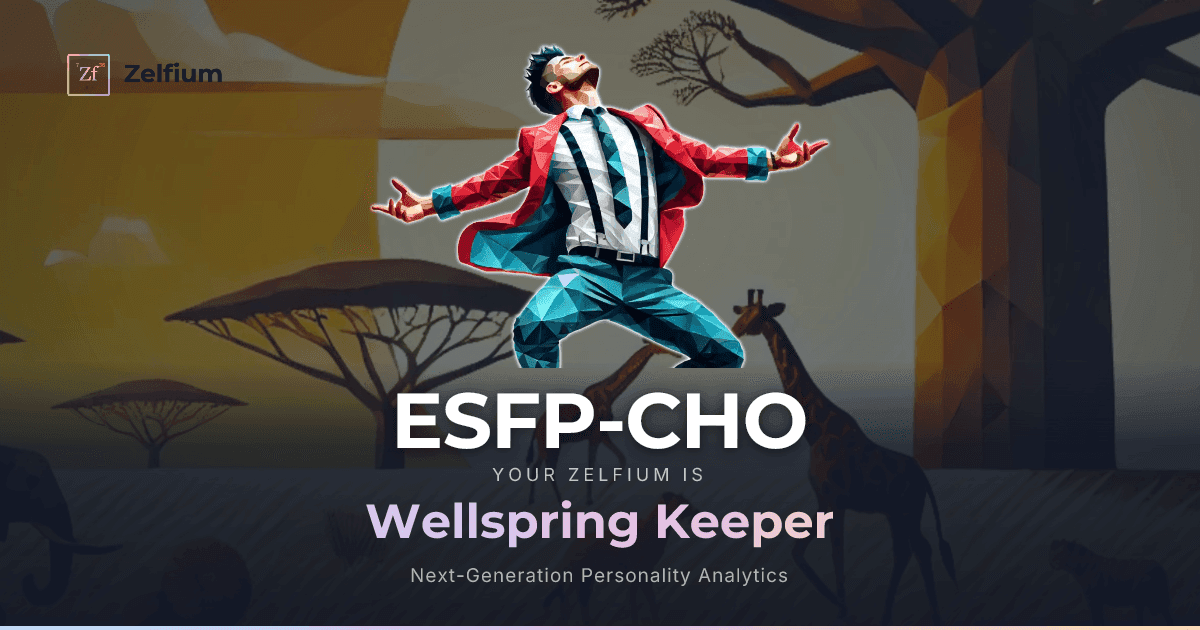
The Wellspring Keeper
When the ESFP's vivid, life-embracing presence meets the CHO's inexhaustible inner warmth, something almost magnetic emerges. This is not merely a social person — this is someone who generates the kind of energy that others instinctively gather around, not because the performance demands attention but because the wellspring of genuine goodwill beneath it makes people feel that the world is a kinder, more interesting place. The ESFP's gift for sensory immediacy and emotional expressiveness gains a new dimension through the CHO's curious optimism and relational generosity. Where other ESFPs might dazzle and move on, the ESFP-CHO dazzles and stays — bringing people along, sharing every discovery, and radiating a confidence that the adventure will be worth it for everyone involved. The result is a performer who never performs alone, whose joy is only complete when it circulates through others.
The ESFP's extraversion and the CHO's harmonious dimension create a synergy that amplifies the best of both. Extraversion provides the outward energy — the impulse to engage, to connect, to bring people together. The CHO's harmony deepens that energy from social warmth into genuine relational investment. The ESFP-CHO does not simply enjoy people; this type is nourished by the act of including them, of making sure the experience being created has room for everyone who wants to be part of it.
The Sensory dimension and the CHO's curiosity form an unusual alliance. Sensory groundedness keeps this type anchored in the real — the taste, the texture, the physical reality of experience. Curiosity pushes that grounding outward: What else is there to try? What have others discovered that remains unknown? This pairing turns everyday pleasures into shared explorations. A walk through a new neighborhood becomes a treasure hunt. A conversation about food becomes a portal into someone's childhood memories. The sensory world stops being a passive backdrop and becomes an active landscape of discovery.
The most distinctive chemistry occurs where the ESFP's pioneering flexibility meets the CHO's optimism. Both dimensions point toward movement and possibility, but from different sources. The ESFP's spontaneity is reactive — responding to what the moment offers. The CHO's optimism is proactive — trusting that what comes next will be good. Together, they produce a forward momentum that feels almost frictionless. Setbacks are absorbed with remarkable grace: "That did not work — what a great story that will make. What shall we try next?" This resilience is not performed. It is the natural product of two systems that both refuse to let difficulty become the final word.
The ESFP-CHO's greatest strength is the ability to make difficult things feel possible by wrapping them in warmth and adventure. Change that would feel threatening from someone else feels exciting when this type is involved, because the enthusiasm is genuine and the care for people is unmistakable. Teams, friend groups, and families with an ESFP-CHO in their midst find themselves attempting things they would never have tried alone — not because they were pressured but because the invitation was irresistible.
There is also a remarkable gift for emotional recovery, both personal and collective. The CHO's optimism and the ESFP's sensory engagement combine to create someone who bounces back from setbacks by immediately engaging with something real — a good meal, a beautiful place, a conversation that reminds everyone what matters. This is not denial; it is an instinctive understanding that the body and the senses can lead the spirit back to solid ground faster than abstract reasoning ever could.
The combination also produces an unusual generosity of spirit. The ESFP shares experiences freely; the CHO ensures that sharing feels natural rather than imposing. Knowledge, joy, and discovery flow outward from this type without self-consciousness, creating an atmosphere where others feel permitted to be generous in return.
The primary tension in the ESFP-CHO is between the desire to keep moving and the desire to keep everyone together. The ESFP's spontaneity and the CHO's curiosity both pull forward — next experience, next discovery, next horizon. But the CHO's harmonious dimension insists that no one be left behind. When the people nearby cannot match the pace, a quiet conflict emerges: slow down and lose momentum, or press forward and risk leaving someone feeling abandoned. This tension plays out in dozens of small daily decisions and can become exhausting when left unexamined.
A second tension exists between optimism and honesty. The CHO's resilient positivity and the ESFP's preference for emotional lightness can sometimes combine to minimize pain — both personal and others'. "It will be fine" is a genuinely held belief, but it can land as dismissiveness when someone needs their difficulty to be fully witnessed before solutions are offered. The warmth that makes this type so beloved can, in certain moments, become a barrier to the kind of raw honesty that deepens relationships beyond the comfortable.
There is also a sustainability question. The ESFP-CHO gives so much energy outward — through social engagement, emotional generosity, and relentless enthusiasm — that the reserves can deplete without warning. The optimism that characterizes this type can mask the depletion until it arrives as sudden exhaustion or uncharacteristic withdrawal, puzzling both the person and those who depend on the steadiness.
Growth for the ESFP-CHO is not about dimming the warmth or slowing the momentum. It is about learning that the wellspring needs periods of quiet refilling. Optimism is genuine and valuable, but it becomes even more powerful when it can sit beside difficulty without trying to transform it immediately. The hardest skill for this type to develop is the willingness to let a moment be uncomfortable — to resist the impulse to fix the atmosphere and instead trust that the people involved can handle their own heaviness for a while. When the ESFP-CHO discovers that staying present with pain does not extinguish joy but actually deepens it, the wellspring reaches a new depth — and the performer finds a register of authenticity that makes everything that came before sound like rehearsal.
The ESFP-CHO portrait drawn here is the "pure form" — what emerges when every pole swings fully in this direction. In reality, each of your dimensions carries a different intensity, and at every intersection, a unique chemistry unfolds. Even a slight tilt in one dimension creates an entirely different internal dynamic — that is the resolution of Zelfium's 7-dimension model.
Zelfium measures each of 36 facets on a 6-point scale. The number of possible patterns:
6³⁶
possible patterns
vs all humans ever born
880 trillion ×
~117 billion humans have ever lived — repeat that 880 trillion times and you still can't fill every pattern
vs stars in the observable universe
~50,000 ×
~200 sextillion stars in the observable universe — still not enough
vs grains of sand on Earth
~1 billion ×
~7.5 quintillion grains of sand — multiply by a billion
vs current world population
~1.3 quintillion ×
Line up 1.3 quintillion copies of today's 8 billion people to fill every type
More than 50,000 times the number of every star in the observable universe. That is the resolution of your personality.
So don't fit yourself into this description too tightly. ESFP-CHO is a compass showing the direction your personality leans — not a box that defines everything you are. The pattern woven by your 36 facets is singular in this universe. To discover that one-of-a-kind blend — to find your own ESFP-CHO — take the assessment.