

Loading...
Loading...
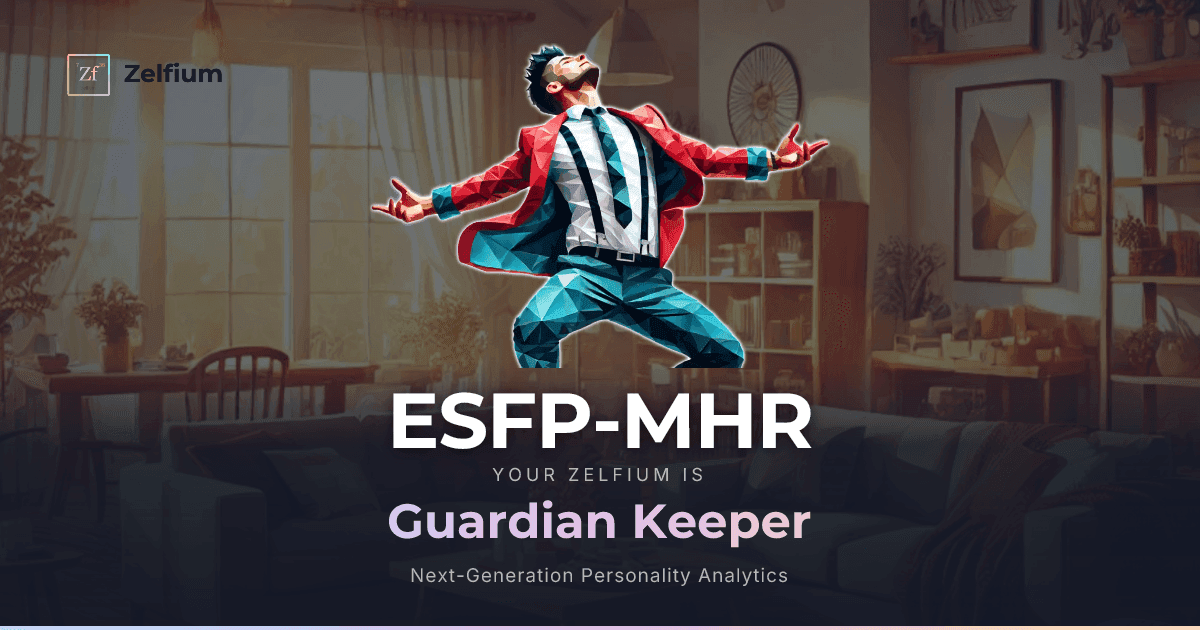
The Guardian Keeper
The ESFP-MHR represents a fascinating convergence: the most spontaneous, present-moment personality in the Zelfium system paired with a background devoted to protection, continuity, and watchful care. The ESFP brings its characteristic warmth, sensory aliveness, and capacity for joy. The MHR background adds a deep commitment to preserving what is valuable, an empathic attunement that feels others' pain as its own, and a sensitivity to emerging threats that operates like a quiet alarm system running beneath the surface of every interaction. The result is someone who can light up a room and simultaneously scan it for danger — a performer who celebrates life with full intensity while maintaining a constant, almost unconscious vigilance over the people who matter most. The joy is genuine, but it is never careless. Beneath the ESFP-MHR's warmth runs a current of fierce protectiveness that transforms ordinary social generosity into something closer to devotion.
The ESFP's extraversion and the MHR's harmonious dimension create a relational intensity that few other combinations can match. Extraversion drives toward connection — actively, eagerly, with an open heart. The MHR's harmony deepens that connection from pleasant interaction into lasting investment. The ESFP-MHR does not just enjoy people; this type becomes devoted to them. Friendships are not casual — they are commitments. The people who enter this type's inner world discover that the warmth they were drawn to is not a surface quality that fades; it is a permanent feature of the relationship, maintained through consistent attention and quiet acts of loyalty.
The Sensory dimension and the MHR's maintaining orientation produce an interesting chemistry. The ESFP's senses are engaged with the present — alive to the textures, colors, sounds, and emotional temperatures of right now. The maintaining dimension values continuity — the traditions, routines, and established patterns that give life its coherence. Together, these create someone who treasures specific moments with unusual vividness and then works to preserve the conditions that made them possible. The ESFP-MHR remembers exactly how a perfect evening unfolded and instinctively maintains the elements — the particular restaurant, the annual gathering, the seasonal ritual — that allowed it to happen.
The most significant interaction occurs between the ESFP's pioneering spontaneity and the MHR's responsiveness. Spontaneity wants to move forward into the unknown; responsiveness is scanning the unknown for threats. In the ESFP-MHR, this creates a distinctive rhythm: bursts of joyful, spontaneous engagement punctuated by moments of heightened alertness when the emotional atmosphere shifts. The performer is dancing, but one ear is always listening for the note that signals something is wrong.
The ESFP-MHR possesses an extraordinary ability to create emotional safety through joy. Where the MHR alone might protect through caution and vigilance, the ESFP's warmth and spontaneity transform that protection into something that feels celebratory rather than restrictive. People in this type's care do not feel guarded — they feel cherished. The safety created is not a fortress; it is a warm room with music playing, where people can relax because someone they trust is quietly making sure nothing goes wrong.
There is also a unique sensitivity to what groups and communities actually need to thrive. The ESFP reads the emotional energy of a room with precision; the MHR's maintaining dimension understands what has held that group together over time; and the responsive dimension detects the earliest signs of fracture or tension. This triple awareness makes the ESFP-MHR an exceptional steward of group culture — someone who knows when a tradition should be honored, when the atmosphere needs lifting, and when a quiet conversation with one member could prevent a larger rupture.
The combination of sensory richness and relational devotion gives this type a gift for creating meaningful rituals. The ESFP-MHR instinctively understands that shared physical experiences — meals, celebrations, seasonal traditions — are not superficial pleasantries but the connective tissue that holds relationships together over decades.
The deepest tension in the ESFP-MHR lives between the desire for spontaneous joy and the weight of protective responsibility. The ESFP's natural rhythm is light, forward-moving, ready for the next experience. But the MHR's responsiveness keeps detecting potential problems — a friend who seems slightly off, a family dynamic that is subtly shifting, a routine that is beginning to fray. The impulse to enjoy the moment and the impulse to guard against what might go wrong compete for the same internal resources, and the ESFP-MHR can find itself caught between wanting to let go and needing to hold on.
A second tension emerges between the ESFP's desire for novelty and the MHR's commitment to continuity. The pioneering dimension wants new experiences; the maintaining dimension values the ones that already exist. When someone suggests changing a long-standing tradition, the ESFP-MHR feels both the excitement of something fresh and the quiet grief of something familiar being abandoned. This dual response can create internal paralysis in moments that other people experience as simple decisions.
The combination of the ESFP's feeling dimension and the MHR's dual sensitivity — harmonious and responsive — creates a third tension: emotional overload. This type absorbs the emotions of everyone nearby with remarkable thoroughness, and the maintaining dimension refuses to let any of it be dismissed as someone else's problem. The result can be a person who carries far more emotional weight than is visible from the outside, because the performance of lightness continues even when the internal reserves are critically low.
Growth for the ESFP-MHR is not about becoming less protective or less joyful. It is about recognizing that the guardian does not need to guard every moment, and that the performer is allowed to rest without the world falling apart. The hardest truth for this type to internalize is that some of the problems detected by the responsive dimension will resolve themselves — that not every crack requires immediate repair, and that the people being protected are often more resilient than the ESFP-MHR gives them credit for. Turning some of the fierce care directed outward inward — protecting personal energy with the same devotion shown to others — is not selfishness. It is the only way the guardian can continue to guard, and the performer can continue to perform, for the long term that both dimensions are ultimately trying to secure.
The ESFP-MHR portrait drawn here is the "pure form" — what emerges when every pole swings fully in this direction. In reality, each of your dimensions carries a different intensity, and at every intersection, a unique chemistry unfolds. Even a slight tilt in one dimension creates an entirely different internal dynamic — that is the resolution of Zelfium's 7-dimension model.
Zelfium measures each of 36 facets on a 6-point scale. The number of possible patterns:
6³⁶
possible patterns
vs all humans ever born
880 trillion ×
~117 billion humans have ever lived — repeat that 880 trillion times and you still can't fill every pattern
vs stars in the observable universe
~50,000 ×
~200 sextillion stars in the observable universe — still not enough
vs grains of sand on Earth
~1 billion ×
~7.5 quintillion grains of sand — multiply by a billion
vs current world population
~1.3 quintillion ×
Line up 1.3 quintillion copies of today's 8 billion people to fill every type
More than 50,000 times the number of every star in the observable universe. That is the resolution of your personality.
So don't fit yourself into this description too tightly. ESFP-MHR is a compass showing the direction your personality leans — not a box that defines everything you are. The pattern woven by your 36 facets is singular in this universe. To discover that one-of-a-kind blend — to find your own ESFP-MHR — take the assessment.