

Loading...
Loading...
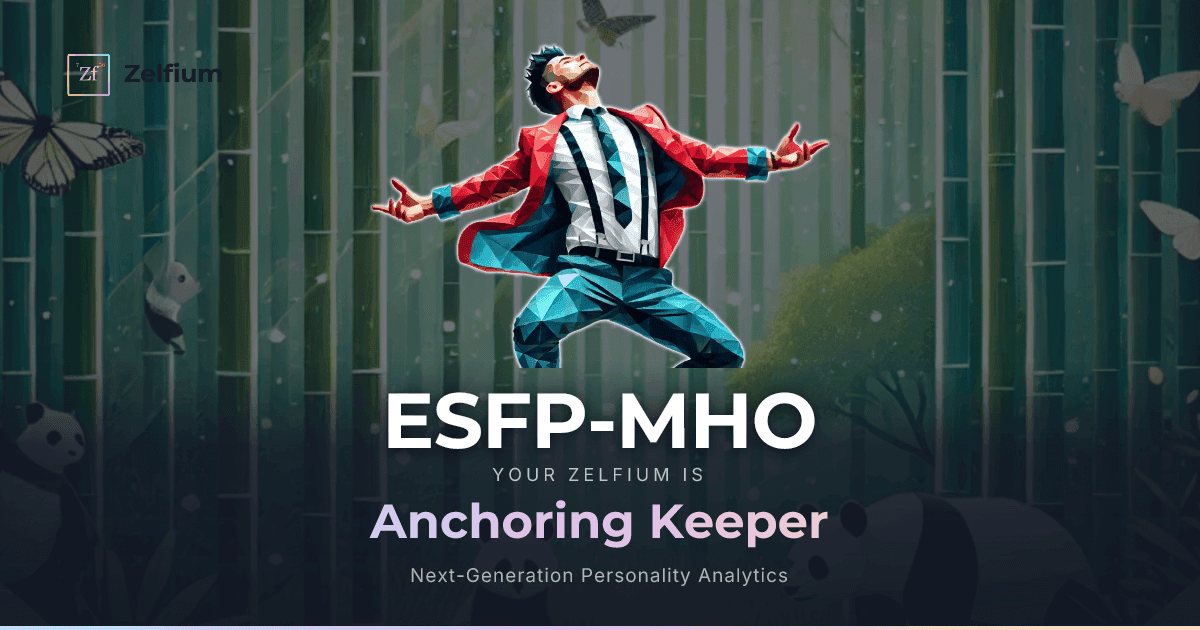
The Anchoring Keeper
The ESFP-MHO is perhaps the most naturally reassuring personality in the entire Zelfium system. The ESFP's warmth, sensory immediacy, and spontaneous joy meet the MHO's stabilizing triad — a devotion to continuity, a heart deeply attuned to people, and an optimism so grounded it functions less like cheerfulness and more like bedrock. The result is someone who brings the party and is also the reason everyone feels safe enough to truly enjoy it. Where other ESFPs might dazzle and move on, the ESFP-MHO stays — not because the next experience is uninteresting, but because the act of sustaining what has been built carries a satisfaction that novelty alone cannot provide. This type does not just create memorable moments; it maintains the conditions under which memorable moments can keep occurring, year after year, in the same relationships, the same communities, the same warm rooms where trust has had time to settle and deepen.
The ESFP's extraversion and the MHO's harmonious dimension amplify each other into a relational warmth that borders on gravitational. People do not merely enjoy the ESFP-MHO's company — they orient toward it. The combination creates a social presence that feels simultaneously exciting and safe. Extraversion provides the outward energy, the magnetism, the willingness to engage with anyone. The MHO's harmony ensures that engagement carries weight — promises are kept, people are remembered, and the relationship offered today will still be offered tomorrow. This consistency within warmth is what makes the ESFP-MHO a figure that entire communities unconsciously organize around.
The Sensory dimension and the MHO's maintaining orientation create a deep appreciation for the rituals and textures of sustained connection. The ESFP's senses savor the present moment with extraordinary richness — the taste of a holiday meal, the particular light of a familiar room, the sound of voices that have been gathering in the same place for years. The maintaining dimension ensures these moments are not treated as disposable. They become traditions, touchstones, the rhythmic heartbeat of a life deliberately built around what matters. The ESFP-MHO does not just experience beauty — it curates and preserves it.
The ESFP's feeling dimension and the MHO's optimism create a distinctive emotional signature. Feeling makes this type acutely sensitive to how others are doing; optimism ensures the response is always warm encouragement rather than anxious concern. The ESFP-MHO notices when someone is struggling and responds not with worry but with faith — a quiet, steady conviction that the person will find their way, communicated through presence, humor, and the simple act of showing up. This particular quality of support — attentive without being heavy — is something people find profoundly comforting and rarely encounter elsewhere.
The ESFP-MHO's greatest strength is the ability to sustain joy over time. Many people can create a single magical evening. Few can create the conditions under which magical evenings happen repeatedly, across years and decades, with the same group of people who are themselves growing and changing. The ESFP's gift for spontaneous celebration combined with the MHO's devotion to continuity produces someone who is both the spark and the hearth — lighting new flames of enjoyment while maintaining the fire that has been burning for years.
There is also an exceptional capacity for emotional endurance with grace. The MHO's optimism prevents the ESFP's emotional sensitivity from becoming overwhelming, creating a person who can absorb difficulty without being capsized by it. When others panic, the ESFP-MHO becomes calmer. When morale drops, this type instinctively finds the gesture, the meal, the shared experience that reminds everyone what they are holding together for. The support offered is not theoretical — it arrives as something tangible, something the senses can hold onto.
The combination also produces an unusual talent for making transitions bearable. Change is inevitable, but the ESFP-MHO manages to honor what is ending while welcoming what is beginning — throwing the farewell dinner that lets people grieve and celebrate simultaneously, maintaining connection across distances that would dissolve lesser bonds.
The primary tension in the ESFP-MHO is between the spontaneity that keeps life fresh and the stability that keeps it safe. The ESFP's pioneering dimension craves new experience, surprise, the unplanned detour. The MHO's maintaining dimension finds comfort in the known, the reliable, the time-tested. These two impulses can coexist peacefully much of the time — but when life demands a genuine choice between adventure and continuity, the internal negotiation can become quietly agonizing. The ESFP wants to leap; the MHO wants to know the landing is solid. Resolution usually comes through a characteristic compromise: calculated spontaneity — the kind of adventure that has a warm home to return to.
A second, subtler tension exists between the MHO's optimism and the full spectrum of emotional experience. Optimism is a genuine and beautiful strength, but in combination with the ESFP's preference for emotional lightness and the MHO's desire for harmony, it can create a pattern of reflexive reassurance that does not always serve. Sometimes the kindest thing is not "It will be fine" but "Tell me how bad it is." The ESFP-MHO's instinct to lift is powerful, and learning to distinguish between moments that need lifting and moments that need witnessing is a skill that deepens every relationship.
There is also the matter of self-sacrifice that compounds across time. The ESFP gives energy outward through social generosity; the MHO gives energy outward through relational devotion; and the optimism insists that personal needs will eventually be met without advocacy. The combination can produce a person who gives ceaselessly while trusting that the universe will take care of them — a beautiful faith, but one that can leave genuine needs unaddressed for longer than is healthy.
Growth for the ESFP-MHO is not about becoming less warm or less steady. It is about learning that the anchor is also permitted to drift occasionally — that the person who holds everything together is allowed to need holding, too. The hardest growth edge is self-advocacy: naming personal needs with the same clarity and warmth used to identify everyone else's. The MHO's optimism may whisper that patience will be rewarded, and often it is. But sometimes the reward only comes to those who ask. Including oneself in the circle of people cared for — with the same devotion, the same consistency, the same refusal to let anyone be forgotten — is not a departure from the ESFP-MHO's nature. It is the completion of it.
The ESFP-MHO portrait drawn here is the "pure form" — what emerges when every pole swings fully in this direction. In reality, each of your dimensions carries a different intensity, and at every intersection, a unique chemistry unfolds. Even a slight tilt in one dimension creates an entirely different internal dynamic — that is the resolution of Zelfium's 7-dimension model.
Zelfium measures each of 36 facets on a 6-point scale. The number of possible patterns:
6³⁶
possible patterns
vs all humans ever born
880 trillion ×
~117 billion humans have ever lived — repeat that 880 trillion times and you still can't fill every pattern
vs stars in the observable universe
~50,000 ×
~200 sextillion stars in the observable universe — still not enough
vs grains of sand on Earth
~1 billion ×
~7.5 quintillion grains of sand — multiply by a billion
vs current world population
~1.3 quintillion ×
Line up 1.3 quintillion copies of today's 8 billion people to fill every type
More than 50,000 times the number of every star in the observable universe. That is the resolution of your personality.
So don't fit yourself into this description too tightly. ESFP-MHO is a compass showing the direction your personality leans — not a box that defines everything you are. The pattern woven by your 36 facets is singular in this universe. To discover that one-of-a-kind blend — to find your own ESFP-MHO — take the assessment.