Loading...
Loading...
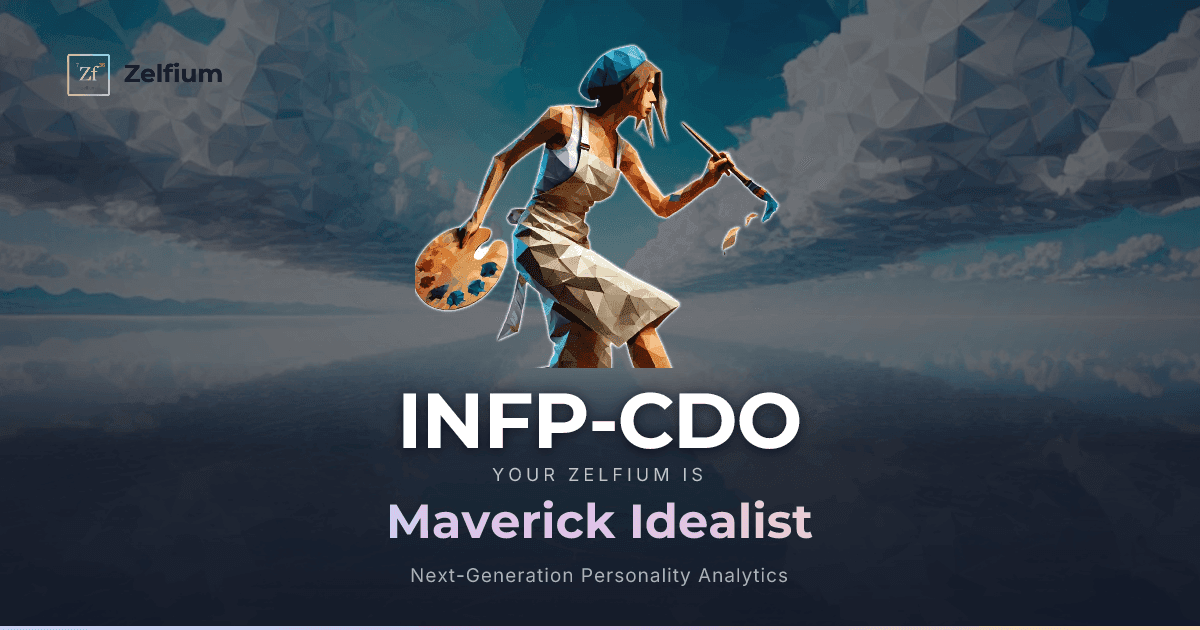
The Maverick Idealist
Most dreamers need the world to meet them halfway. The INFP-CDO does not. This is what happens when the INFP's vivid inner life — a world constructed from values, imagination, and a fierce need for authenticity — meets the CDO's maverick temperament, where curiosity, intellectual independence, and unshakable optimism converge into a self-directed force that needs no permission, no validation, and no roadmap drawn by someone else. The result is a dreamer who does not wait for conditions to be right before pursuing a vision. The CDO's independence frees the INFP from the approval-seeking that can paralyze more conventional idealists, and the CDO's optimism provides a steady wind at the back even when the terrain ahead is entirely uncharted. Where many INFPs struggle with the gap between their vision and the world's indifference, the INFP-CDO treats that gap not as a source of suffering but as interesting territory to explore. The dream remains deeply personal and deeply felt — but the dreamer who carries it is surprisingly fearless about walking alone.
The INFP's four dimensions — introversion, openness, feeling, and pioneering — create someone whose richest experiences are internal: a private world of meaning, imagery, and values that few others ever see. The CDO's three dimensions — curiosity, detachment, and optimism — create an inner world that is intellectually self-governing, growth-oriented, and emotionally unflappable. When these two layers coexist, the solitary visionary acquires an engine.
The interaction between introversion and the CDO's detachment creates an unusually self-contained person. The INFP retreats inward for creative and emotional processing; the CDO's detachment makes that retreat feel not just comfortable but natural — there is no anxiety about missing out, no guilt about not participating in social rituals that feel hollow. The INFP-CDO is genuinely at home alone with ideas, and the combination of introversion and detachment means the pressure to seek external validation is remarkably low. The inner compass is trusted absolutely.
The intersection of the INFP's openness and the CDO's curiosity creates a powerful exploratory drive. Openness sees the symbolic, the metaphorical, the not-yet-real; curiosity says "Let us go there and find out." But the CDO's detachment adds a crucial modifier: the exploration is conducted on entirely personal terms. The INFP-CDO does not follow intellectual trends, does not seek out fashionable ideas, and does not care whether the creative direction chosen is currently popular. If the vision is authentic, that is enough.
The most transformative interaction, however, is between feeling and the CDO's optimism. The INFP's feeling dimension registers the weight of the world's imperfection — injustice, dishonesty, the betrayal of values. Without the CDO, this weight can become paralyzing. Optimism does not dismiss it; optimism carries it. The INFP-CDO feels the full force of what is wrong and still believes something can be done about it — not because the odds are favorable, but because an inner confidence says that effort matters regardless of odds. This is not reckless positivity. It is a values-driven resilience that allows the dreamer to sustain creative and moral work over timescales that would exhaust a less anchored idealist.
The INFP-CDO possesses a rare ability to pursue a deeply personal vision without needing external permission or encouragement. This is the artist who creates without worrying about the market, the advocate who speaks without calculating the political cost, the thinker who follows a thread of inquiry because it is true, not because it is popular. The combination of the INFP's creative depth with the CDO's self-directed confidence creates someone whose work carries an unmistakable signature of authenticity — because no one else was consulted in its making.
There is also an unusual resilience to rejection and indifference. The CDO's detachment buffers the INFP's sensitivity to criticism, and the CDO's optimism buffers the INFP's tendency toward discouragement. The result is a dreamer who can take a punch — who can watch their work be ignored or misunderstood and return to it the next day with undiminished conviction. This durability is what separates the INFP-CDO's creative output from the many unfinished notebooks of more fragile visionaries.
Finally, the pioneering dimension of the INFP and the CDO's curiosity combine to produce a genuine willingness to venture into territory that others find uncomfortable. The INFP-CDO is drawn to the edges of experience — the places where conventional thinking stops and something more interesting begins. The work that emerges from those edges has a quality of originality that cannot be manufactured.
The most significant tension in the INFP-CDO is between feeling's deep need for connection and the CDO's thorough self-sufficiency. The INFP wants to be known, wants to share the inner world with someone who truly understands. The CDO is comfortable alone, sees through social performances, and maintains a distance that protects analytical independence but can also protect against vulnerability. The INFP-CDO may find that the very independence that makes creative work possible also makes intimate connection difficult — not because of inability to feel, but because the barriers to entry are exceptionally high. The people who do gain access to the inner world know they have gained something rare, but those people may be very few.
A second tension lives between the INFP's idealism and the CDO's pragmatic autonomy. The INFP cares deeply about making the world better; the CDO cares deeply about maintaining freedom. When these goals align — pursuing a personal vision that also serves a larger good — the result is extraordinary. When they diverge — when meaningful impact requires compromise, collaboration, or the surrender of independence — a genuine dilemma emerges. Learning to distinguish between the compromises that would betray values and the compromises that would extend reach is an ongoing negotiation.
There is also a subtle tension between optimism and feeling. The CDO's confident forward momentum can sometimes bypass the INFP's need to sit with emotional complexity. Not every feeling should be efficiently processed into action. Some experiences need to be honored with time and attention before optimism sweeps in with the next plan. Growth lies in recognizing when the dreamer's heart needs stillness, not progress.
Growth for the INFP-CDO is not about becoming more collaborative or less independent. It is about choosing, with intention, when to let people in. The self-sufficiency is real, the creative independence is valuable, and the inner compass is trustworthy. None of these need dismantling. But the dream that is never shared is a dream that never fully lives — and the dreamer who never allows themselves to need anyone risks building a beautiful world with no one in it. The growth edge is selective vulnerability: learning to identify the people and moments worthy of lowering the drawbridge, and trusting that letting someone see the inner world will not compromise the independence that built it. The INFP-CDO who learns this discovers that authenticity shared is not diminished but amplified — and that the maverick who occasionally lets someone walk alongside them does not become less original. If anything, they become more real.
The INFP-CDO portrait drawn here is the "pure form" — what emerges when every pole swings fully in this direction. In reality, each of your dimensions carries a different intensity, and at every intersection, a unique chemistry unfolds. Even a slight tilt in one dimension creates an entirely different internal dynamic — that is the resolution of Zelfium's 7-dimension model.
Zelfium measures each of 36 facets on a 6-point scale. The number of possible patterns:
6³⁶
possible patterns
vs all humans ever born
880 trillion ×
~117 billion humans have ever lived — repeat that 880 trillion times and you still can't fill every pattern
vs stars in the observable universe
~50,000 ×
~200 sextillion stars in the observable universe — still not enough
vs grains of sand on Earth
~1 billion ×
~7.5 quintillion grains of sand — multiply by a billion
vs current world population
~1.3 quintillion ×
Line up 1.3 quintillion copies of today's 8 billion people to fill every type
More than 50,000 times the number of every star in the observable universe. That is the resolution of your personality.
So don't fit yourself into this description too tightly. INFP-CDO is a compass showing the direction your personality leans — not a box that defines everything you are. The pattern woven by your 36 facets is singular in this universe. To discover that one-of-a-kind blend — to find your own INFP-CDO — take the assessment.