

Loading...
Loading...
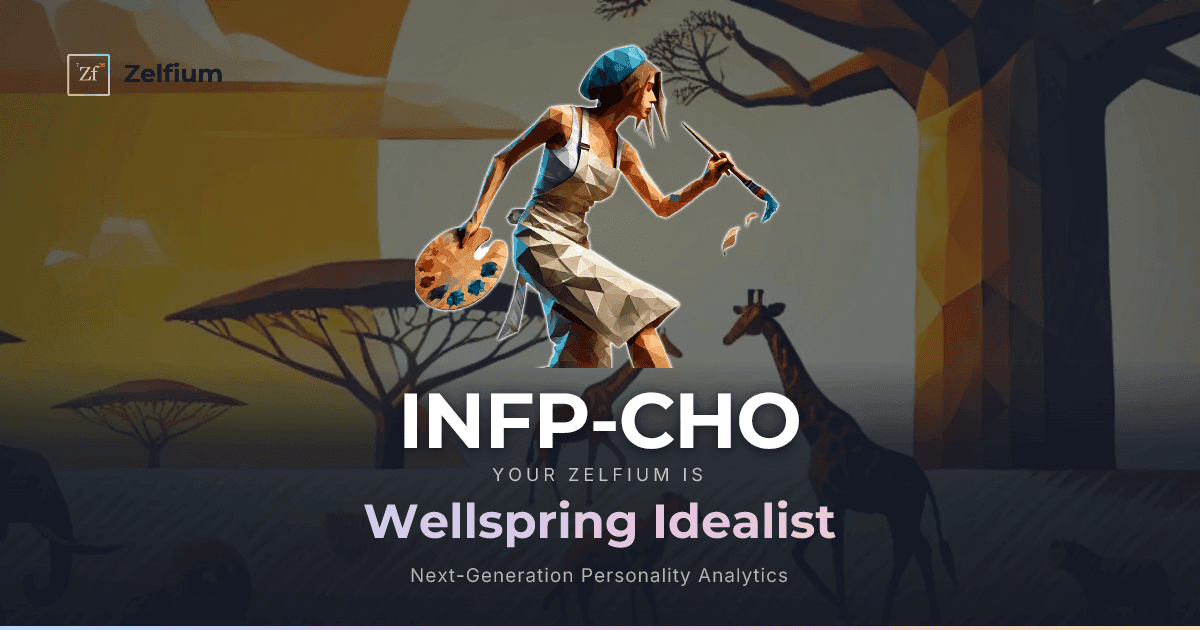
The Wellspring Idealist
There are people who dream, and there are people who make others feel invited into the dream. The INFP-CHO is the second kind. This is what emerges when the INFP's vivid interior world — a landscape of values, vision, and emotional depth that few ever fully see — meets the CHO's wellspring nature, where curiosity, warmth, and an unshakable optimism fuse into a generosity that never seems to run dry. The result is a dreamer whose idealism is not fragile but buoyant, carried forward by an inner confidence that the world can be made more beautiful and that people are fundamentally worth believing in. Where a pure INFP might guard the inner vision, uncertain whether the world deserves to see it, the CHO's optimistic current lifts that hesitation. The dream does not stay private. It flows outward, gaining warmth as it travels, and when it reaches others, it arrives not as a demand for perfection but as an invitation to something better. This generous momentum — vision offered without condition, possibility shared without anxiety — is what makes the INFP-CHO a genuinely radiant presence.
The INFP's four dimensions — introversion, openness, feeling, and pioneering — create someone who lives most fully in an interior world of meaning and imagination. The CHO's three dimensions — curiosity, harmony, and optimism — create an inner disposition that is growth-oriented, relationally warm, and emotionally resilient. When these layers merge, the solitary dreamer acquires something unexpected: an atmosphere of safety that makes others want to draw near.
Introversion still sets the tempo. The INFP-CHO needs time alone to reconnect with the creative and emotional source. But the CHO's harmonious dimension means that solitude is never truly solitary — the imagination is populated with people, and the creative work is shaped by a genuine desire to share what has been found. The wellspring flows inward first, but its nature is to overflow.
The interaction between the INFP's openness and the CHO's curiosity creates a double engine of exploration. The INFP's openness reaches toward beauty, metaphor, and the not-yet-real; the CHO's curiosity reaches toward growth, learning, and new human connections. Together, they produce a mind that is simultaneously dreaming forward and reaching outward — imagining what life could be while actively seeking the people and experiences that will enrich that vision.
The most transformative intersection, however, is between the INFP's feeling dimension and the CHO's optimism. Feeling anchors the INFP in deeply held values and an acute awareness of suffering and injustice. Without the CHO, this awareness can become a weight — the gap between what is and what should be can feel crushing. Optimism does not deny the gap. Instead, it provides the emotional resilience to keep working across it. The INFP-CHO feels the pain of the world's imperfection as intensely as any INFP, but the CHO's optimistic core whispers that this pain is not the final word. Things can improve. People can grow. Beauty can be built in imperfect places. This is not naivety — it is faith tested against real sorrow, and it gives the dreamer's vision a durability that more fragile idealism cannot sustain.
The INFP-CHO possesses a rare gift for making idealism feel achievable rather than distant. This is the person whose creative work, whose conversation, whose simple presence reminds others that hope is not foolishness but a form of courage. The INFP's capacity to envision what is beautiful, combined with the CHO's capacity to believe it can be realized, creates an atmosphere that lifts people without asking anything of them.
There is also an unusual warmth that draws others close without overwhelming them. The INFP's selectivity in relationships is softened by the CHO's inclusive spirit, producing someone who maintains depth without exclusivity. The inner circle may be small, but the circle of people who feel welcomed and believed in is far larger. Others leave the INFP-CHO's presence feeling not just understood but encouraged — as though their own potential has been quietly affirmed.
Finally, the CHO's resilient optimism gives the INFP's creative process a sustainability it often lacks. Where many INFPs begin projects in a blaze of inspiration and abandon them when reality disappoints, the CHO's steady confidence helps this type weather the difficult middle passages. The vision does not have to be perfect to be worth pursuing. The work does not have to be flawless to be worth finishing. This patient persistence, fueled by genuine hope rather than grim discipline, allows the INFP-CHO to complete what other dreamers only begin.
The most significant tension in the INFP-CHO is between feeling's acute sensitivity to suffering and optimism's instinct to look forward. When the INFP registers the full weight of an injustice, a loss, or a betrayal of values, optimism may step in too quickly — reassuring, reframing, seeking the silver lining before the pain has been fully honored. This is not dishonesty; it is the CHO's natural buoyancy asserting itself. But the INFP's feeling dimension knows that some truths need to be sat with, not solved. Growth lies in learning when to let optimism lead and when to let feeling have its full, unhurried say.
A second tension lives between introversion's need for retreat and the CHO's warm, inclusive impulse. The INFP-CHO genuinely enjoys sharing the inner world with others, but the energy required to do so still draws from the same finite reserves that introversion protects. The wellspring metaphor is apt but incomplete — even wells need time to refill. Learning to say "not right now" without guilt, even to people genuinely cared about, is essential.
There is also a subtler tension between pioneering's resistance to commitment and the CHO's desire to sustain what has been built. The INFP wants to keep creative options open; the CHO wants to tend the relationships and projects already underway. These two impulses can create a quiet indecision — not wanting to close doors, but also not wanting to let good things wither from inattention. Recognizing that commitment and creative freedom are not opposites but partners — that tending one garden deeply can be its own form of exploration — is the path forward.
Growth for the INFP-CHO is not about dimming the radiance or learning to expect less of life. It is about developing the discernment to know when optimism serves the truth and when it softens it prematurely. The INFP-CHO who can sit with darkness long enough to understand it — without rushing toward reassurance — discovers that the light on the other side is not less bright but more real. The dreamer's vision gains credibility when it has clearly passed through difficulty rather than around it. There will always be a temptation to skip the painful middle — to leap from recognition of a problem to confidence in its resolution. The growth edge is the willingness to stay in that middle space, feeling the full complexity, trusting that the optimistic core is strong enough to hold sorrow without being destroyed by it. The INFP-CHO who learns this discovers something powerful: hope that has been tested by genuine suffering is the only kind that can truly sustain others. And sustaining others — through vision, through warmth, through an inexhaustible belief in what is possible — is precisely what this combination was made to do.
The INFP-CHO portrait drawn here is the "pure form" — what emerges when every pole swings fully in this direction. In reality, each of your dimensions carries a different intensity, and at every intersection, a unique chemistry unfolds. Even a slight tilt in one dimension creates an entirely different internal dynamic — that is the resolution of Zelfium's 7-dimension model.
Zelfium measures each of 36 facets on a 6-point scale. The number of possible patterns:
6³⁶
possible patterns
vs all humans ever born
880 trillion ×
~117 billion humans have ever lived — repeat that 880 trillion times and you still can't fill every pattern
vs stars in the observable universe
~50,000 ×
~200 sextillion stars in the observable universe — still not enough
vs grains of sand on Earth
~1 billion ×
~7.5 quintillion grains of sand — multiply by a billion
vs current world population
~1.3 quintillion ×
Line up 1.3 quintillion copies of today's 8 billion people to fill every type
More than 50,000 times the number of every star in the observable universe. That is the resolution of your personality.
So don't fit yourself into this description too tightly. INFP-CHO is a compass showing the direction your personality leans — not a box that defines everything you are. The pattern woven by your 36 facets is singular in this universe. To discover that one-of-a-kind blend — to find your own INFP-CHO — take the assessment.