Loading...
Loading...
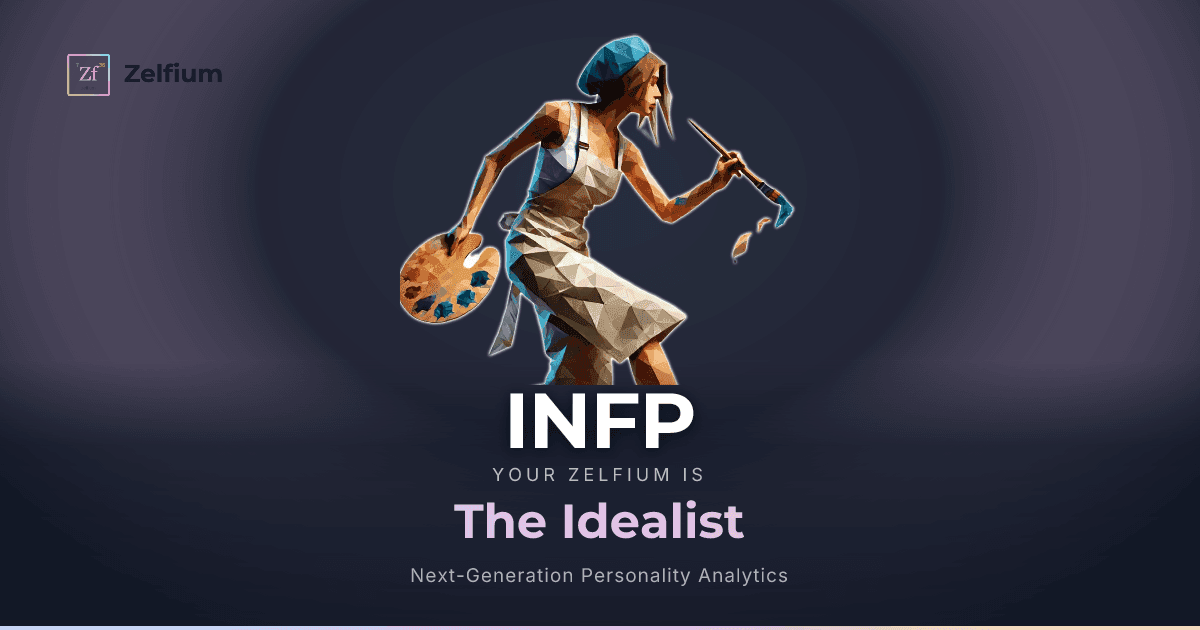
The Idealist
INFP stands for Introverted (I), OpeN (N), Feeling (F), and Pioneering (P) — four dimensions that together create someone who lives at the intersection of inner depth and creative possibility. The INFP carries a vivid internal world: a landscape of values, ideals, emotions, and visions that is richer and more detailed than most people ever realize. Introversion gives the space to develop this world with extraordinary care. Openness fills it with imagination, symbolism, and a sense of what life could be at its best. Feeling anchors everything to deeply held values — not rules imposed from outside, but convictions that arise from an authentic sense of what matters. And pioneering keeps the whole structure fluid, open to revision, resistant to premature closure. People with this pattern are drawn to meaning, authenticity, and creative expression. They would rather struggle toward something genuine than succeed at something hollow. This makes the INFP one of the most idealistic types in the Zelfium system — and when that idealism finds a channel, whether in art, writing, counseling, advocacy, or any field where human depth matters, the work produced has a quality of emotional truth that others can feel but rarely achieve themselves.
The same 4-letter type produces 8 distinct profiles depending on the remaining 3 dimensions.
Extraverted / Introverted
The INFP's inner world is not a retreat from reality — it is where the most important experiences happen. This type processes life deeply, turning over events, conversations, and feelings long after they occur, finding layers of meaning that quicker minds miss entirely. This reflective quality gives the INFP unusual emotional intelligence: an understanding of nuance, a sense of what is unspoken, and an awareness of shifts in atmosphere that others walk right through. Solitude is where this processing happens best, and it is needed the way others need sleep — not as a luxury but as a biological necessity. Without enough of it, the INFP feels scattered, overwhelmed, and disconnected from their own center. In social settings, this type brings a quality of presence that is warm but selective. There is no performance of energy not genuinely felt; instead, genuine attention is offered, which means fewer interactions but deeper ones. The people who experience the INFP's full attention know it is something rare. The challenge is not to become more outgoing but to trust that a quieter way of being in the world is valuable exactly as it is — and to protect the solitude needed without guilt, even in a culture that often confuses introversion with something that needs to be fixed.
OpeN / Sensory
The INFP sees the world through a lens of possibility and meaning. Facts interest this type less than what facts signify; surfaces interest them less than what lies beneath. Thinking happens in metaphor, analogy, and symbol — seeing connections between things that more literal minds would never link. A piece of music can open a door to an entire emotional landscape. A single image can carry a truth that would take paragraphs to explain in words. This capacity for abstraction and association gives the INFP a creative richness that is genuinely unusual. People with this pattern can imagine experiences they have never had, inhabit perspectives that are not their own, and envision futures that do not yet exist. This is the engine of both creativity and empathy. The tension this type carries is between the world as imagined and the world as it actually is. The inner vision is so vivid and so beautiful that ordinary reality can feel disappointingly flat by comparison. Growth does not mean dimming the imagination; it means learning to find beauty in imperfection, to love what is real without abandoning the sense of what is possible. The dreamer who can hold both — the vision and the reality — becomes not less idealistic but more effective.
Thinking / Feeling
The INFP's decisions are guided by an internal compass of values that is deeply personal and fiercely held. Situations are not evaluated primarily by logic or efficiency but by asking: does this align with what is believed to be right? Does this honor the human beings involved? Is this authentic? This is not sentimentality — it is a sophisticated moral sensibility that operates on a level many analytical minds never reach. The INFP feels the weight of ethical questions that others dismiss as irrelevant and cannot simply set aside values for the sake of convenience or profit. The empathy is not performative; people with this pattern genuinely feel what others feel, sometimes to the point where it becomes difficult to separate another's emotions from their own. This emotional permeability is both the greatest gift and the most significant vulnerability. It allows the INFP to understand people with startling depth, to offer comfort that actually reaches people where they hurt, and to create art that resonates because it comes from genuine emotional truth. The growth edge is boundary: learning to care deeply without absorbing every feeling, to honor values without being consumed by every injustice, and to recognize that self-care is not selfishness but sustainability.
Judging / Pioneering
The INFP resists premature closure the way others resist uncertainty. Where some people feel anxious until a decision is made and a plan is set, this type feels anxious when doors close too quickly — when life becomes too defined, too structured, too settled. This is because the pioneering dimension keeps the INFP oriented toward possibility rather than resolution. There is a desire to stay open to what might emerge, to follow the thread of inspiration wherever it leads, to keep space for the unexpected. This gives remarkable creative flexibility: the ability to adapt, improvise, and follow intuition into territory that more structured minds would never enter. The best creative work often comes from these unplanned excursions. The challenge is that the same openness that fuels creativity can make it difficult to finish things, commit to decisions, and build the practical structures that turn dreams into realities. Many projects may be started and few finished, or so long spent keeping options open that the window closes on its own. Growth for the INFP is not about becoming rigid or conventional. It is about discovering that certain kinds of structure — the ones designed on personal terms — actually protect creative freedom rather than threatening it. A garden needs a boundary to flourish, but the gardener gets to choose the shape of the boundary.
The INFP pattern weaves together depth, vision, values, and openness into something that no other combination quite produces: a person whose inner life is a creative and moral universe unto itself. Introversion and feeling combine to create extraordinary emotional depth — the INFP feels things with an intensity and subtlety that gives access to truths that cooler temperaments miss. Openness takes that emotional material and transforms it into imagery, narrative, and vision — this type does not just feel things but imagines what they mean and what they could become. And pioneering keeps the whole process alive and evolving, refusing to let the inner world calcify into rigid doctrine. The result is someone who can express what it feels like to be human in ways that others recognize as deeply true, even if they could never articulate it themselves. Whether through writing, art, counseling, teaching, or simply the quality of presence, the INFP has a gift for making the invisible visible — for giving form to the experiences and values that connect people at the deepest level.
The INFP's creative and emotional process does not follow a schedule. Inspiration arrives on its own terms, and when it does, it can be all-consuming — hours disappear as the INFP writes, creates, or explores an idea that has seized their imagination. Between these periods of intense engagement, there may be stretches that look like inactivity from the outside but are actually essential incubation. The mind is working beneath the surface, processing, connecting, ripening — and the work that emerges after these fallow periods is richer for having had the time to develop. Pioneering supports this rhythm by keeping the door open to the unexpected thread that might lead somewhere important, and introversion provides the inner sanctuary where the most delicate creative work can happen undisturbed. The difficulty comes when external demands — deadlines, obligations, other people's timelines — collide with this internal rhythm. The INFP can force output on command, but the result rarely satisfies. Learning to negotiate between a natural creative tempo and the world's expectations, without betraying either, is one of the most important practical skills someone with this pattern can develop.
The INFP brings a rare quality to relationships: the ability to see people as they truly are and to accept what is seen. Introversion means engagement is selective, but when it happens, the combination of feeling and openness creates an almost uncanny empathy. The INFP senses emotional undercurrents that others miss, hears the real message behind the spoken words, and offers a kind of understanding that makes people feel genuinely known — sometimes for the first time. This is a gift that draws people close, and the INFP may find that others share things with them that they share with no one else. The shadow side of this depth is the weight it places on the listener. Because people with this pattern feel so much and imagine so vividly, they can become overwhelmed by other people's pain. They may also struggle with conflict, because sensitivity to how words will land can make it difficult to express anger, set boundaries, or deliver hard truths — even when doing so would be kinder in the long run. Growth in relationships is about learning that honesty, even when it risks momentary discomfort, is itself an act of love — and that protecting one's own emotional energy is not a betrayal of a caring nature but a prerequisite for sustaining it.
The deepest tension in the INFP pattern is between the ideal and the real. Openness and feeling combine to create a vision of how life should be — beautiful, meaningful, just, and authentic — that is powerful enough to organize an entire emotional life around. When reality falls short of that vision, the gap can become a source of genuine suffering. People with this pattern may feel disappointed in the world, in other people, and in themselves for not living up to standards that were, in truth, impossibly high. Growth does not mean lowering ideals. It means developing a more compassionate relationship with imperfection — one's own and others'. The dreamer who can love the flawed, unfinished world without abandoning the dream becomes someone of extraordinary resilience and wisdom. A second tension runs between the desire for authentic self-expression and the fear of exposure. The INFP wants to be known, but being truly known means being truly vulnerable, and sensitivity makes vulnerability feel genuinely dangerous. Learning to share the inner world in measured, chosen ways — neither hiding completely nor revealing everything at once — is the relational skill that unlocks the deepest connections. Finally, the tension between pioneering's openness and the need to make commitments is one the INFP will negotiate throughout life. The key insight is that commitment does not have to mean rigidity. It is possible to commit to a direction while remaining flexible about the route. The people and projects that deserve loyalty are the ones that leave room for continued growth.
The same 4-letter type produces 8 distinct profiles depending on the remaining 3 dimensions.
The INFP portrait drawn here is the "pure form" — what emerges when every pole swings fully in this direction. In reality, each of your dimensions carries a different intensity, and at every intersection, a unique chemistry unfolds. Even a slight tilt in one dimension creates an entirely different internal dynamic — that is the resolution of Zelfium's 7-dimension model.
Zelfium measures each of 36 facets on a 6-point scale. The number of possible patterns:
6³⁶
possible patterns
vs all humans ever born
880 trillion ×
~117 billion humans have ever lived — repeat that 880 trillion times and you still can't fill every pattern
vs stars in the observable universe
~50,000 ×
~200 sextillion stars in the observable universe — still not enough
vs grains of sand on Earth
~1 billion ×
~7.5 quintillion grains of sand — multiply by a billion
vs current world population
~1.3 quintillion ×
Line up 1.3 quintillion copies of today's 8 billion people to fill every type
More than 50,000 times the number of every star in the observable universe. That is the resolution of your personality.
So don't fit yourself into this description too tightly. INFP is a compass showing the direction your personality leans — not a box that defines everything you are. The pattern woven by your 36 facets is singular in this universe. To discover that one-of-a-kind blend — to find your own INFP — take the assessment.