Loading...
Loading...
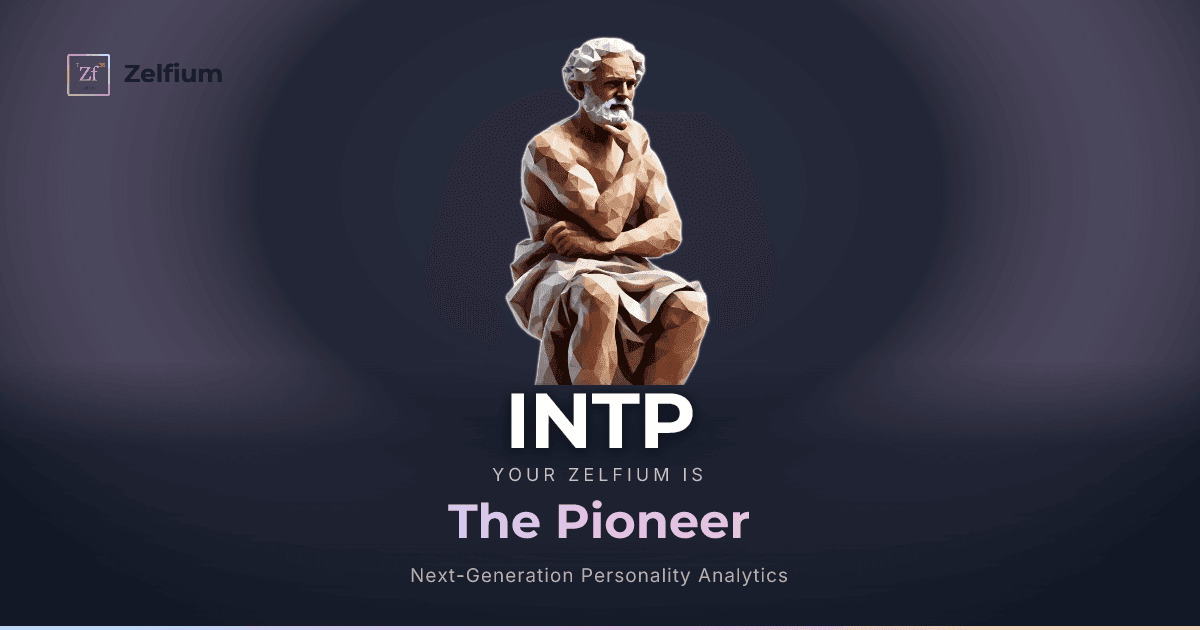
The Pioneer
INTP stands for Introverted (I), OpeN (N), Thinking (T), and Pioneering (P) — four dimensions that together describe someone who quietly reshapes the world from the inside out. The INTP is a builder of invisible architectures: frameworks, theories, and systems that most people never see but that explain the deepest workings of things. This type's mind naturally gravitates toward the question behind the question, pulling apart assumptions that others accept without examination and reassembling them into something truer. The combination of deep inner focus, wide-ranging conceptual vision, rigorous analytical thinking, and a restless drive to explore rather than settle makes the INTP one of the rarest kinds of thinker — someone who can see a pattern no one else has noticed and then construct a logical scaffold to prove it exists. People with this pattern are not interested in answers that merely work; they want answers that are fundamentally correct. This pursuit of intellectual honesty, paired with an allergy to arbitrary rules, means the INTP's best contributions tend to arrive in fields where originality matters more than compliance: theoretical science, systems design, philosophy, independent research, and the quiet revolutions that change how people think.
The same 4-letter type produces 8 distinct profiles depending on the remaining 3 dimensions.
Extraverted / Introverted
The INTP's real home is the world inside their own mind. Where many people recharge through social contact and external stimulation, someone with this pattern finds their richest experiences in solitude — thinking, building mental models, observing, and making sense of things at their own pace. This is not shyness and it is not social anxiety. It is a fundamental orientation toward depth. The INTP processes the world more thoroughly than most, and that processing requires space. When they do engage socially, they bring a quality of attention that is genuinely rare: noticing what others miss, listening for what is actually being said beneath the surface, and when they speak, their observations tend to cut straight to the heart of things. The challenge is not to become more outgoing — that framing misunderstands what introversion is. The real work is finding environments and relationships where this depth is recognized as the asset it is, rather than mistaken for distance or disinterest. People with this type may sometimes feel pressure to perform sociability they do not feel. But that pressure is not evidence of a deficiency. The world needs people who go deep, and the INTP is one of them.
OpeN / Sensory
The world, for the INTP, is saturated with hidden patterns and connections that most people walk right past. A casual remark can set off a chain reaction of ideas that keeps this type's mind racing for hours. There is an instinctive reach for abstraction — the underlying principle, the "what if," the model that unifies seemingly unrelated phenomena. This is not intellectual play for its own sake; it is genuinely how the INTP engages with reality. This type is drawn to the unconventional, the theoretical, and the not-yet-imagined. The thinking often leaps several steps ahead of where the conversation is, which can make someone with this pattern seem hard to follow — but that is simply the speed at which their pattern recognition operates. The gift here is vision: seeing possibilities where others see walls, and imagining futures that do not yet exist. The growth edge is grounding. Not every insight needs to be pursued immediately. Learning to identify which of the many ideas deserve sustained effort — and then translating those ideas into forms that others can see and use — is what transforms brilliant thinking into actual impact. The INTP's openness is a creative engine; building the discipline to channel it is what makes the engine productive.
Thinking / Feeling
Logic is not just a tool the INTP uses; it is the lens through which everything is understood. When faced with a decision, this type instinctively reaches for structure: what are the variables, where are the trade-offs, what does the evidence actually show? There is deep satisfaction in taking something messy and ambiguous and reducing it to its essential elements. The INTP can hold multiple layers of complexity simultaneously without losing the thread, and is drawn to building frameworks that explain not just a single situation but entire categories of problems. Others may sometimes read this analytical style as coldness, but the truth is that people with this pattern care deeply — they simply express that care through clarity rather than comfort. A commitment to intellectual honesty means choosing correctness over pleasantness, and pointing out the flaw in a beloved idea because truth matters more than feelings. The growth opportunity here is not to abandon logic but to widen it. The most important decisions in life — whom to trust, what to value, when to let go — do not always yield to analysis alone. Giving intuition a seat at the table does not weaken the INTP's thinking; it completes it.
Judging / Pioneering
Freedom is not a preference for the INTP; it is a requirement. Something inside this type fundamentally resists living on someone else's schedule, following rules that exist only because they have always existed, and meeting expectations simply because they were set. There is an internal compass, and when it points somewhere, the INTP follows it with startling intensity. When it points nowhere, inertia takes hold just as powerfully. Someone with this pattern can shift from zero to total absorption in an instant once the right project or question ignites them, losing all sense of time in the process. This is not laziness interrupted by bursts of productivity — it is a fundamentally different relationship with motivation itself. The originality, the refusal to be boxed in, and the ability to see possibility where others see rules are genuine strengths. The growth direction is not about becoming more disciplined in the conventional sense. It is about building personal structures — ones that serve the vision rather than constrain it — so that the most important work does not depend entirely on the arrival of inspiration. The pioneer who builds a base camp can explore farther than the one who sets out with nothing.
The INTP pattern creates something distinctive: a mind that constructs invisible architectures in silence. When introversion's deep focus meets openness's boundless pattern recognition, solitude becomes not rest but the most productive creative environment imaginable. Add thinking's logical precision, and vague intuitions are transformed into testable frameworks. Then pioneering ensures that this building process is experienced not as obligation but as intellectual adventure — open-ended, revisable, alive. What emerges is a capacity that no other combination quite replicates: the ability to see the deep structure beneath complex problems and to give language to things that existing frameworks cannot explain. The INTP is the person who notices that the question itself is wrong before anyone else has finished answering it. That may look slow from the outside, but the place they eventually arrive is deeper than where anyone else was heading.
The INTP's thinking has a distinctive rhythm. Openness generates a stream of "what if" questions, and thinking immediately subjects each one to logical scrutiny — this cycle runs almost continuously. From the outside, someone with this pattern may appear to be doing nothing during moments when, internally, elaborate thought experiments are unfolding. Introversion protects the silence this process needs, and pioneering keeps the door open: "No need to conclude yet — let us explore a little further." When action does come, the timing is unconventional. The INTP does not plan and then execute; they think until the structure becomes clear and then build in a concentrated burst. Pioneering's improvisational energy and thinking's analytical rigor combine so that design and implementation happen almost simultaneously. The trade-off is that when openness spots a better possibility mid-stream, the direction changes without hesitation — which can look like never finishing, though to the INTP, clinging to an inferior path once a better one is visible would feel intellectually dishonest.
When the INTP connects with people, introversion and thinking create a distinctive impression. It is not that interest is lacking — the interest simply takes a different form. When someone shares a problem, the instinct is to analyze its structure rather than to offer sympathy first. The response is "here is what might help" instead of "that must be hard," and that is its own kind of caring — the kind that actually tries to solve things. Openness and pioneering add unpredictability to conversations: the INTP sees patterns three steps ahead and may suddenly leap to a seemingly unrelated topic, following a connection that is perfectly clear inside their head but invisible to others. This type thrives in deep conversation and wilts in small talk. But when someone matches their intellectual rhythm — where ideas spark between two minds and each thought catalyzes the next — the INTP becomes one of the most engaged and energizing conversationalists imaginable. People with this pattern value a few deep connections far more than a wide social circle, and those who earn their trust discover a loyalty and authenticity that runs very deep.
Several fundamental tensions live inside the INTP pattern. The most prominent is the pull between openness and pioneering's "infinite horizon" — the desire to keep exploring, to follow every interesting thread — and thinking's need for logical closure. The INTP wants to chase every idea and wants to build complete systems, and these two impulses compete for the same hours. Finding a personal balance between exploration and completion is a lifelong project. A second tension sits between the analytical clarity that introversion and thinking create together and the fact that life's most important domains — love, trust, belonging — resist pure logic. Thinking wants the right answer, but relationships often have no right answer. Growth here means not abandoning analysis but acknowledging that some valuable things exist outside its reach, and developing the courage to sit with uncertainty rather than forcing premature resolution. Finally, pioneering's resistance to structure is both the INTP's greatest ally and most persistent obstacle. External routines feel suffocating, but self-designed structures — systems for capturing ideas, rhythms for sustaining focus, habits for staying connected to the people who matter — free creativity from dependence on inspiration's whims. The best work emerges when freedom and structure stop being opposites and start being partners. Growth for the INTP is not about becoming more conventional. It is about building the personal infrastructure that lets unconventionality reach its full power.
The same 4-letter type produces 8 distinct profiles depending on the remaining 3 dimensions.
The INTP portrait drawn here is the "pure form" — what emerges when every pole swings fully in this direction. In reality, each of your dimensions carries a different intensity, and at every intersection, a unique chemistry unfolds. Even a slight tilt in one dimension creates an entirely different internal dynamic — that is the resolution of Zelfium's 7-dimension model.
Zelfium measures each of 36 facets on a 6-point scale. The number of possible patterns:
6³⁶
possible patterns
vs all humans ever born
880 trillion ×
~117 billion humans have ever lived — repeat that 880 trillion times and you still can't fill every pattern
vs stars in the observable universe
~50,000 ×
~200 sextillion stars in the observable universe — still not enough
vs grains of sand on Earth
~1 billion ×
~7.5 quintillion grains of sand — multiply by a billion
vs current world population
~1.3 quintillion ×
Line up 1.3 quintillion copies of today's 8 billion people to fill every type
More than 50,000 times the number of every star in the observable universe. That is the resolution of your personality.
So don't fit yourself into this description too tightly. INTP is a compass showing the direction your personality leans — not a box that defines everything you are. The pattern woven by your 36 facets is singular in this universe. To discover that one-of-a-kind blend — to find your own INTP — take the assessment.