

Loading...
Loading...
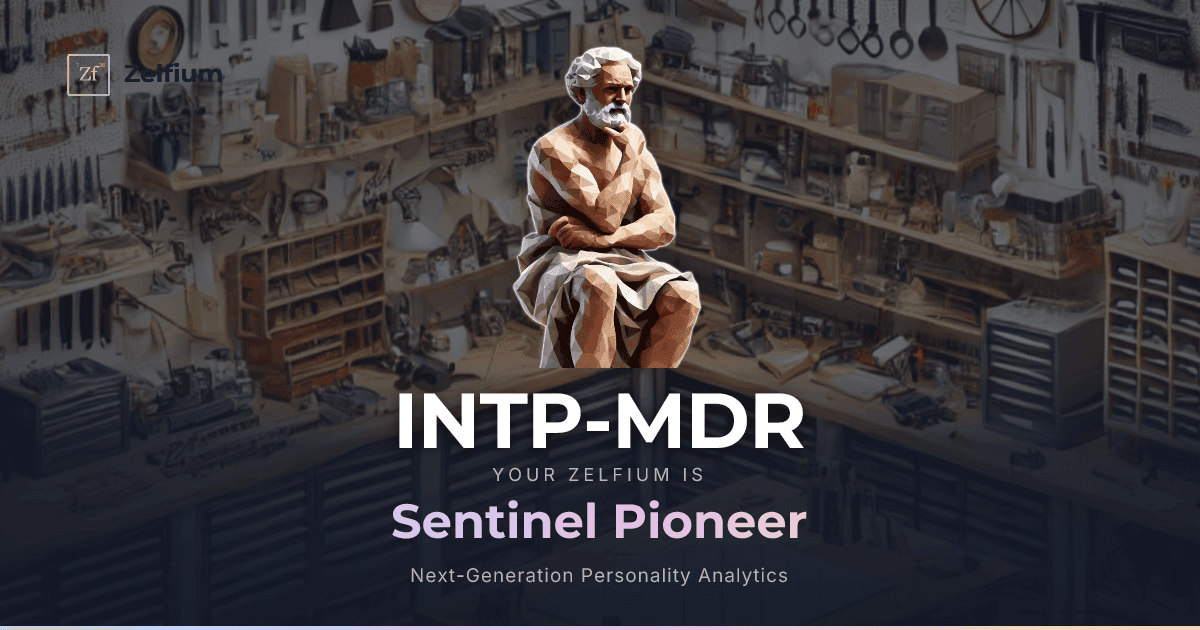
The Sentinel Pioneer
The INTP-MDR is perhaps the most self-contained combination the Pioneer pattern can produce. The INTP's mind — built for constructing invisible frameworks, pursuing logical elegance, and questioning every assumption — meets the Sentinel's inner world, where proven methods are respected, independent judgment is paramount, and a high-resolution sensitivity to risk ensures that nothing deteriorates unnoticed. The result is a thinker of extraordinary depth and extraordinary discipline: someone who builds theories not in wide, speculative sweeps but in carefully validated increments, stress-testing each element before allowing the next to rest upon it. Where the pure INTP might construct a dazzling framework that contains an unexamined assumption at its core, the INTP-MDR will not proceed until that assumption has been excavated, evaluated, and either confirmed or replaced. This makes the work slower, quieter, and far less glamorous than the intellectual fireworks many INTPs produce — but it also makes it more durable. The INTP-MDR builds things that last, and builds them alone, and trusts the work to speak for itself.
The INTP's four dimensions — introversion, openness, thinking, and pioneering — create a mind oriented toward solitary theoretical exploration. The MDR's three dimensions — maintaining, detachment, and responsiveness — create an inner world defined by commitment to proven depth, radical intellectual independence, and constant vigilance for what might go wrong. When these two layers merge, the theoretical explorer becomes something more exacting: a thinker who combines the INTP's capacity for original insight with the MDR's insistence that every insight earn its place through rigorous verification.
The most powerful interaction is between the INTP's thinking and the MDR's detachment. Both dimensions privilege objectivity, logical clarity, and the willingness to follow evidence without regard for social comfort. In the INTP-MDR, this double commitment to truth-seeking creates an analytical stance of almost formidable purity. There is no social filter, no emotional distortion, and no motivated reasoning. What is observed is reported accurately. What is concluded is concluded honestly. This is a mind that other thinkers can trust absolutely — not because it is warm, but because it will never tell them what they want to hear at the expense of what is actually true.
The interaction between openness and maintaining produces the INTP-MDR's distinctive tempo. Openness generates hypotheses rapidly — seeing patterns, imagining possibilities, connecting disparate domains. Maintaining then applies a conservative filter: is this hypothesis consistent with what has already been established? Does it build on proven ground, or does it require abandoning something that still works? This does not suppress the INTP's creativity — but it channels it through a narrower gate, and what emerges tends to be ideas that are both original and robust.
Responsiveness adds a third layer that gives the INTP-MDR's work its particular quality: an almost involuntary quality control. The MDR's sensitivity to risk means that every framework built is simultaneously being scanned for weaknesses — internal inconsistencies, unstated dependencies, failure modes that have not been considered. Combined with the INTP's pattern recognition and thinking's logical rigor, this creates a self-correcting intellectual process that catches errors at their earliest stage. The INTP-MDR rarely publishes a flawed analysis, not because of perfectionism but because the internal detection system has already caught the flaw before anyone else could.
The INTP-MDR produces intellectual work of exceptional reliability. The triple filter of thinking's logical rigor, detachment's objectivity, and responsiveness's error-detection means that when this type commits to a conclusion, the conclusion has been examined from every available angle. People who work with the INTP-MDR learn that an endorsed position is not merely an opinion — it is a verdict that has survived sustained internal scrutiny. This makes the INTP-MDR invaluable in any context where accuracy matters more than speed.
There is also a rare capacity for sustained depth. Many brilliant minds are broad but shallow — touching many subjects without mastering any. The INTP-MDR's maintaining dimension ensures that intellectual energy is concentrated rather than dispersed. This type is likely to know one domain with a thoroughness that others find almost unsettling — not just the current state of the field but its history, its failure modes, its unresolved questions, and the structural reasons why those questions remain open.
Finally, the INTP-MDR's independence makes the work genuinely original. Detachment removes the gravitational pull of intellectual fashion. Maintaining removes the restlessness that drives many thinkers to chase trends. The result is someone who works on the problems they have personally identified as important, using methods they have personally validated, and arriving at conclusions that owe nothing to anyone else's agenda. This is the purest form of intellectual integrity, and the work it produces often ages better than the more celebrated insights of thinkers who were more responsive to the currents of their time.
The deepest tension in the INTP-MDR is between the INTP's desire for open-ended exploration and the MDR's need for validated certainty. Pioneering and openness want to keep moving — there is always another hypothesis, another connection, another possibility to explore. Maintaining and responsiveness want to stop and verify — nothing should be built on a foundation that has not been fully tested. This creates a characteristic internal struggle: the explorer who is perpetually checking the ground beneath each step. In its productive form, this produces work of extraordinary thoroughness. In its unproductive form, it produces paralysis — an inability to advance because the verification process never declares the current foundation sufficiently solid.
A second tension lives in the compounding of introversion, detachment, and maintaining — three forces that together can create an almost hermetic seal around the INTP-MDR's inner world. Introversion provides distance from social stimulation. Detachment provides distance from emotional entanglement. Maintaining provides the routines and familiar structures that make sustained isolation comfortable. The result can be a life of deep intellectual productivity that is simultaneously a life of profound relational poverty — not because the INTP-MDR does not value connection, but because every force in the system cooperates to make solitude more convenient than companionship.
Responsiveness adds its own weight. The constant scan for threats, combined with thinking's tendency to model worst-case scenarios, can produce a persistent low-grade anxiety that the INTP-MDR rarely acknowledges and even more rarely shares. Detachment makes it unlikely that this anxiety will be expressed to others. Maintaining makes it unlikely that new coping strategies will be sought. The result is a thinker who may carry a significant emotional burden with a composure so practiced that no one — including themselves — recognizes it as a burden at all.
Growth for the INTP-MDR is not about lowering standards or broadening social exposure. It is about recognizing the distinction between productive rigor and defensive perfectionism. Productive rigor builds excellent work. Defensive perfectionism prevents any work from being released because the standard it must meet is one that no finite effort can achieve. Learning to recognize which mode is operating in a given moment — and developing the willingness to ship at "thoroughly validated" rather than "invulnerable to all possible critique" — is the pragmatic skill that converts deep thinking into tangible contribution. Equally important is the deliberate creation of at least one relationship in which the inner process is visible — not performed, but genuinely shared. The INTP-MDR's independence is not threatened by allowing someone to witness the work in progress, including the doubt, the revision, and the anxiety that responsiveness generates. In fact, the most independent minds benefit most from this kind of companionship, precisely because they would never seek it on their own. The austere mind that learns to tolerate being seen does not become less rigorous. It becomes less alone — and discovers that the work, paradoxically, improves when it is no longer the only relationship in the room.
The INTP-MDR portrait drawn here is the "pure form" — what emerges when every pole swings fully in this direction. In reality, each of your dimensions carries a different intensity, and at every intersection, a unique chemistry unfolds. Even a slight tilt in one dimension creates an entirely different internal dynamic — that is the resolution of Zelfium's 7-dimension model.
Zelfium measures each of 36 facets on a 6-point scale. The number of possible patterns:
6³⁶
possible patterns
vs all humans ever born
880 trillion ×
~117 billion humans have ever lived — repeat that 880 trillion times and you still can't fill every pattern
vs stars in the observable universe
~50,000 ×
~200 sextillion stars in the observable universe — still not enough
vs grains of sand on Earth
~1 billion ×
~7.5 quintillion grains of sand — multiply by a billion
vs current world population
~1.3 quintillion ×
Line up 1.3 quintillion copies of today's 8 billion people to fill every type
More than 50,000 times the number of every star in the observable universe. That is the resolution of your personality.
So don't fit yourself into this description too tightly. INTP-MDR is a compass showing the direction your personality leans — not a box that defines everything you are. The pattern woven by your 36 facets is singular in this universe. To discover that one-of-a-kind blend — to find your own INTP-MDR — take the assessment.