

Loading...
Loading...
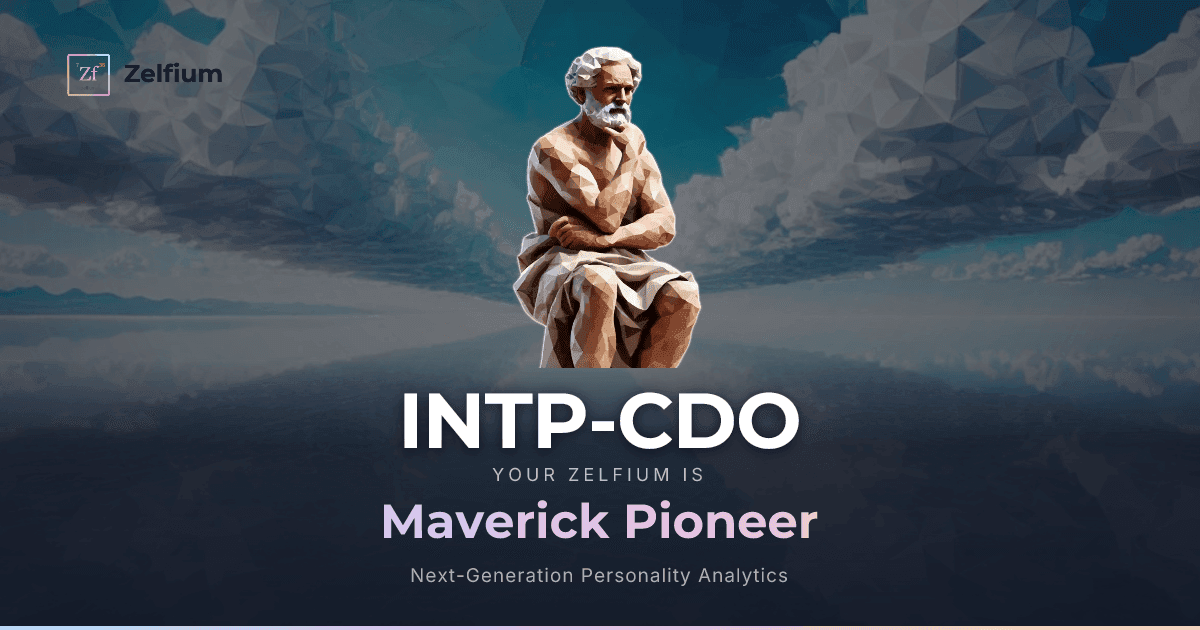
The Maverick Pioneer
The INTP-CDO is what happens when the Pioneer's architecture-building intellect acquires the Maverick's unshakable self-sovereignty. The INTP already operates at the frontier of thought — dismantling assumptions, constructing frameworks no one has imagined, pursuing the deep structure of things with a patience that borders on obsession. The CDO background amplifies this with three forces that together remove nearly every external brake on intellectual freedom: curiosity that treats the unknown as an invitation rather than a threat, detachment that renders social approval irrelevant to the direction of inquiry, and optimism that transforms even prolonged uncertainty into a kind of energizing adventure. The result is a thinker of extraordinary independence — someone who not only builds original frameworks but builds them on entirely self-determined terms, without reference to convention, consensus, or the comfort of having company. Where many brilliant minds are quietly tethered by the desire for recognition or the fear of isolation, the INTP-CDO has cut both ropes. This is intellectual sovereignty in its purest form — a mind that answers to nothing but the logic it has personally verified and the questions it has personally chosen.
The INTP's four dimensions — introversion, openness, thinking, and pioneering — create a mind designed for deep, solitary construction. The CDO's three dimensions — curiosity, detachment, and optimism — create an inner life characterized by fearless exploration, radical independence, and an unshakable confidence that the journey will prove worthwhile. When these two layers merge, something formidable emerges: the theorist who needs nothing from the world except the freedom to think.
The most striking amplification is the triple reinforcement of intellectual independence. The INTP's introversion already provides distance from social noise. The INTP's thinking already prioritizes logic over social comfort. And the CDO's detachment completes the insulation — removing even the residual desire for intellectual companionship that many introverted thinkers retain. The INTP-CDO can operate in complete intellectual solitude not just comfortably but productively, pursuing lines of inquiry so unconventional that no existing community of thought would recognize them as legitimate. This is both the type's greatest power and its most characteristic risk.
The interaction between openness and curiosity creates an exploratory drive of almost frightening scope. Openness generates abstract hypotheses across every domain; curiosity refuses to let any hypothesis go untested. Together, they produce a mind that is perpetually in motion across the landscape of ideas — not scattered, but systematically probing every frontier that the pattern-recognition engine identifies as promising. The CDO's optimism prevents this restless exploration from becoming anxious or compulsive. "I have not found the answer yet" registers not as failure but as an open question still worth holding — a rare emotional stance that allows the INTP-CDO to sustain inquiry across years without the corrosive doubt that forces many thinkers to settle for adequate answers before they have reached the right ones.
The most distinctive interaction is between pioneering and the CDO's detachment-optimism combination. Pioneering resists closure and craves freedom. Detachment removes the social cost of exercising that freedom. Optimism removes the emotional cost. The result is a mind with almost no internal resistance to following an idea wherever it leads — even when "wherever it leads" means years of solitary work on a problem no one else considers important. This is the engine that produces genuinely original thought, and the INTP-CDO possesses it in an unusually pure form.
The INTP-CDO possesses an extraordinary capacity for original thinking. The triple insulation from external influence — introversion from social noise, thinking from emotional pressure, detachment from the need for approval — means that ideas are shaped entirely by their own internal logic rather than by what is fashionable, fundable, or socially legible. This is the mind that produces the insight everyone else arrives at twenty years later.
There is also a remarkable endurance for uncertainty. Many thinkers are driven to premature conclusions by the discomfort of not knowing. The INTP-CDO's combination of pioneering openness and CDO optimism creates a genuinely comfortable relationship with the unknown. Uncertainty is not a problem to be eliminated but a space to be inhabited — and inhabited productively, because the INTP-CDO is actively building within it rather than anxiously waiting for it to resolve.
Finally, the CDO's self-sufficiency gives the INTP's work a structural resilience that externally motivated work cannot match. The INTP-CDO does not abandon a promising line of inquiry because funding dried up, because the intellectual fashion shifted, or because colleagues lost interest. The motivation is internal, the validation is internal, and the persistence is therefore independent of circumstance. This is how the most important intellectual work in history has always been done — by minds that could sustain conviction in the absence of external reinforcement.
The central tension in the INTP-CDO is the risk that self-sovereignty becomes self-enclosure. The combination of introversion, thinking, and detachment creates such effective insulation from external input that the INTP-CDO can gradually lose access to the corrective friction that even the most independent mind needs. Blind spots accumulate. Assumptions that were once provisional harden into axioms because no one is present to challenge them. The intellectual sovereignty that enables original thought can, over years, become a closed system — internally consistent but disconnected from the reality it was meant to describe. The most dangerous version of this is invisible to the person experiencing it, because every quality that would trigger a course correction — social feedback, emotional discomfort, doubt — has been systematically neutralized by the combination itself.
A second tension exists between pioneering's resistance to completion and the CDO's optimism, which together can produce an indefinite deferral of finished work. Pioneering says "the framework is not complete yet." Optimism says "there is no rush — it will come together." Detachment says "I do not need anyone else to validate its current state." Without any force in the system pushing toward publication, delivery, or practical application, the INTP-CDO can spend extraordinary periods building something that never leaves the workshop. The work may be brilliant, but brilliance that is never shared is brilliance that changes nothing.
There is also the tension of emotional thinness. Detachment and optimism together create a very stable but potentially narrow emotional range. The INTP-CDO rarely panics, rarely despairs, and rarely feels overwhelmed — but this composure can come at the cost of emotional depth. Experiences that would profoundly move most people — loss, intimacy, the vulnerability of being truly known — may be processed with such efficiency that their transformative potential is never realized. Growth is not always comfortable, and a system designed to minimize discomfort may inadvertently minimize growth.
Growth for the INTP-CDO is not about abandoning sovereignty or seeking external validation. It is about building deliberate channels for the kinds of input that sovereignty alone cannot provide. The most important of these is exposure to minds that operate on fundamentally different assumptions — not for the sake of compromise, but for the calibration that only genuine intellectual friction can produce. Equally important is the discipline of finishing and releasing work while it still feels incomplete. The INTP-CDO's standards are high enough that nothing will ever feel finished; learning to ship at "defensible" rather than "perfect" is the pragmatic skill that converts private brilliance into public contribution. And beneath both of these lies the deeper invitation: to allow something — a relationship, an experience, a vulnerability — to penetrate the well-constructed independence and reveal what sovereign thinking alone cannot discover. The bedrock of the self is firm enough. The question is whether something surprising can be allowed to grow upon it.
The INTP-CDO portrait drawn here is the "pure form" — what emerges when every pole swings fully in this direction. In reality, each of your dimensions carries a different intensity, and at every intersection, a unique chemistry unfolds. Even a slight tilt in one dimension creates an entirely different internal dynamic — that is the resolution of Zelfium's 7-dimension model.
Zelfium measures each of 36 facets on a 6-point scale. The number of possible patterns:
6³⁶
possible patterns
vs all humans ever born
880 trillion ×
~117 billion humans have ever lived — repeat that 880 trillion times and you still can't fill every pattern
vs stars in the observable universe
~50,000 ×
~200 sextillion stars in the observable universe — still not enough
vs grains of sand on Earth
~1 billion ×
~7.5 quintillion grains of sand — multiply by a billion
vs current world population
~1.3 quintillion ×
Line up 1.3 quintillion copies of today's 8 billion people to fill every type
More than 50,000 times the number of every star in the observable universe. That is the resolution of your personality.
So don't fit yourself into this description too tightly. INTP-CDO is a compass showing the direction your personality leans — not a box that defines everything you are. The pattern woven by your 36 facets is singular in this universe. To discover that one-of-a-kind blend — to find your own INTP-CDO — take the assessment.