
Loading...
Loading...
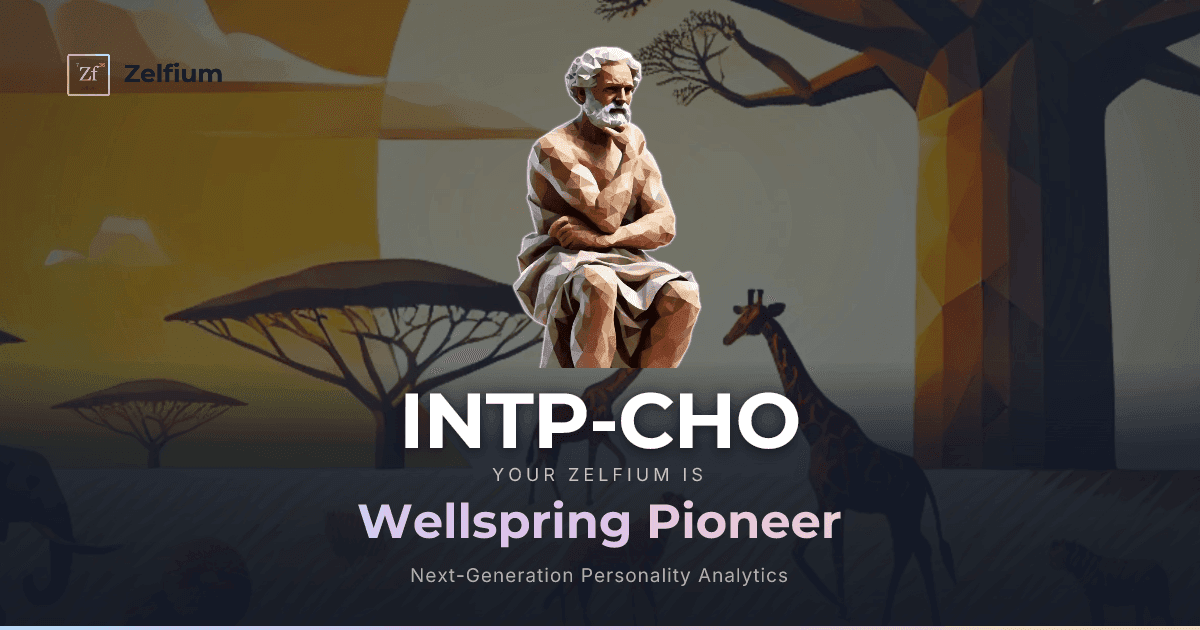
The Wellspring Pioneer
Something rare happens when the INTP's solitary architecture-building mind meets the CHO's irrepressible wellspring of shared discovery. The Pioneer typically constructs invisible frameworks in silence — dismantling assumptions, testing logical scaffolds, pursuing the question behind the question. But the CHO background floods that inner workshop with a warmth and outward momentum that the INTP alone would never generate. Curiosity amplifies openness into something nearly unstoppable, harmony pulls the theorist's gaze toward people, and optimism ensures that the whole enterprise — even the failures, even the dead ends — feels like a worthwhile adventure rather than a grinding obligation. The result is a thinker who does not merely see deep structures but wants to bring others along for the discovery. Where the pure INTP might publish a paper and walk away, the INTP-CHO stays to explain it, to see the light go on in someone else's eyes, and to feel the particular satisfaction that comes from making the invisible visible to people who needed to see it. This is not extroversion grafted onto introversion. It is generativity — the drive to create things that keep producing value long after the creator has moved on.
The INTP's four dimensions — introversion, openness, thinking, and pioneering — create a mind that retreats into solitude to build conceptual worlds. The CHO's three dimensions — curiosity, harmony, and optimism — create an inner life oriented toward shared exploration, emotional attunement, and an almost buoyant confidence that things will work out. When these two layers coexist, the solitary theorist acquires something unexpected: a generous momentum.
Introversion still sets the rhythm. The INTP-CHO needs quiet to think, space to build, time to follow ideas wherever they lead. But the CHO's harmonious dimension means the work never feels complete until someone else has been invited into it. There is no tension between building alone and sharing widely — for this combination, building is the private act, and sharing is the public completion of that act. The theory locked in a notebook feels unfinished; the theory explained over coffee feels alive.
The most amplifying interaction is between the INTP's openness and the CHO's curiosity. Both dimensions pull toward the unknown, but they pull differently. Openness is abstract and pattern-driven — it wants to see the structure beneath the surface. Curiosity is growth-driven and challenge-hungry — it wants to push past what was previously possible. Together, they create a double engine of exploration that is extraordinarily difficult to exhaust. The INTP-CHO can sustain intellectual inquiry at intensities that would burn out someone powered by only one of these forces, because when openness tires of a particular thread, curiosity finds a new one, and when curiosity scatters, openness pulls it back toward the deeper pattern.
The most surprising interaction, however, is between thinking and optimism. Thinking is rigorous, skeptical, and uninterested in comfort — it wants the correct answer, not the reassuring one. Optimism provides emotional ballast that allows thinking to operate at full intensity without collapsing into cynicism. Many analytical minds eventually become brittle, worn down by the relentless exposure to flaws and failures that clear-eyed thinking reveals. The CHO's optimism acts as a kind of emotional immune system — not by suppressing the awareness of problems, but by maintaining a deep-seated trust that problems are interesting rather than defeating. This is what keeps the INTP-CHO's intellectual fire burning decade after decade when other brilliant minds have quietly gone dark.
The INTP-CHO possesses an unusual capacity to make difficult ideas accessible without dumbing them down. The INTP's pattern recognition identifies the deep structure; the CHO's harmony ensures the explanation is delivered with genuine care for the listener's comprehension. The result is not simplification but translation — rendering complex truths in forms that others can use without losing the complexity that makes them true.
There is also a distinctive resilience to intellectual failure. Pioneering's love of exploration, amplified by CHO's optimism, means that dead ends are experienced as redirections rather than defeats. The INTP-CHO iterates faster and with less emotional friction than most thinkers because the cost of being wrong is subjectively low — it is simply the price of the next interesting discovery.
Perhaps most importantly, the CHO's generous momentum ensures that the INTP's best ideas actually reach the world. Many brilliant theoretical minds produce insights that die in notebooks. The INTP-CHO's harmonious drive to share, combined with curiosity's infectious energy and optimism's forward-facing confidence, creates a natural distribution channel for ideas that deserve to travel far.
The central tension is between introversion's need for solitude and the CHO's pull toward people. The INTP requires extended quiet to do deep thinking. The CHO finds solitary discovery incomplete — something is missing until the insight has been offered to others and received. This creates an oscillation between deep withdrawal and enthusiastic engagement that can feel disorienting. The INTP-CHO may confuse the CHO's desire for shared discovery with a social need, overscheduling connection and then wondering why the thinking has gone shallow. Protecting solitude while honoring the impulse to share requires deliberate architectural choices — when to close the door, and when to open it — rather than letting mood dictate the rhythm.
A second tension lives between thinking's demand for correctness and optimism's instinct to keep moving forward. Thinking wants to get it right; optimism whispers that it does not need to be perfect yet. For most purposes, optimism's counsel is healthy — it prevents the perfectionism that paralyzes many INTPs. But occasionally, it allows the INTP-CHO to release work before it has been fully stress-tested, trading rigor for momentum. The challenge is learning which projects demand the INTP's exacting standards and which benefit from the CHO's "good enough to share now" instinct.
There is also the risk that the CHO's harmony, with its deep attunement to others, can subtly redirect the INTP's intellectual agenda toward questions that are socially rewarding rather than fundamentally important. The INTP's greatest contributions come from pursuing problems that no one else has noticed. The CHO's warmth can, if unchecked, steer the mind toward problems that everyone has noticed — because those are the ones where sharing the solution produces the most immediate human connection. Maintaining the discipline to follow the quiet, asocial questions alongside the socially resonant ones is essential for the INTP-CHO to reach full depth.
Growth for the INTP-CHO is not about choosing between solitude and connection, or between rigor and generosity. It is about building a life architecture that sequences these forces rather than blending them into a compromised middle. The deepest thinking happens alone; the deepest satisfaction happens when that thinking is shared. The sharpest analysis demands full skepticism; the most enduring creative energy demands a wellspring of trust that the work is worth doing. The INTP-CHO who learns to move between these modes intentionally — entering solitude fully, emerging to share fully, and not apologizing for either — discovers that the generative impulse is not a distraction from intellectual depth but its most powerful amplifier. Ideas that are built to be shared are built more carefully than ideas built only for oneself.
The INTP-CHO portrait drawn here is the "pure form" — what emerges when every pole swings fully in this direction. In reality, each of your dimensions carries a different intensity, and at every intersection, a unique chemistry unfolds. Even a slight tilt in one dimension creates an entirely different internal dynamic — that is the resolution of Zelfium's 7-dimension model.
Zelfium measures each of 36 facets on a 6-point scale. The number of possible patterns:
6³⁶
possible patterns
vs all humans ever born
880 trillion ×
~117 billion humans have ever lived — repeat that 880 trillion times and you still can't fill every pattern
vs stars in the observable universe
~50,000 ×
~200 sextillion stars in the observable universe — still not enough
vs grains of sand on Earth
~1 billion ×
~7.5 quintillion grains of sand — multiply by a billion
vs current world population
~1.3 quintillion ×
Line up 1.3 quintillion copies of today's 8 billion people to fill every type
More than 50,000 times the number of every star in the observable universe. That is the resolution of your personality.
So don't fit yourself into this description too tightly. INTP-CHO is a compass showing the direction your personality leans — not a box that defines everything you are. The pattern woven by your 36 facets is singular in this universe. To discover that one-of-a-kind blend — to find your own INTP-CHO — take the assessment.