

Loading...
Loading...
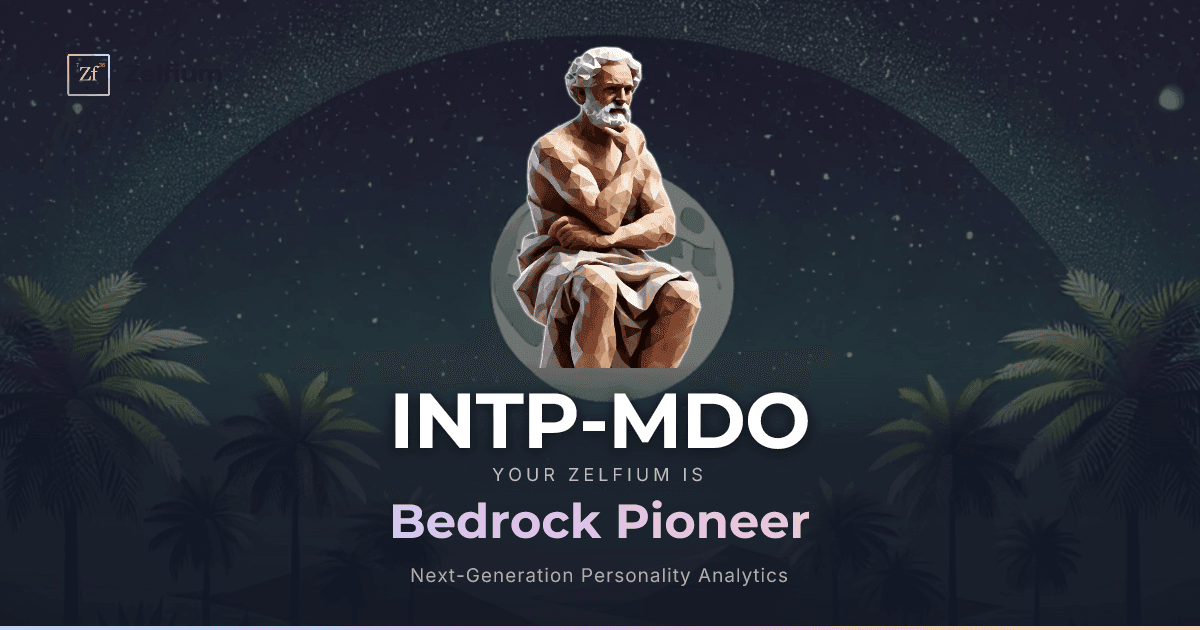
The Bedrock Pioneer
The INTP-MDO is a rare marriage of intellectual audacity and structural permanence. The Pioneer's mind — built for dismantling the obvious, constructing frameworks from first principles, and following ideas wherever they lead — meets the Bedrock's inner world, where proven methods are honored, independent judgment is the only compass worth trusting, and a deep-rooted confidence ensures that uncertainty never becomes anxiety. The result is a thinker who builds with the ambition of an architect and the patience of a stonemason. Where the pure INTP might produce a brilliant insight and immediately pivot to the next interesting question, the INTP-MDO stays — not because the next question lacks appeal, but because an unfinished foundation offends something deep in the system. This type builds frameworks meant to endure, validates them with independent rigor, and does so with a composure that makes the entire process look effortless — though it is anything but. The INTP-MDO does not seek recognition for the work. The work exists, it holds, and that is sufficient. This is the Pioneer who builds monuments, not experiments.
The INTP's four dimensions — introversion, openness, thinking, and pioneering — create a mind designed for original theoretical construction. The MDO's three dimensions — maintaining, detachment, and optimism — create an inner life characterized by commitment to depth, radical self-sufficiency, and a steady confidence that effort will produce results. When these layers merge, the restless theorist becomes something more grounded: a thinker who retains the capacity for original insight but channels it through a discipline that ensures the insight is completed, verified, and built to last.
The most stabilizing interaction is between pioneering and the MDO's maintaining-optimism combination. Pioneering is the dimension that keeps the INTP in perpetual motion — resisting closure, craving freedom, abandoning projects when the initial intellectual excitement fades. Maintaining provides the counterweight: a deep respect for what has been built and a reluctance to discard it. Optimism adds the crucial lubricant: "this project will come together; it is worth staying with." Together, these forces do not eliminate the Pioneer's restlessness, but they give it a constructive channel. Instead of starting ten projects and finishing none, the INTP-MDO is more likely to start three and finish the one that matters most — because the MDO's patience allows the deeper value of completion to become visible.
The interaction between thinking and detachment creates an analytical partnership of striking purity. Both dimensions value objectivity. Both are indifferent to social approval. Both will follow evidence wherever it leads without flinching. In the INTP-MDO, this creates a mind that is almost entirely immune to intellectual fashion — uninfluenced by what is popular, unfazed by what is controversial, and unconcerned with whether the conclusions are comfortable for anyone, including the thinker. This is pure analytical sovereignty, and it is the engine that produces the INTP-MDO's most original and most durable work.
The interaction between openness and maintaining is where the INTP-MDO's distinctive quality emerges most clearly. Openness generates far-reaching hypotheses and novel frameworks. Maintaining subjects them to a practical test: does this build on what is already known? Is it an improvement, or merely a novelty? The result is a thinker who produces fewer ideas than a pure INTP but whose ideas have a structural integrity that withstands scrutiny. Where other INTPs scatter seeds broadly, the INTP-MDO plants fewer but tends them to maturity.
The INTP-MDO possesses an exceptional capacity for building intellectual work that endures. The combination of the INTP's originality, maintaining's commitment to depth, detachment's immunity to external distortion, and optimism's patient confidence produces frameworks that are both genuinely novel and structurally sound. This type does not produce fashionable insights — it produces the kind of work that people discover decades later and find still holds.
There is also a remarkable self-sufficiency that makes the INTP-MDO unusually resilient in environments where external support is absent. Motivation is internal. Validation is internal. Standards are internal. The INTP-MDO can sustain intellectual effort for years without encouragement, feedback, or recognition — not because these things are unwanted, but because the internal system generates enough fuel on its own. This is the thinker who continues working on a problem long after everyone else has declared it unsolvable, and who eventually solves it alone.
Finally, the MDO's optimism gives the INTP's analytical mind an emotional durability that many pure INTPs lack. Clear-eyed analysis is inherently confrontational — it reveals problems, exposes flaws, and strips away comforting illusions. Without emotional ballast, this process eventually produces either cynicism or burnout. The MDO's deep confidence that things will work out — not naively, but as a genuine assessment rooted in self-trust — prevents both outcomes. The INTP-MDO can look at hard truths without being consumed by them, which is a rarer capacity than it appears.
The central tension in the INTP-MDO is between the INTP's need for intellectual novelty and the MDO's pull toward consolidation. Openness wants to explore new territory. Maintaining wants to deepen existing territory. Pioneering wants to start fresh. Optimism says "what you have is already working." This creates a characteristic pattern: the INTP-MDO may stay in a productive groove for long periods — years, even — refining and extending existing work with great competence, while the Pioneer inside grows increasingly restless. When the restlessness finally breaks through, the shift can be abrupt and disorienting, as the thinker suddenly abandons a well-developed domain for something entirely new. The people around the INTP-MDO, who had come to rely on the consistency, may find this bewildering. But for the INTP-MDO, the departure was inevitable — the Pioneer simply reached the point where even maintaining's patience could no longer contain the need for fresh intellectual terrain.
A second tension exists between detachment and the fact that the INTP-MDO, like all humans, needs connection — even if every internal signal suggests otherwise. Introversion provides distance. Detachment provides comfort with that distance. Maintaining provides routines that fill the space where relationships might be. Optimism provides confidence that everything is fine as it is. This coalition of forces can produce a life that is impressively productive and quietly lonely — not painfully lonely, but lonely in the sense that the INTP-MDO may arrive at a moment of real accomplishment and find no one nearby who shared the journey, understood the work, or can appreciate what it cost.
There is also the subtle tension between optimism and responsiveness's absence. The MDO carries optimism rather than responsiveness — confidence rather than vigilance. This means the INTP-MDO is less likely to detect emerging problems in relationships, in health, or in the assumptions underlying the work itself. The lack of an early-warning system is compensated by composure, but composure and awareness are not the same thing. Things can deteriorate for some time before the INTP-MDO notices, simply because the default assumption is that things are fine.
Growth for the INTP-MDO is not about becoming less independent or less patient. It is about recognizing that even the most self-contained system benefits from inputs it did not generate itself. The most important growth edge is the deliberate cultivation of relationships that provide honest external perspective — not for emotional support, though that may also be valuable, but for the calibration that only a different mind can offer. The INTP-MDO's work is strong precisely because it is built on independent assessment. But independent assessment has characteristic blind spots, and the only way to discover them is through exposure to perspectives that the system would not have produced on its own. Equally important is the practice of periodic reassessment: examining whether the established approaches still deserve their position, or whether maintaining has silently converted a provisional choice into an unexamined habit. The Bedrock does not need to become fluid. But even bedrock benefits from the occasional survey — to confirm that it is still where it needs to be, and that what has been built upon it is still worth building.
The INTP-MDO portrait drawn here is the "pure form" — what emerges when every pole swings fully in this direction. In reality, each of your dimensions carries a different intensity, and at every intersection, a unique chemistry unfolds. Even a slight tilt in one dimension creates an entirely different internal dynamic — that is the resolution of Zelfium's 7-dimension model.
Zelfium measures each of 36 facets on a 6-point scale. The number of possible patterns:
6³⁶
possible patterns
vs all humans ever born
880 trillion ×
~117 billion humans have ever lived — repeat that 880 trillion times and you still can't fill every pattern
vs stars in the observable universe
~50,000 ×
~200 sextillion stars in the observable universe — still not enough
vs grains of sand on Earth
~1 billion ×
~7.5 quintillion grains of sand — multiply by a billion
vs current world population
~1.3 quintillion ×
Line up 1.3 quintillion copies of today's 8 billion people to fill every type
More than 50,000 times the number of every star in the observable universe. That is the resolution of your personality.
So don't fit yourself into this description too tightly. INTP-MDO is a compass showing the direction your personality leans — not a box that defines everything you are. The pattern woven by your 36 facets is singular in this universe. To discover that one-of-a-kind blend — to find your own INTP-MDO — take the assessment.