

Loading...
Loading...
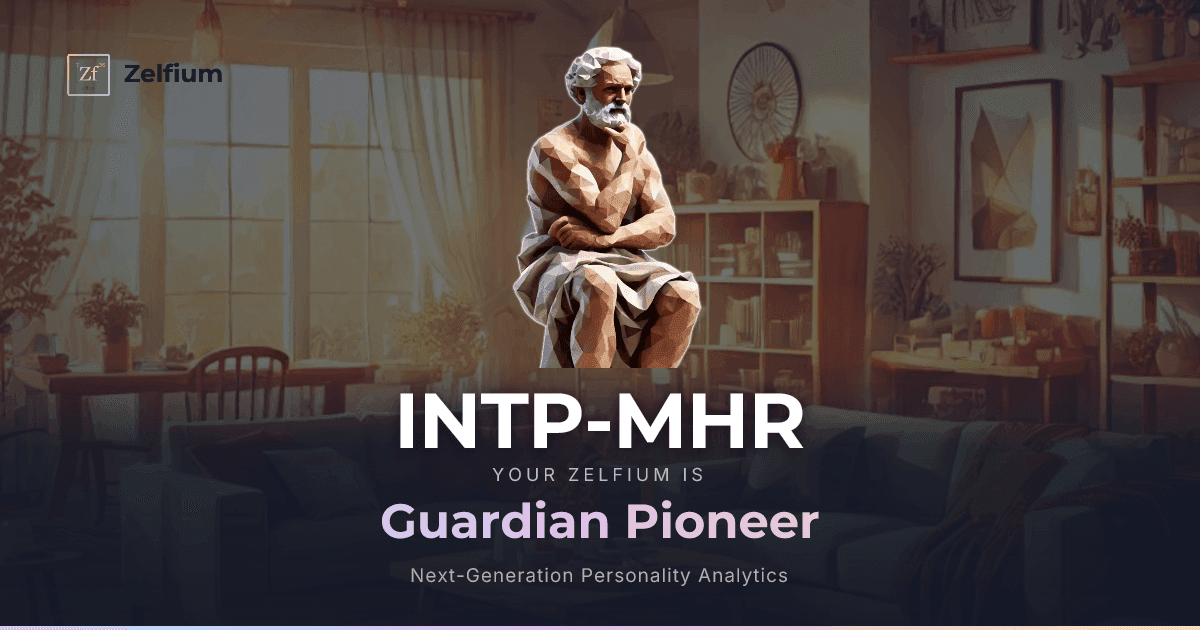
The Guardian Pioneer
The INTP-MHR is a study in productive paradox. The Pioneer's mind — restless, theoretical, drawn to the question behind the question — meets the Guardian's inner world, where continuity is sacred, people matter deeply, and the faintest sign of trouble triggers an involuntary alert. The INTP builds invisible architectures; the MHR stands guard over what already exists. In most people, these orientations would pull in opposite directions: one toward the unknown, the other toward the familiar. But in the INTP-MHR, they reach an unusual synthesis. The frameworks this type constructs are not built for their own sake or for the thrill of novelty — they are built to protect, to strengthen, and to make the things that matter more resilient. Where the pure INTP might pursue abstraction for its beauty, the INTP-MHR pursues abstraction for its utility: the theory that explains why a system is failing, the framework that reveals which relationship needs attention, the pattern recognition that spots danger before it arrives. This is the Pioneer who builds not to explore but to shelter — and who does so with a depth of care that the analytical exterior rarely reveals.
The INTP's four dimensions — introversion, openness, thinking, and pioneering — create a mind oriented toward solitary construction of novel frameworks. The MHR's three dimensions — maintaining, harmony, and responsiveness — create an inner world oriented toward preservation, relational depth, and acute sensitivity to emerging threats. When these two layers meet, something unexpected appears: the theoretical mind that builds not for the frontier but for the home.
The most paradoxical interaction is between the INTP's openness and the MHR's maintaining dimension. Openness pulls toward novelty, abstraction, and the unexplored. Maintaining values continuity, proven methods, and the accumulated wisdom of experience. In many people, these would produce simple conflict — a desire for the new constantly frustrated by an attachment to the old. In the INTP-MHR, they produce something more sophisticated: an openness that is channeled toward improving what exists rather than replacing it. The INTP-MHR does not innovate for innovation's sake. This type innovates to solve specific problems within established systems — finding the theoretical insight that makes a familiar structure work better, revealing the hidden pattern that explains why a trusted method sometimes fails.
The interaction between thinking and harmony creates the INTP-MHR's most distinctive quality: analytical empathy. Thinking demands logical rigor and objectivity. Harmony attunes the entire system to other people's emotional states. In the INTP-MHR, these do not compete — they specialize. Harmony detects the signal: someone is struggling, a relationship is under strain, a group dynamic is shifting. Thinking then analyzes the signal: what is the structural cause, what are the leverage points, what intervention would address the root rather than the symptom? The result is a form of caring that is both precise and deep — the person who notices that a friend is struggling and then quietly works out exactly why, arriving with not just concern but a genuine understanding of the problem's architecture.
Responsiveness amplifies this entire system. The MHR's sensitivity to risk operates like a high-resolution scanner, constantly monitoring for threats to the things and people the INTP-MHR has decided matter. Combined with the INTP's pattern recognition and pioneering's open-ended vigilance, this produces someone who detects emerging problems with extraordinary accuracy — often well before the people involved have noticed anything themselves.
The INTP-MHR possesses a rare capacity to diagnose relational and systemic problems with both precision and genuine care. Where most analytical minds keep emotional data at arm's length, the INTP-MHR integrates it directly into the diagnostic process. The result is someone trusted by both the analytical minds who value accuracy and the emotionally attuned minds who value being understood — because the INTP-MHR delivers both simultaneously.
There is also an unusual talent for preventive thinking. The combination of maintaining's protective instinct, responsiveness's early-warning sensitivity, and the INTP's framework-building capacity means this type does not merely react to problems — it anticipates them, builds mental models of how they will develop, and often takes quiet preventive action before anyone else has registered that something needs attention. The INTP-MHR is the person who fixed the foundation crack six months before the building would have shown visible damage.
Finally, the MHR background gives the INTP's intellectual work a depth of purpose that pure curiosity cannot provide. When frameworks are built not for intellectual satisfaction alone but to protect people and preserve what matters, the motivation has an endurance that novelty-seeking cannot match. The INTP-MHR may not produce the most glamorous theoretical work, but it often produces the most useful — the kind that people return to again and again because it genuinely helps.
The deepest tension in the INTP-MHR is between pioneering's desire for freedom and the MHR's gravitational pull toward responsibility. Pioneering wants to explore, to follow ideas wherever they lead, to resist obligation. Maintaining says "stay and protect what you have built." Harmony says "the people who depend on you need you present." Responsiveness adds urgency: "something might go wrong if you leave." This creates a powerful inward pull that can feel like a leash on the Pioneer's freedom. The INTP-MHR may carry a quiet resentment toward obligations that are genuinely chosen and valued, simply because the pioneering dimension experiences any constraint as confinement — even when the constraint comes from love.
A second tension lives between openness's pull toward the abstract and maintaining's preference for the concrete. The INTP-MHR may feel torn between the desire to pursue a purely theoretical question — the kind of intellectual exploration that has no practical application but is deeply satisfying — and the MHR's insistence that thinking should serve something real. When maintaining wins too often, the INTP's creative range narrows. When openness wins too often, the MHR's protective mandate goes unfulfilled. Neither side should dominate permanently, but the negotiation between them is ongoing and not always comfortable.
There is also the compounding effect of responsiveness and introversion. Both create a rich inner world — responsiveness fills it with perceived threats and emotional data, while introversion processes everything deeply. The INTP-MHR can develop an exhausting internal landscape: an analytical mind that cannot stop scanning for problems, cannot stop modeling worst-case scenarios, and cannot easily share the burden of this vigilance because introversion makes it difficult to articulate what is being carried. The weight is invisible to others, which means it is rarely shared.
Growth for the INTP-MHR is not about choosing between exploration and protection, or between theory and care. It is about recognizing that the Pioneer and the Guardian serve the same purpose from different angles — both are trying to make the world more intelligible and more safe. The frameworks built in solitude and the relationships tended with quiet devotion are not competing interests; they are two expressions of the same deep commitment to getting things right. The practical growth edge is learning to externalize the vigilance — to tell a trusted person "here is what I am worried about" rather than carrying the full weight of the early-warning system alone. Sharing the scan does not weaken the scanner. It allows the INTP-MHR to distinguish between genuine threats that deserve analytical attention and phantom threats generated by responsiveness running at full sensitivity without rest. The vigilant mind that learns to occasionally set down its watch discovers that the things it has been protecting are stronger than it feared — and that it has earned the right to rest among them.
The INTP-MHR portrait drawn here is the "pure form" — what emerges when every pole swings fully in this direction. In reality, each of your dimensions carries a different intensity, and at every intersection, a unique chemistry unfolds. Even a slight tilt in one dimension creates an entirely different internal dynamic — that is the resolution of Zelfium's 7-dimension model.
Zelfium measures each of 36 facets on a 6-point scale. The number of possible patterns:
6³⁶
possible patterns
vs all humans ever born
880 trillion ×
~117 billion humans have ever lived — repeat that 880 trillion times and you still can't fill every pattern
vs stars in the observable universe
~50,000 ×
~200 sextillion stars in the observable universe — still not enough
vs grains of sand on Earth
~1 billion ×
~7.5 quintillion grains of sand — multiply by a billion
vs current world population
~1.3 quintillion ×
Line up 1.3 quintillion copies of today's 8 billion people to fill every type
More than 50,000 times the number of every star in the observable universe. That is the resolution of your personality.
So don't fit yourself into this description too tightly. INTP-MHR is a compass showing the direction your personality leans — not a box that defines everything you are. The pattern woven by your 36 facets is singular in this universe. To discover that one-of-a-kind blend — to find your own INTP-MHR — take the assessment.