Loading...
Loading...
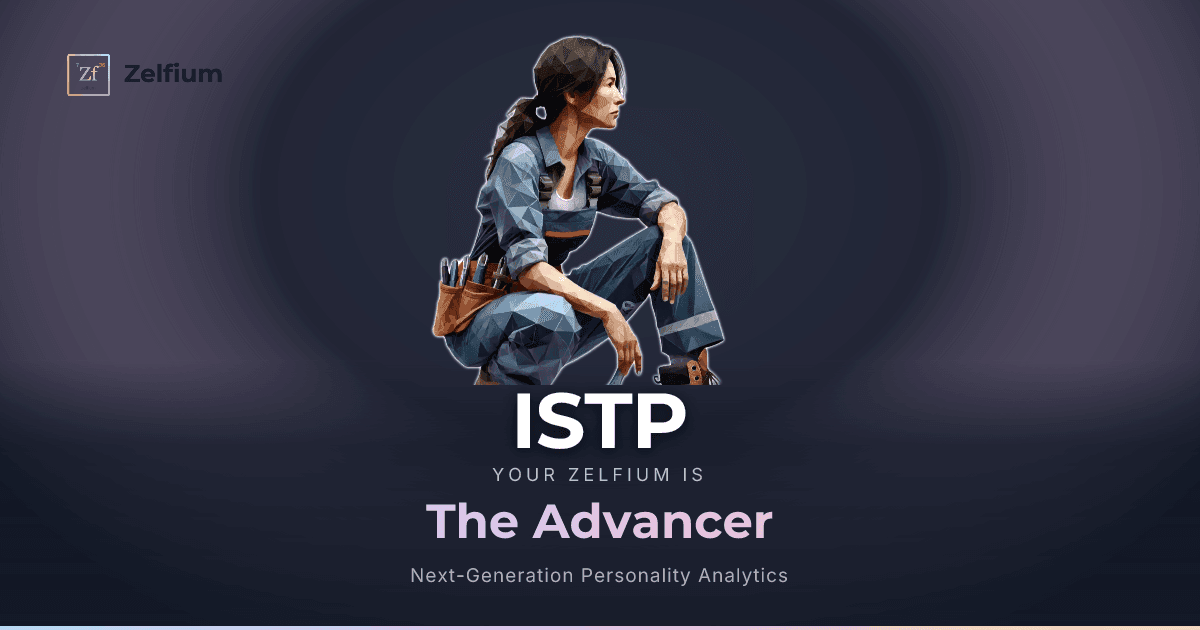
The Advancer
The ISTP pattern is defined by four fundamental orientations that shape how a person experiences and moves through the world. The I stands for Introverted, meaning energy is drawn from the inner world of thought and reflection rather than from external stimulation. The S stands for Sensory, reflecting a deep attunement to concrete reality — what can be seen, touched, measured, and verified through direct experience. The T stands for Thinking, pointing to a natural reliance on logic and objective analysis when making decisions. And the P stands for Pioneering, capturing a preference for flexibility, spontaneity, and the freedom to respond to situations as they unfold rather than following predetermined plans. Together, these dimensions create someone who is quietly masterful with the physical world — a person who observes carefully, understands how systems actually work, and intervenes with precision when the moment calls for it. People with this combination are at their best when working with their hands, solving tangible problems, and maintaining the independence to approach challenges in their own way. Whether troubleshooting machinery, navigating a crisis, or mastering a craft, the ISTP's blend of calm analysis and adaptive action makes them remarkably effective in situations that would overwhelm others.
The same 4-letter type produces 8 distinct profiles depending on the remaining 3 dimensions.
Extraverted / Introverted
The ISTP's richest experiences happen on the inside. While many people recharge through social activity and external engagement, someone with this orientation finds the deepest clarity and energy in solitude — in the quiet space where observation, tinkering, and processing can happen at a natural pace. This is not shyness, and it is not a social limitation. It is the architecture of how an ISTP engages with reality. Deep processing requires space.
When stepping into social settings, this type brings something most people cannot: an extraordinary quality of attention. ISTPs notice what others miss — the slight shift in someone's expression, the detail that does not quite fit, the mechanical sound that signals a problem no one else has caught. Their observations are precise because the mind is not scattered across a dozen superficial interactions. It is focused, patient, and remarkably perceptive.
The challenge is not about becoming more outgoing. It is about finding environments and relationships that recognize the value of quiet presence rather than mistaking it for disengagement. The people who truly know an ISTP understand that silence is not absence — it is attention. And when words do come, they carry the weight of genuine thought behind them.
OpeN / Sensory
ISTPs live in the real world, and they live in it fully. Where others drift into abstractions and hypotheticals, this type stays grounded in what is actually happening — the texture of materials, the behavior of systems, the lessons that experience has written into body and mind. This is not a lack of imagination. It is a different kind of intelligence, one rooted in direct engagement with physical reality.
People with this orientation notice details that dreamers overlook. They remember how things have been done before and, more importantly, why those methods work. The ISTP's respect for proven approaches is not rigidity — it is an acknowledgment that the accumulated wisdom of practice deserves to be taken seriously. When building something, fixing something, or navigating a challenging situation, this type draws on a deep reservoir of hands-on knowledge that no amount of theorizing can replace.
This practical mastery is an anchor for any team or community. The growth edge is not about becoming more creative or visionary. It is about occasionally loosening the grip on "how things have always been done" and asking, "What if there were another way?" Not to replace practicality, but to expand it — to let grounded intelligence reach into territories it has not yet explored.
Thinking / Feeling
Logic is not merely a tool the ISTP uses — it is the lens through which the world is naturally understood. When facing a decision, someone with this pattern instinctively looks for structure: What are the variables? Where are the tradeoffs? What does the evidence actually show? There is a deep satisfaction in taking something messy and ambiguous and distilling it down to its essential components.
ISTPs are drawn to frameworks that explain not just individual situations but entire categories of problems. They can hold multiple layers of complexity in mind simultaneously without losing the thread. Others may sometimes perceive this type as detached or unemotional, but the truth is that caring runs deep — it is simply expressed through clarity rather than sentiment. The ISTP's commitment to intellectual honesty means choosing what is correct over what is comfortable, even when that is the harder path.
The area worth exploring is this: some of life's most important decisions — whom to trust, what to value, when to let go — do not yield cleanly to analysis. Giving intuition and emotion a seat at the decision-making table does not weaken logic. It completes it. The sharpest analytical minds become even sharper when they learn to read the signals that logic alone cannot capture.
Judging / Pioneering
Freedom is not a preference for the ISTP — it is a necessity. Something fundamental inside this type resists being locked into someone else's schedule, bound by someone else's rules, or confined to expectations that exist simply because they have always existed. There is an internal compass, and when it points somewhere, it is followed with striking intensity. When it is silent, inertia can take hold just as strongly.
ISTPs can shift from stillness to total immersion in an instant. When the right project or challenge captures their interest, all sense of time disappears. This is not laziness interrupted by bursts of productivity — it is a fundamentally different relationship with motivation itself. The originality, the refusal to be boxed in, the ability to see possibility where others see rules — these are genuine strengths.
The path forward is not about becoming more disciplined in the conventional sense. It is about building a personal kind of structure — one that serves the vision rather than constraining it. The goal is ensuring that the work that matters most does not depend entirely on the arrival of inspiration, while still preserving the spontaneity that makes this approach uniquely effective.
When introversion meets the sensory dimension, something remarkable emerges: a quiet mastery of the physical world. The ISTP does not need to announce competence — it becomes evident the moment hands meet a problem. While others talk about what might work, this type has already noticed the subtle clue that everyone else missed: the faint vibration that signals a worn bearing, the hairline crack in a weld, the slight asymmetry that reveals where a system is failing. Introverted depth gives the patience to observe, and sensory acuity gives something worth observing.
Add Thinking to this foundation, and the ISTP becomes more than an observer — a diagnostician emerges. Sensory perception captures the raw data; the analytical mind instantly organizes it into cause and effect. It is not just noticing that something is wrong — it is understanding why, and seeing the most efficient path to fixing it. This integration of perception and logic is what makes ISTPs extraordinarily effective in hands-on problem-solving.
The Pioneering dimension ensures that solutions are never merely by-the-book. This type adapts, improvises, and finds the approach that fits the specific situation rather than defaulting to a standard procedure. The mastery is alive and responsive, not mechanical.
The intersection of Thinking and Pioneering gives the ISTP a distinctive cognitive style that might be called logical improvisation. Rather than planning extensively and then executing, the analytical engine runs in real time, making optimal decisions as situations unfold. In a crisis, this capacity is unmistakable. While others freeze or panic, the ISTP is calmly reading variables, calculating tradeoffs, and selecting the most rational course of action. This ability to think on one's feet is a form of living intelligence that no amount of advance planning can replicate.
The sensory and pioneering dimensions together shape how ISTPs learn. They reach for the thing itself before reaching for the manual. They disassemble, experiment, and test — building understanding inductively from direct experience. This process may look inefficient from the outside, but it produces an unusually deep form of knowledge: understanding that is anchored not in abstract theory but in the felt reality of one's own hands and senses. When something goes wrong, there is no consulting a reference — the body already knows. There is a physical certainty to ISTP problem-solving that sets it apart.
The combination of introversion and the pioneering spirit makes the ISTP a profoundly self-directed individual. People with this pattern navigate by their own internal rhythms and interests, moving freely through problems and projects in a way that is distinctly their own. Within a team, an ISTP may orbit like an independent satellite — not out of coldness, but because there is a clear understanding of how to contribute best. Given trust and autonomy, this type will quietly deliver results that exceed expectations.
The sensory and thinking dimensions shape a distinctive way of showing care. ISTPs demonstrate love through action rather than words. When someone they care about is struggling, the instinct is not to offer sympathetic phrases but to solve the concrete problem — to fix what is broken, to provide practical guidance, to be present and ready to act at the exact moment help is needed. This "love as action" can be hard to read for those who expect emotional expression, but those who understand it find the ISTP's presence deeply reassuring. Because words are offered sparingly, the ones that do come carry genuine weight, and actions are never performative.
Inside the ISTP, several productive tensions coexist. The sensory and thinking dimensions together create a sharp pragmatism — things are evaluated by whether they work. But that same pragmatism can sometimes process emotional nuance as inefficiency. When someone is upset for reasons that do not seem logical, the instinct to ask "why?" can itself become hurtful. Recognizing this does not require abandoning the analytical nature. It means expanding the scope of what the thinking lens can hold — redefining emotion not as a problem to be solved but as a reality to be honored.
The tension between introversion and the pioneering spirit also holds a key to growth. The deep need for autonomy and freedom is the wellspring of creativity and problem-solving power, but it can also create a gravitational pull away from sustained commitment — to a place, a relationship, a long-term project. There are moments when staying is not confinement but deepening, and discovering that distinction through experience opens the next stage of development.
When the sensory and pioneering dimensions resonate together, the ISTP becomes a master of the present moment. But that exceptional focus on the here and now can narrow the view of longer-term consequences. Today's problem is solved brilliantly while less thought goes to what that solution sets in motion three months from now. Cultivating the habit of asking "What happens next?" does not diminish practical intelligence — it amplifies it. When the master of the immediate also becomes a strategic thinker, the capacity to move forward becomes truly unstoppable.
The same 4-letter type produces 8 distinct profiles depending on the remaining 3 dimensions.
The ISTP portrait drawn here is the "pure form" — what emerges when every pole swings fully in this direction. In reality, each of your dimensions carries a different intensity, and at every intersection, a unique chemistry unfolds. Even a slight tilt in one dimension creates an entirely different internal dynamic — that is the resolution of Zelfium's 7-dimension model.
Zelfium measures each of 36 facets on a 6-point scale. The number of possible patterns:
6³⁶
possible patterns
vs all humans ever born
880 trillion ×
~117 billion humans have ever lived — repeat that 880 trillion times and you still can't fill every pattern
vs stars in the observable universe
~50,000 ×
~200 sextillion stars in the observable universe — still not enough
vs grains of sand on Earth
~1 billion ×
~7.5 quintillion grains of sand — multiply by a billion
vs current world population
~1.3 quintillion ×
Line up 1.3 quintillion copies of today's 8 billion people to fill every type
More than 50,000 times the number of every star in the observable universe. That is the resolution of your personality.
So don't fit yourself into this description too tightly. ISTP is a compass showing the direction your personality leans — not a box that defines everything you are. The pattern woven by your 36 facets is singular in this universe. To discover that one-of-a-kind blend — to find your own ISTP — take the assessment.