

Loading...
Loading...
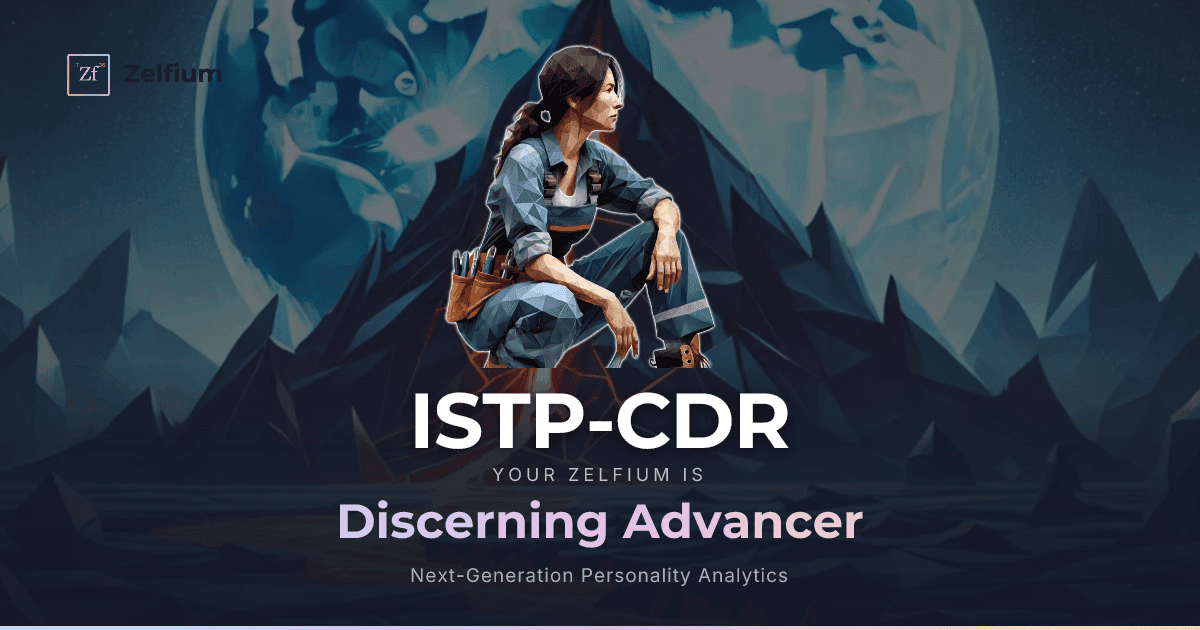
The Discerning Advancer
Some people fix things. The ISTP-CDR sees through things — and then fixes them with a precision that leaves no room for self-deception. This is what emerges when the ISTP's hands-on mastery, grounded in sensory reality and logical rigor, meets the CDR's discerning inner world, where relentless curiosity, intellectual independence, and acute sensitivity converge into a perceptual instrument of extraordinary resolution. The ISTP already notices what others miss — the misaligned component, the anomalous sound, the system behaving just slightly outside its normal parameters. The CDR background sharpens this perception into something almost uncomfortably precise, adding a curiosity that will not stop until root causes are identified, a detachment that refuses to accept comfortable explanations, and a responsiveness that registers the faintest signals of impending failure. The result is a diagnostician of rare depth — someone who trusts nothing at face value, verifies everything through direct experience, and acts only when understanding is complete. Where a pure ISTP solves the problem at hand, the ISTP-CDR solves the problem behind the problem, often alone, often before anyone else realized there was one.
The ISTP's four dimensions — introversion, sensory awareness, thinking, and pioneering — produce a mind that learns through contact and trusts what can be tested. The CDR's three dimensions — curiosity, detachment, and responsiveness — create an inner world that is fearlessly exploratory, fiercely independent, and perceptually attuned to threats and dissonances at a resolution most people never access. When these two layers coexist, the practical problem-solver becomes something more: a deeply autonomous investigator.
Introversion and detachment reinforce each other powerfully. The ISTP already operates best in solitude; the CDR's independence means that even the social pressure to conform or collaborate on someone else's terms has little hold. The ISTP-CDR does not merely prefer working alone — there is a genuine cognitive advantage in it. Without the distortion of group opinion or social performance, the analytical engine runs cleaner, the sensory data is purer, and conclusions reflect reality rather than consensus.
The CDR's curiosity transforms the ISTP's practical exploration into something more relentless. Where the ISTP is satisfied when something works, the CDR dimension insists on understanding why — and whether the working state conceals a deeper vulnerability. This curiosity is not abstract; it is applied directly to the tangible world the ISTP already inhabits. The result is someone who takes apart not just machines but assumptions, not just systems but the reasoning behind them.
The most charged interaction is between the ISTP's sensory groundedness and the CDR's responsiveness. The sensory dimension anchors perception in concrete reality — what can be seen, heard, measured. Responsiveness adds a layer of almost preternatural alertness to subtle shifts, emerging risks, and the faint signals that precede system failures. Together, these produce a diagnostic sensitivity that is both empirically grounded and intuitively sharp — the ability to feel that something is wrong and then prove it with evidence.
The ISTP-CDR possesses a diagnostic capacity that few combinations can rival. The sensory dimension captures the raw data — the sound, the texture, the deviation from baseline. Thinking organizes it into logical structure. Curiosity refuses to stop at the first plausible explanation. Detachment prevents emotional investment in any particular answer. And responsiveness catches the signals that have not yet crossed the threshold of conscious awareness. This five-layer diagnostic process produces assessments of startling accuracy.
There is also an integrity to the ISTP-CDR's work that earns a very particular form of trust. Because detachment prevents both social flattery and self-deception, and because the ISTP insists on verifying everything through direct experience, the conclusions reached are unusually reliable. People learn that when this type says something is sound, it has been tested — and when something is flagged as failing, it is time to pay attention. This trust is earned through accuracy, not warmth, and it is the kind of trust that holds up when everything else falls apart.
The pioneering dimension ensures that the ISTP-CDR's diagnostic precision does not calcify into rigidity. Solutions are adapted to circumstances, improvised when necessary, and always tested against reality rather than theory.
The deepest tension in the ISTP-CDR is the alliance between responsiveness and detachment that can produce a relentless internal critic. Responsiveness sees every flaw — in systems, in solutions, in the self. Detachment refuses to soften the assessment. The ISTP-CDR can experience a harsh inner landscape where nothing is ever quite good enough, where every fix reveals a new vulnerability, and where the same perceptual acuity that makes this type an exceptional diagnostician turns inward to produce an exhausting cycle of self-evaluation.
A second tension exists between curiosity and the ISTP's pragmatic efficiency. The thinking dimension wants the most direct solution. Curiosity wants to understand every contributing factor, every adjacent system, every historical precedent. The ISTP-CDR can find themselves caught between the urge to fix and the urge to fully understand — and since the CDR will not accept a fix that does not address root causes, the resolution phase can extend far beyond what the situation practically requires.
There is also the loneliness inherent in this combination. Introversion provides the solitude. Detachment removes the social cushioning. Responsiveness, paradoxically, keeps the emotional world vividly alive even while detachment keeps others at a distance. The ISTP-CDR can find themselves in the uncomfortable position of seeing human dynamics with painful clarity while lacking — or deliberately maintaining — the distance that prevents full participation in them.
Growth for the ISTP-CDR is not about becoming more trusting or more open. It is about learning that the same perceptual precision that detects flaws can also be trained to detect what is working — and to let that detection register with the same weight. The diagnostic lens is extraordinary; the growth edge is choosing, sometimes, to turn it toward what is sound rather than what is broken. There is also the recognition that not every insight needs to be processed in solitude. The CDR's independence is genuine and valuable, but some forms of understanding — about oneself, about the meaning of work, about what makes effort worthwhile — emerge only in the presence of a trusted other. Inviting one person into the workshop of the mind, not to validate but to witness, is not a surrender of autonomy. It is its completion.
The ISTP-CDR portrait drawn here is the "pure form" — what emerges when every pole swings fully in this direction. In reality, each of your dimensions carries a different intensity, and at every intersection, a unique chemistry unfolds. Even a slight tilt in one dimension creates an entirely different internal dynamic — that is the resolution of Zelfium's 7-dimension model.
Zelfium measures each of 36 facets on a 6-point scale. The number of possible patterns:
6³⁶
possible patterns
vs all humans ever born
880 trillion ×
~117 billion humans have ever lived — repeat that 880 trillion times and you still can't fill every pattern
vs stars in the observable universe
~50,000 ×
~200 sextillion stars in the observable universe — still not enough
vs grains of sand on Earth
~1 billion ×
~7.5 quintillion grains of sand — multiply by a billion
vs current world population
~1.3 quintillion ×
Line up 1.3 quintillion copies of today's 8 billion people to fill every type
More than 50,000 times the number of every star in the observable universe. That is the resolution of your personality.
So don't fit yourself into this description too tightly. ISTP-CDR is a compass showing the direction your personality leans — not a box that defines everything you are. The pattern woven by your 36 facets is singular in this universe. To discover that one-of-a-kind blend — to find your own ISTP-CDR — take the assessment.