

Loading...
Loading...
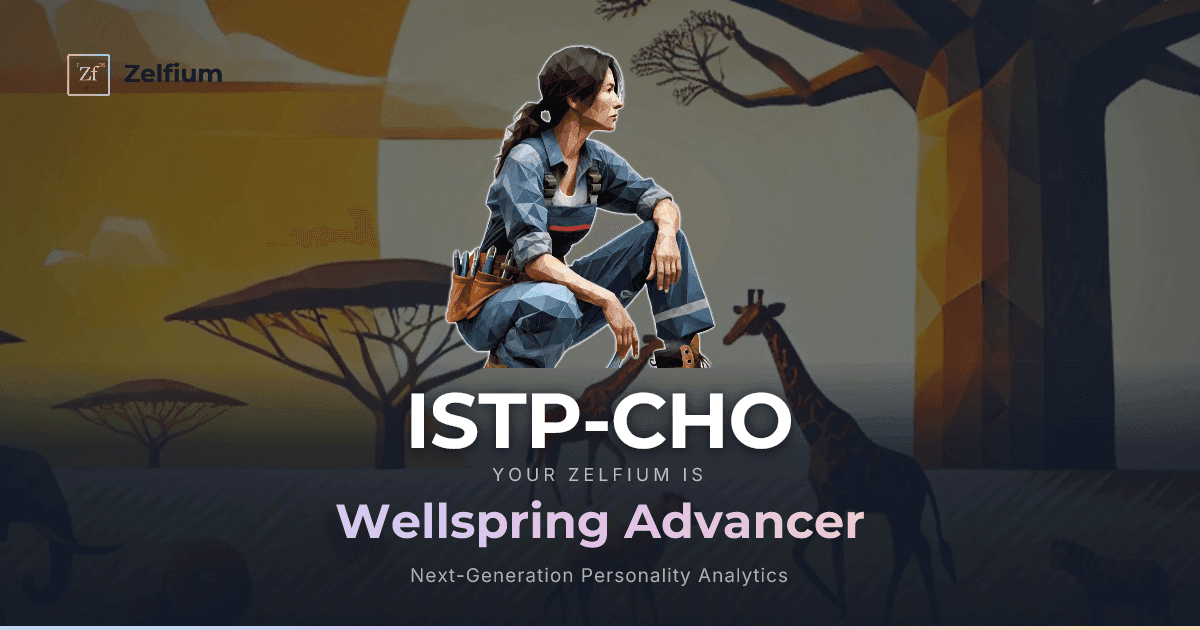
The Wellspring Advancer
Most craftsmen work alone. The ISTP-CHO works alone and then opens the workshop doors. This is what happens when the ISTP's quiet mastery of physical reality — the sensory acuity, the logical engine, the adaptive freedom — meets the CHO's wellspring nature, where curiosity, warmth, and emotional buoyancy fuse into an almost gravitational pull that draws others into the adventure. The result is a hands-on problem-solver who does not merely fix things but makes the process of fixing them feel like an invitation. Where a pure ISTP might disappear into the garage for days and emerge with a perfectly rebuilt engine, the ISTP-CHO emerges wanting to show someone how it works, what went wrong, and why the solution is elegant. The CHO background transforms solitary competence into something shared — not through obligation, but through a genuine, internally generated belief that knowledge hoarded is knowledge wasted and that every skill worth having is a skill worth teaching.
The ISTP's four dimensions — introversion, sensory awareness, thinking, and pioneering — create someone who learns by touching, testing, and taking apart. The CHO's three dimensions — curiosity, harmony, and optimism — create an inner world that is endlessly exploratory, emotionally generous, and fundamentally confident that things will turn out well. When these layers coexist, the independent technician develops an unexpected social warmth.
Introversion still governs the need for space. The ISTP-CHO requires quiet time with tools and problems. But the CHO's harmonious dimension ensures that the satisfaction of solving something alone is incomplete — there is always an impulse to share the discovery, to invite someone into the process, to turn a solitary victory into a communal one. The ISTP builds mastery; the CHO makes that mastery generous.
The CHO's curiosity amplifies the ISTP's already broad practical interests. Where the ISTP explores how physical systems work, the CHO adds the question of how people experience those systems — not just whether a tool functions, but whether it feels right in someone's hand. Two kinds of curiosity merge: the mechanical and the human, each enriching the other with perspectives neither would find alone.
The most transformative interaction is between the ISTP's pioneering dimension and the CHO's optimism. The pioneering spirit wants freedom to improvise, to follow inspiration wherever it leads. Optimism removes the fear from that improvisation — failure is not a verdict but a data point, and the next attempt carries the same buoyant confidence as the first. Together, these forces produce a person who experiments with striking fearlessness, not because risk is invisible but because the belief in eventual success is simply stronger than the fear of temporary failure.
The ISTP-CHO possesses a rare gift for making competence approachable. Technical mastery can be intimidating; this type makes it feel accessible. The ISTP's demonstrations are precise and real — nothing is oversimplified — but the CHO's warmth ensures that the person watching never feels stupid for not already knowing. This creates an exceptional mentor, the kind who teaches by doing alongside rather than lecturing from above.
There is also an unusual resilience in the face of practical failure. When a project goes wrong — a build collapses, a repair does not hold, a plan proves unworkable — the ISTP's diagnostic clarity identifies what failed while the CHO's optimism immediately reframes the situation as an opportunity for a better approach. This rapid recovery cycle means the ISTP-CHO rarely stays discouraged for long, and that steadiness is contagious in any team or workshop.
Finally, the CHO's generous momentum gives the ISTP's skills a social reach they would not naturally achieve. Solutions do not remain private discoveries. The harmonious dimension drives a desire to share techniques, and the optimistic dimension ensures the sharing carries an energy that makes others want to try for themselves.
The central tension in the ISTP-CHO is between depth and breadth of engagement. The ISTP craves deep immersion in a single problem — hours or days of focused, solitary work. The CHO craves shared experience — the joy of discovery multiplied by the presence of others. These two rhythms can compete for the same time and energy, creating a pattern where the ISTP-CHO oscillates between intense isolation and intense sociability in ways that can puzzle both the person and those around them.
A subtler tension exists between the ISTP's analytical honesty and the CHO's optimistic warmth. Thinking demands accurate assessment: this solution is flawed, this approach will not work, this situation is genuinely difficult. Optimism wants to believe things will be fine and to reassure others accordingly. When the thinking dimension identifies a real problem and the optimistic dimension tries to smooth it over, the ISTP-CHO can experience an internal conflict — the urge to be truthful pulling against the urge to be encouraging. The resolution lies not in choosing one over the other but in learning to deliver honest assessments with the warmth that makes them receivable.
There is also the tension of pace. The CHO's curiosity races ahead — new projects, new people, new possibilities. The ISTP's sensory mastery requires patience — the slow, careful work of truly understanding how something functions. When curiosity outpaces competence, the ISTP-CHO can spread too thin, starting more than can be finished with the craftsmanship this type's own standards demand.
Growth for the ISTP-CHO is not about becoming more solitary or more social. It is about developing the wisdom to know which mode serves the current moment. There is a time for the workshop with the door closed — for the deep, sensory immersion that produces genuine mastery. And there is a time for the workshop with the door open — for the shared discovery that gives mastery its meaning. The ISTP-CHO who learns to honor both rhythms without guilt discovers something powerful: that hands-on competence and human warmth are not opposing forces but complementary ones. The craftsman who can also invite others into the work does not dilute the craft. The craft itself becomes richer for being shared, and the sharing becomes deeper for being rooted in something real.
The ISTP-CHO portrait drawn here is the "pure form" — what emerges when every pole swings fully in this direction. In reality, each of your dimensions carries a different intensity, and at every intersection, a unique chemistry unfolds. Even a slight tilt in one dimension creates an entirely different internal dynamic — that is the resolution of Zelfium's 7-dimension model.
Zelfium measures each of 36 facets on a 6-point scale. The number of possible patterns:
6³⁶
possible patterns
vs all humans ever born
880 trillion ×
~117 billion humans have ever lived — repeat that 880 trillion times and you still can't fill every pattern
vs stars in the observable universe
~50,000 ×
~200 sextillion stars in the observable universe — still not enough
vs grains of sand on Earth
~1 billion ×
~7.5 quintillion grains of sand — multiply by a billion
vs current world population
~1.3 quintillion ×
Line up 1.3 quintillion copies of today's 8 billion people to fill every type
More than 50,000 times the number of every star in the observable universe. That is the resolution of your personality.
So don't fit yourself into this description too tightly. ISTP-CHO is a compass showing the direction your personality leans — not a box that defines everything you are. The pattern woven by your 36 facets is singular in this universe. To discover that one-of-a-kind blend — to find your own ISTP-CHO — take the assessment.