

Loading...
Loading...
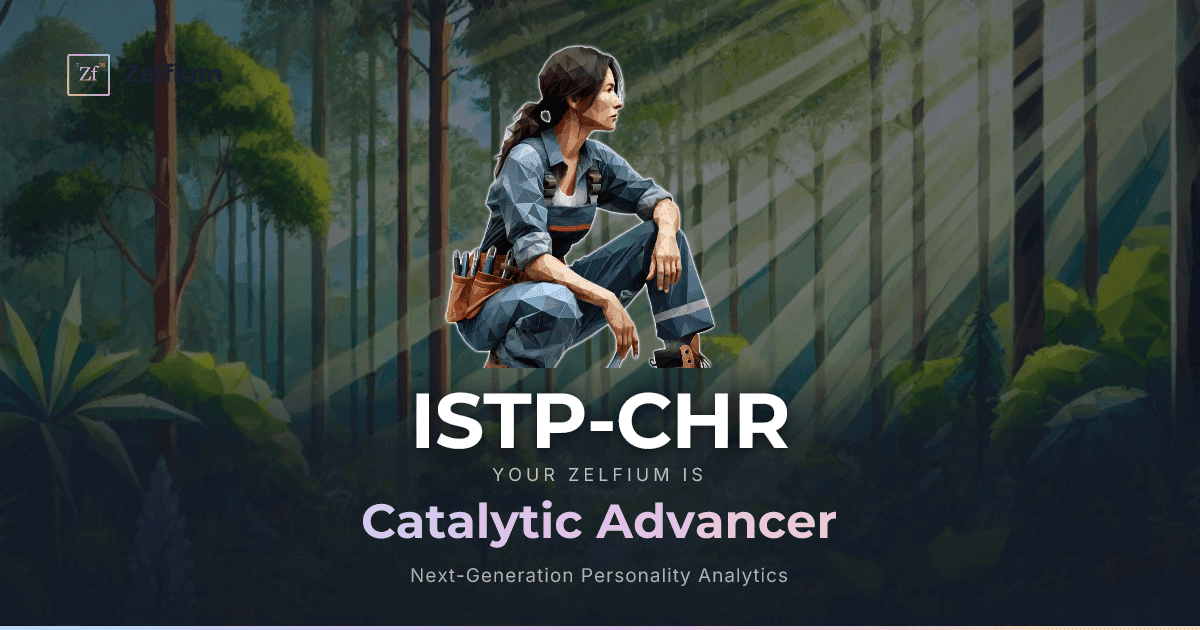
The Catalytic Advancer
There is a particular kind of person who fixes things not because it is their job, but because they cannot bear to see something — or someone — functioning below capacity. The ISTP-CHR emerges when the Advancer's hands-on mastery meets the Catalyst's restless concern for human wellbeing. The ISTP's sensory precision, logical engine, and adaptive freedom are already formidable tools for solving tangible problems. The CHR background floods this practical intelligence with something unexpected: a curiosity that reaches beyond mechanisms into people, an empathy that registers suffering as urgently as a misaligned gear, and a responsiveness that detects emotional undercurrents with the same acuity the ISTP brings to physical systems. The result is not a softened technician or a less rigorous helper. It is someone who diagnoses what is broken — in a machine, in a team, in a person's confidence — with equal precision, and who feels genuinely compelled to act on every diagnosis. Where a pure ISTP might fix the engine and walk away satisfied, the ISTP-CHR notices that the driver has been white-knuckling the steering wheel for months and quietly addresses that too.
The ISTP's four dimensions — introversion, sensory awareness, thinking, and pioneering — produce a person who processes the world through direct contact: touching, testing, disassembling, understanding from the inside out. The CHR's three dimensions — curiosity, harmony, and responsiveness — create an inner world that is growth-hungry, deeply attuned to others, and emotionally alert to an unusual degree. When these layers coexist, the solitary problem-solver develops an unexpected second channel of perception.
Introversion still sets the rhythm. The ISTP-CHR needs solitude, needs the quiet workshop of the mind where things can be taken apart and understood. But the CHR's harmonious dimension means that even in that workshop, other people's needs are present — not as interruptions, but as problems worthy of the same careful attention given to any mechanical challenge. The ISTP builds solutions; the CHR ensures those solutions account for the humans who will use them.
The CHR's curiosity amplifies the ISTP's sensory intelligence in a specific direction. Where the ISTP is drawn to how physical systems behave, the CHR's curiosity adds a human dimension — wanting to understand not just how a team operates but why certain members are struggling within it. Practical observation and human insight feed each other: noticing that someone flinches at a particular topic carries the same diagnostic weight as noticing that a bearing vibrates at a specific frequency.
The most distinctive interaction, however, is between the ISTP's thinking dimension and the CHR's responsiveness. Thinking demands logical rigor and efficient solutions. Responsiveness floods the system with emotional data — the tension someone is carrying in their shoulders, the hesitation before a colleague speaks, the quiet desperation in a request for help. In most people, these forces would create friction. In the ISTP-CHR, they forge something rare: responsiveness supplies the signals that thinking then organizes into actionable understanding. The result is not cold analysis or sentimental concern but a form of practical empathy — a mind that can identify exactly what is wrong with a situation and feel the urgency to make it right.
The ISTP-CHR possesses an unusual capacity to earn trust from people who have given up on being understood. The ISTP's calm, non-judgmental presence — a person who listens with their hands as much as their ears — is deepened by the CHR's genuine warmth, creating someone others approach not for grand advice but for the one precise intervention that actually changes things. This type does not lecture about what should be done. This type does the thing, quietly, and the person on the receiving end realizes only afterward that something fundamental shifted.
There is also a remarkable ability to bridge the gap between technical and human worlds. In environments where engineers dismiss emotions and empaths dismiss data, the ISTP-CHR moves fluently between both languages. Systems are understood as things built by and for people, and people are understood as systems with needs that can be identified and addressed. This bridging capacity makes the ISTP-CHR extraordinarily effective in roles where both mechanical precision and human sensitivity are needed — and those roles are far more common than most organizations realize.
The CHR's catalytic nature gives the ISTP's practical solutions a social reach they would never achieve alone. Fixes do not stay private. The harmonious dimension drives a need to share what works in ways others can replicate, and responsiveness ensures the sharing is attuned to how the audience will receive it.
The deepest tension in the ISTP-CHR lives between the need for solitary immersion and the pull toward human connection. The ISTP requires long stretches of undisturbed focus — the workshop, the problem, the silence. The CHR's harmonious and responsive dimensions keep other people emotionally present even during those stretches, generating a low hum of awareness that can make true solitude elusive. The hands are working on one thing; the emotional radar is tracking three others. Managing this dual awareness without exhaustion is a lifelong negotiation.
A second tension sits between the ISTP's pragmatic efficiency and the CHR's emotional thoroughness. The thinking dimension wants the most logical solution, delivered fast. Responsiveness insists on registering every nuance of how that solution lands — every hesitation, every unspoken reaction. The ISTP-CHR can experience a frustrating loop: the efficient answer is clear, but the emotional data keeps arriving, complicating what should be simple. The path through is not suppressing either faculty but learning to trust that a good-enough solution delivered with care often outperforms a perfect solution delivered without it.
There is also a tension around self-standards. The ISTP sets high standards for technical competence; the CHR sets high standards for relational attentiveness. Together, these produce a person who can feel simultaneously inadequate as a craftsman and as a caregiver — not skilled enough, not sensitive enough, not present enough. Recognizing that this double audit is a structural feature of the combination, not a personal failing, is essential for sustaining the energy this type gives so freely.
Growth for the ISTP-CHR is not about choosing between the workshop and the world. It is about building a life architecture that honors both the need to work with hands and the need to work with hearts — without demanding that both operate at full intensity simultaneously. There will be seasons when the sensory craftsman leads, absorbed in the pure satisfaction of a problem solved with precision. There will be seasons when the catalytic dimension takes the foreground, drawn irresistibly toward someone who needs what only this type can offer. The ISTP-CHR who learns to move between these modes with intention discovers that practical mastery and human compassion are not competing forces. They are two expressions of the same impulse — the refusal to leave broken things unrepaired — and when they work in concert, the result is a form of care that is both precise and deeply felt.
The ISTP-CHR portrait drawn here is the "pure form" — what emerges when every pole swings fully in this direction. In reality, each of your dimensions carries a different intensity, and at every intersection, a unique chemistry unfolds. Even a slight tilt in one dimension creates an entirely different internal dynamic — that is the resolution of Zelfium's 7-dimension model.
Zelfium measures each of 36 facets on a 6-point scale. The number of possible patterns:
6³⁶
possible patterns
vs all humans ever born
880 trillion ×
~117 billion humans have ever lived — repeat that 880 trillion times and you still can't fill every pattern
vs stars in the observable universe
~50,000 ×
~200 sextillion stars in the observable universe — still not enough
vs grains of sand on Earth
~1 billion ×
~7.5 quintillion grains of sand — multiply by a billion
vs current world population
~1.3 quintillion ×
Line up 1.3 quintillion copies of today's 8 billion people to fill every type
More than 50,000 times the number of every star in the observable universe. That is the resolution of your personality.
So don't fit yourself into this description too tightly. ISTP-CHR is a compass showing the direction your personality leans — not a box that defines everything you are. The pattern woven by your 36 facets is singular in this universe. To discover that one-of-a-kind blend — to find your own ISTP-CHR — take the assessment.