
Loading...
Loading...
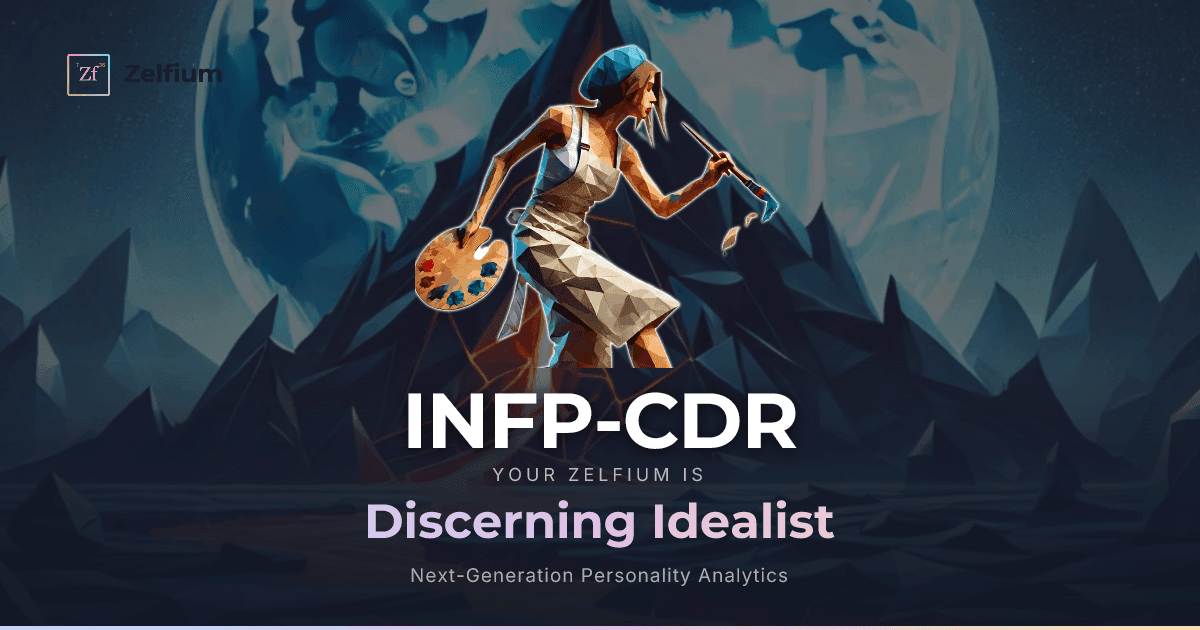
The Discerning Idealist
The INFP-CDR is what happens when an idealist develops X-ray vision. The INFP's interior world — rich with values, imagination, and a longing for authenticity — meets the CDR's discerning temperament, where restless curiosity, intellectual independence, and acute perceptual sensitivity converge into an ability to see through surfaces to the structure beneath. The result is a dreamer who does not merely imagine a better world but examines, with unsettling precision, why the current one falls short. Where a pure INFP might feel that something is wrong without being able to articulate it clearly, the CDR's analytical depth provides the language and the framework. And where a pure CDR might see through illusions without caring much about what should replace them, the INFP's values provide the moral architecture. This combination produces someone who can perceive what is broken, understand why it matters, and envision what could be built instead — all while maintaining an independence of thought that refuses to accept comfortable answers simply because they are popular.
The INFP's four dimensions — introversion, openness, feeling, and pioneering — create a person whose deepest life happens in the private theater of meaning and vision. The CDR's three dimensions — curiosity, detachment, and responsiveness — create an inner world that is analytically restless, socially autonomous, and perceptually vigilant. When these two layers inhabit the same person, the dreamer acquires a scalpel.
Introversion governs the rhythm for both layers. The INFP-CDR is doubly inward — the INFP retreats to dream, and the CDR retreats to analyze. This makes solitude not just a preference but a near-physiological requirement. The inner work that happens in those quiet hours is extraordinary in its range: simultaneously imagining and interrogating, feeling and dissecting, building visions and testing them against reality. Few types do as much internal labor as the INFP-CDR, and almost none of it is visible from the outside.
The interaction between the INFP's openness and the CDR's curiosity produces a powerful but demanding intellect. Openness sees connections, patterns, and possibilities everywhere; curiosity refuses to accept any of them without investigation. The INFP imagines a beautiful theory; the CDR immediately asks whether it holds. This internal dialectic — vision followed by scrutiny, inspiration followed by interrogation — is both the source of the INFP-CDR's exceptional insight and the reason creative projects can take so long to reach completion. Every idea must pass through two filters: Is it beautiful? And is it true?
The most complex interaction, however, is between feeling and the CDR's detachment. Feeling operates through values — deeply personal, deeply held, often difficult to articulate in purely logical terms. Detachment operates through analytical independence — a refusal to let social pressure, sentiment, or convention distort the picture. In many people these would produce a painful split: the heart pulling one way, the mind pulling another. In the INFP-CDR, they develop an uneasy but productive alliance. Detachment does not override feeling; it sharpens it. The values are still there, still passionate, still deeply personal — but they have been tested against independent analysis and emerged stronger for it. The INFP-CDR's convictions carry a weight that more sentimental idealism cannot, precisely because they have survived their own scrutiny.
The INFP-CDR possesses an unusual ability to combine moral vision with intellectual rigor. This is the person who can articulate not only what is wrong but why it is wrong — who can trace an injustice back to its structural roots and present the case with both emotional power and analytical precision. The combination of the INFP's creative empathy with the CDR's perceptual sharpness means this type sees what others miss and cares about what others overlook.
There is also a distinctive intellectual integrity. The CDR's independence ensures that the INFP's idealism is never merely conformist — the values held are genuinely personal, genuinely examined, genuinely believed rather than inherited or performed. When the INFP-CDR speaks, people sense an authenticity that has been earned through real internal work, not assumed as a social posture.
Finally, the CDR's responsiveness gives the INFP's creative instinct a perceptual depth that is remarkable. Subtle shifts in tone, atmosphere, and human energy register with extraordinary clarity, and the INFP's openness transforms those perceptions into creative material. The INFP-CDR notices what most people cannot and then makes art, writing, or insight from the raw material of what others have failed to see. This combination of sensitivity and independence produces work that is both deeply felt and unsparingly honest.
The deepest tension in the INFP-CDR is between feeling's warmth and detachment's analytical distance. The INFP wants to connect deeply with people, to be moved by their stories, to feel alongside them. The CDR steps back, evaluates, maintains independence. The INFP-CDR may find themselves in a painful oscillation — drawn close by genuine empathy, then pulling away as the analytical mind notices inconsistencies, performances, or misalignments that the heart would prefer not to see. Learning to hold both faculties simultaneously — caring deeply while seeing clearly — is the central developmental challenge.
A second tension lives between the INFP's idealism and the CDR's unflinching realism. The INFP envisions how things should be; the CDR sees, with uncomfortable precision, how things actually are. The gap between these two assessments can become a source of chronic frustration or even despair. The dreamer who sees too clearly is at risk of becoming not cynical but heartbroken — disillusioned not with the dream but with the world's apparent inability to deserve it. Growth lies in recognizing that clear-eyed perception of reality and commitment to a higher vision are not contradictions but essential partners.
There is also a tension around isolation. Both the INFP and the CDR incline toward solitude — the INFP for creative and emotional processing, the CDR for analytical independence. Together, they can create a withdrawal so complete that genuine connection becomes rare. The responsiveness dimension keeps detecting signals from other people, but detachment keeps moderating the impulse to respond. The INFP-CDR who lives too long in isolation may find that the inner world, however rich, begins to lack the oxygen that only human connection can provide.
Growth for the INFP-CDR is not about becoming warmer or less analytical. It is about building bridges between the inner world and the outer one — finding ways to bring the extraordinary depth of internal work into contact with other people without sacrificing the independence that makes it valuable. The CDR's detachment does not need to be dismantled. It needs a door — a way to let trusted people in without the entire fortress being compromised. The INFP's idealism does not need to be tempered. It needs to be expressed in forms that can survive contact with reality, gaining strength from the encounter rather than shattering against it. The INFP-CDR who learns to share insights selectively and connect authentically without losing analytical clarity discovers something rare: a form of integrity that is both visionary and grounded, both deeply feeling and unflinchingly honest. That combination — the dreamer who can also discern — is something the world does not produce often and cannot afford to waste.
The INFP-CDR portrait drawn here is the "pure form" — what emerges when every pole swings fully in this direction. In reality, each of your dimensions carries a different intensity, and at every intersection, a unique chemistry unfolds. Even a slight tilt in one dimension creates an entirely different internal dynamic — that is the resolution of Zelfium's 7-dimension model.
Zelfium measures each of 36 facets on a 6-point scale. The number of possible patterns:
6³⁶
possible patterns
vs all humans ever born
880 trillion ×
~117 billion humans have ever lived — repeat that 880 trillion times and you still can't fill every pattern
vs stars in the observable universe
~50,000 ×
~200 sextillion stars in the observable universe — still not enough
vs grains of sand on Earth
~1 billion ×
~7.5 quintillion grains of sand — multiply by a billion
vs current world population
~1.3 quintillion ×
Line up 1.3 quintillion copies of today's 8 billion people to fill every type
More than 50,000 times the number of every star in the observable universe. That is the resolution of your personality.
So don't fit yourself into this description too tightly. INFP-CDR is a compass showing the direction your personality leans — not a box that defines everything you are. The pattern woven by your 36 facets is singular in this universe. To discover that one-of-a-kind blend — to find your own INFP-CDR — take the assessment.