

Loading...
Loading...
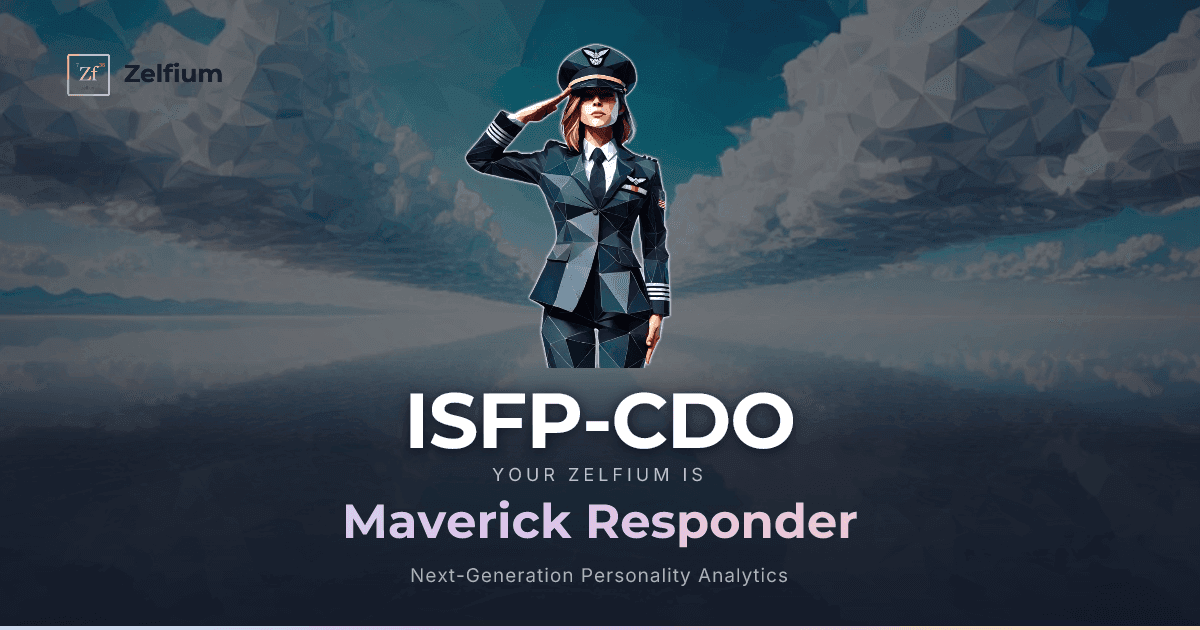
The Maverick Responder
There is something striking about a person who creates from deeply personal feeling and yet answers to no one about what that creation should look like. The ISFP-CDO is what happens when the ISFP's sensory-emotional artistry — an interior world of vivid feeling, physical awareness, and value-driven authenticity — meets the CDO's maverick independence: a mind that draws its own map, trusts its own compass, and carries an optimism so deeply rooted that failure registers as interesting rather than threatening. The result is someone who moves through the world with a quiet but formidable self-direction, creating and living on entirely personal terms without the anxiety that usually accompanies that kind of freedom. Where a pure ISFP might hesitate before sharing unconventional work, wondering whether it will be understood or accepted, the CDO background dissolves that hesitation — not through bravado but through a genuine indifference to external validation that frees the creative impulse to follow its own logic completely. The ISFP-CDO does not rebel against convention. Convention simply does not occur as a constraint worth noticing.
The ISFP's four dimensions — introversion, Sensory awareness, Feeling, and Pioneering openness — create someone who absorbs the physical world with extraordinary fidelity, processes it through personal values, and responds with a fluid spontaneity that resists imposed structure. The CDO's three dimensions — curiosity, detachment, and optimism — create an inner world that is perpetually seeking new territory, evaluating it with independent clarity, and approaching whatever is found with a confidence that uncertainty cannot shake. When these layers meet, the quiet artist acquires an unusual armor: the freedom to be entirely authentic without worrying about the cost.
Introversion combines with detachment to produce a doubled independence. The ISFP retreats inward to process experience; the CDO's detachment ensures that what is processed there is evaluated by personal standards alone. External opinions, social trends, and the expectations of peers pass through the ISFP-CDO's awareness like weather — noticed, perhaps interesting, but never decisive. This creates a person whose creative and personal choices carry an uncommon purity of motivation. The work is done because it matters to the person doing it, not because it will be recognized or rewarded.
The CDO's curiosity adds a forward-leaning energy to the ISFP's sensory engagement. The ISFP is naturally present-oriented, fully inhabiting the current moment and its textures. Curiosity pulls toward what has not yet been tried — a new medium, a new environment, a new way of living that has not been tested. The combination creates someone who is both deeply grounded in immediate experience and restlessly interested in what lies beyond it, producing a life that is anchored but never static.
The most liberating interaction occurs between the ISFP's Feeling dimension and the CDO's optimism. Feeling can be heavy. When values are violated, when authenticity is compromised, when the world fails to live up to what the heart knows is possible, the emotional response is deep and sometimes crushing. Optimism does not eliminate that response, but it provides a floor beneath it — a steady conviction that the pain is real but temporary, that creative energy will return, that the next attempt will be different. This gives the ISFP-CDO a resilience in creative and emotional life that less optimistic ISFPs may lack: the ability to be wounded by the world's imperfections and then, without denying the wound, turn back toward creation with renewed purpose.
The ISFP-CDO possesses a creative fearlessness that is genuinely rare. This is not the loud confidence of someone performing boldness — it is the quiet assurance of someone who has simply never found external judgment compelling enough to alter course. The ISFP's sensory-emotional authenticity produces work that is deeply personal; the CDO's independence ensures that personal vision is never compromised for acceptability; and the optimistic foundation means that even when the work is misunderstood, the creator does not lose faith in it. This combination produces artists, makers, and craftspeople whose output carries an unmistakable originality — not because originality was pursued as a goal, but because the internal compass was followed without deviation.
There is also a distinctive capacity for thriving in unstructured environments. The ISFP's Pioneering dimension already prefers openness to planning, and the CDO's combination of curiosity and self-reliance amplifies this into a genuine ability to navigate uncertainty without stress. Where others need roadmaps, the ISFP-CDO navigates by feel and by trust — feel for what is right in the moment, trust that the next moment will present its own opportunities. This makes the type unusually effective in situations that demand improvisation, adaptation, and comfort with the unknown.
Finally, the CDO's detachment gives the ISFP's warmth a particular quality: it is offered freely but never desperately. The ISFP-CDO cares deeply about the people who have earned a place in the inner world, but that care does not come with dependency or the need for reciprocation. Love is given because it is felt, not because it is owed or expected in return. This creates relationships of unusual health and freedom — connections where both parties can breathe, grow, and be themselves without the weight of obligation.
The central tension in the ISFP-CDO is between the Feeling dimension's deep caring and detachment's structural independence. The ISFP feels what others feel — absorbs the emotional atmosphere of a room, senses when someone is struggling, registers injustice with visceral intensity. Detachment, however, maintains an analytical distance from those feelings, evaluating them rather than being swept along by them. This can create an internal experience of caring deeply while simultaneously standing apart from the caring — a kind of emotional parallax that can be confusing to both the ISFP-CDO and the people who try to get close. Others may sense the warmth but be puzzled by the accompanying reserve, unable to reconcile the two. The ISFP-CDO may wonder why connection that is deeply desired also triggers the instinct to withdraw.
A second tension exists between the ISFP's present-moment immersion and the CDO's forward-oriented curiosity. The Sensory dimension wants to stay — to fully inhabit this experience, this material, this relationship in its current form. Curiosity is already imagining what comes next. Optimism whispers that the next thing will be even more interesting. This forward pull can prevent the ISFP-CDO from fully receiving the depth that sustained attention produces, creating a pattern of brilliant beginnings followed by premature departures. The art that emerges from deep immersion in a single medium or subject over years is qualitatively different from what emerges from constant exploration — and the ISFP-CDO may need to consciously choose depth over breadth at certain pivotal moments.
There is also the tension of solitude. The combined introversion and detachment make the ISFP-CDO comfortable alone to a degree that can gradually become self-reinforcing. Each year, the circle of people who truly know this person may shrink slightly as standards for genuine connection remain high and the ease of solitary existence removes the urgency of seeking companionship. This is not loneliness — it is chosen freedom. But the question of whether the freedom has become a fortress is worth asking periodically.
Growth for the ISFP-CDO is not about becoming more conventional, more social, or more cautious. It is about recognizing that the maverick's greatest risk is not the judgment of others — it is the possibility that absolute self-sufficiency, taken to its logical conclusion, produces a life that is free but thin. The world that is built on personal terms is authentic, beautiful, and entirely one's own. The question is whether there is room in it for something that was not planned, not chosen, not controlled — something that arrives unbidden and disrupts the elegant independence with the messy, illogical, profoundly enriching demands of genuine interdependence. The ISFP-CDO who learns to let someone in — not because it is needed but because the risk of being known is ultimately more interesting than the safety of being sovereign — discovers a dimension of creative and emotional life that solitary mastery, for all its beauty, cannot provide. The compass still points true. The map is still self-drawn. But the journey becomes something richer when there is someone walking alongside — not following, not leading, just present — whose unpredictable company makes the destination less important than the walk itself.
The ISFP-CDO portrait drawn here is the "pure form" — what emerges when every pole swings fully in this direction. In reality, each of your dimensions carries a different intensity, and at every intersection, a unique chemistry unfolds. Even a slight tilt in one dimension creates an entirely different internal dynamic — that is the resolution of Zelfium's 7-dimension model.
Zelfium measures each of 36 facets on a 6-point scale. The number of possible patterns:
6³⁶
possible patterns
vs all humans ever born
880 trillion ×
~117 billion humans have ever lived — repeat that 880 trillion times and you still can't fill every pattern
vs stars in the observable universe
~50,000 ×
~200 sextillion stars in the observable universe — still not enough
vs grains of sand on Earth
~1 billion ×
~7.5 quintillion grains of sand — multiply by a billion
vs current world population
~1.3 quintillion ×
Line up 1.3 quintillion copies of today's 8 billion people to fill every type
More than 50,000 times the number of every star in the observable universe. That is the resolution of your personality.
So don't fit yourself into this description too tightly. ISFP-CDO is a compass showing the direction your personality leans — not a box that defines everything you are. The pattern woven by your 36 facets is singular in this universe. To discover that one-of-a-kind blend — to find your own ISFP-CDO — take the assessment.