

Loading...
Loading...
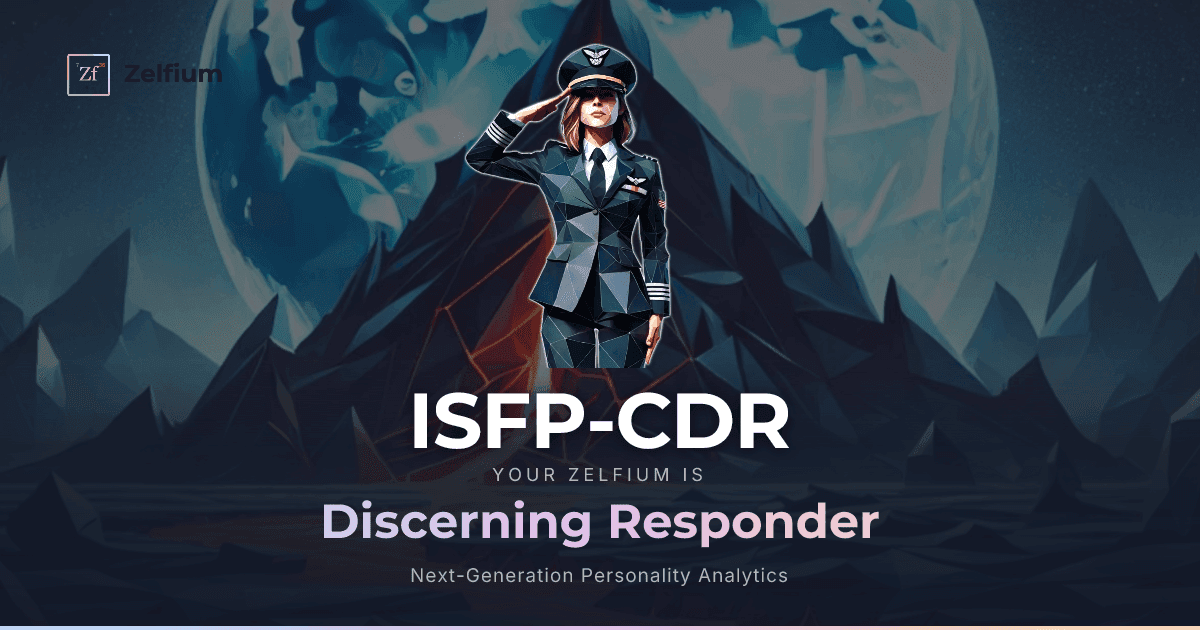
The Discerning Responder
There is a rare kind of perception that emerges when someone who feels the world with the whole body also possesses the analytical independence to stand apart from what is felt and examine it with unsparing clarity. The ISFP-CDR is what happens when the ISFP's deeply personal, sensory-emotional engagement with life meets the CDR's discerning inner architecture — a mind that is relentlessly curious, fiercely independent in its judgments, and sensitive enough to catch the flaw in the fabric before anyone else has noticed it exists. The result is an artist who is also a critic — not in the sense of tearing things down, but in the older, deeper sense of someone who can distinguish the genuine from the fraudulent with an accuracy that borders on instinct. Where a pure ISFP might create from feeling alone and trust the result, the ISFP-CDR cannot stop there. The CDR background adds a layer of rigorous self-examination that tests every creative act, every relationship, every value against a standard that is entirely self-generated and unyielding. This does not diminish the art. It refines it, producing work and a way of being that carries the unmistakable signature of something that has been both deeply felt and honestly examined.
The ISFP's four dimensions — introversion, Sensory awareness, Feeling, and Pioneering openness — create someone who lives in vivid sensory detail, navigates by personal values, and moves through life with a fluid responsiveness that resists confinement. The CDR's three dimensions — curiosity, detachment, and responsiveness — create an inner world that is perpetually investigating, evaluating from an independent vantage point, and registering environmental signals with uncommon fidelity. When these layers coexist, the sensory artist gains an internal critic of extraordinary precision.
Introversion is amplified rather than merely maintained. Both the ISFP and the CDR's detachment pull toward inner space — the ISFP to process sensory-emotional experience, the CDR to analyze and evaluate independently. The ISFP-CDR may be among the most inwardly oriented combinations in the entire system, and this is not a limitation. It is the environment in which the richest inner work occurs. The danger is not insufficient reflection but insufficient contact with the outer world that provides the raw material for both feeling and analysis.
The CDR's curiosity adds an investigative edge to the ISFP's sensory engagement. Where the ISFP absorbs experience for its own sake — the beauty of a moment, the rightness of a feeling — curiosity asks why. Why does this material produce this response? What makes one arrangement beautiful and another merely competent? This relentless questioning does not diminish the aesthetic experience; it deepens it, turning the ISFP-CDR into someone whose creative judgments are grounded in both feeling and understanding.
The most complex interaction occurs between the ISFP's Feeling dimension and the CDR's detachment. Feeling navigates by values, empathy, and personal authenticity. Detachment maintains analytical distance, evaluating situations and people by independent criteria rather than emotional resonance. In the ISFP-CDR, these two forces exist in a productive but sometimes painful tension — the heart says one thing, the independent mind says another, and neither is willing to defer. The resolution, when it comes, tends to produce judgments of unusual depth: assessments that are both emotionally true and intellectually honest, precisely because they have survived the internal debate between two fundamentally different ways of knowing.
The ISFP-CDR possesses an exceptionally refined aesthetic judgment. This is not mere taste — it is the capacity to perceive quality at a level that integrates sensory response with analytical rigor. The ISFP feels what works; the CDR understands why it works and can identify what does not. Together, they produce someone whose creative output — whether in visual arts, design, craftsmanship, or the arrangement of daily life — carries a quality of precision that transcends both raw feeling and cold analysis.
There is also a distinctive capacity for honest observation that others find simultaneously challenging and invaluable. The ISFP-CDR sees what is actually happening in a room, a relationship, or a system — not what people have agreed to pretend is happening. This honesty is delivered not with the CDR's natural bluntness but softened by the ISFP's Feeling dimension, which ensures that truth is offered with care for how it lands. The result is someone who can say the difficult thing that everyone is avoiding and do so in a way that people can actually hear.
Finally, the CDR's responsiveness amplifies the ISFP's already considerable perceptual gifts. The ISFP's sensory awareness catches beauty and texture; the CDR's responsiveness catches risk and dissonance. Together, the ISFP-CDR perceives the full spectrum of environmental signal — what is beautiful and what is breaking, what is harmonious and what is false — with a completeness that few other combinations can match.
The deepest tension in the ISFP-CDR is between Feeling's desire for authenticity and detachment's demand for objectivity. The ISFP creates, connects, and makes decisions from the heart — from the felt sense of what is right, true, and beautiful. Detachment stands apart and asks whether what feels right is actually right, whether what seems true survives examination, whether what appears beautiful is merely comfortable. This internal dialogue can be extraordinarily productive, but it can also become a form of self-sabotage when the analytical voice becomes so loud that it paralyzes the creative impulse. The ISFP-CDR may experience periods where the desire to create is strong but the internal critic refuses to approve anything as good enough to share.
A second tension exists between the CDR's responsiveness and the ISFP's need for present-moment peace. Responsiveness is a threat-detection system; it scans the environment for what might go wrong, what is subtly off, what needs attention. The ISFP's Sensory dimension, by contrast, wants to rest in the beauty of what is — to savor the moment without analysis. These two orientations can compete for the same attentional space, creating an experience of being simultaneously drawn into the present moment's beauty and pulled out of it by the awareness that something in the environment is not quite right.
There is also the tension of social isolation that the combined introversion and detachment can produce. The ISFP already tends toward small circles and private experience; the CDR's detachment adds another layer of selectivity that can narrow the circle further. The ISFP-CDR may find that the standards for genuine connection — authenticity from the Feeling side, intellectual substance from the detachment side — are so high that very few people qualify, leaving a person of considerable warmth and depth in a social landscape that feels sparse. Learning that imperfect connections still have value — that not every relationship needs to meet the highest standard to be worth maintaining — is a growth edge that serves both the heart and the mind.
Growth for the ISFP-CDR is not about silencing the inner critic or dimming the perceptual acuity that makes life so richly detailed and occasionally so exhausting. It is about learning to sequence rather than simultaneously operate the two great faculties this combination provides. There is a time for feeling — for absorbing the world through the senses without asking why, for creating without editing, for connecting without evaluating. And there is a time for analysis — for stepping back, examining what has been made or felt, and applying the independent judgment that ensures authenticity is not just claimed but earned. The ISFP-CDR who learns to honor both modes without letting either consume the other discovers a particular kind of mastery: the ability to create something that is both deeply felt and rigorously honest, something that moves others precisely because it refuses to compromise on either dimension. That refusal is not stubbornness. It is the hallmark of someone whose inner world is rich enough to hold both tenderness and truth — and brave enough to let both of them speak.
The ISFP-CDR portrait drawn here is the "pure form" — what emerges when every pole swings fully in this direction. In reality, each of your dimensions carries a different intensity, and at every intersection, a unique chemistry unfolds. Even a slight tilt in one dimension creates an entirely different internal dynamic — that is the resolution of Zelfium's 7-dimension model.
Zelfium measures each of 36 facets on a 6-point scale. The number of possible patterns:
6³⁶
possible patterns
vs all humans ever born
880 trillion ×
~117 billion humans have ever lived — repeat that 880 trillion times and you still can't fill every pattern
vs stars in the observable universe
~50,000 ×
~200 sextillion stars in the observable universe — still not enough
vs grains of sand on Earth
~1 billion ×
~7.5 quintillion grains of sand — multiply by a billion
vs current world population
~1.3 quintillion ×
Line up 1.3 quintillion copies of today's 8 billion people to fill every type
More than 50,000 times the number of every star in the observable universe. That is the resolution of your personality.
So don't fit yourself into this description too tightly. ISFP-CDR is a compass showing the direction your personality leans — not a box that defines everything you are. The pattern woven by your 36 facets is singular in this universe. To discover that one-of-a-kind blend — to find your own ISFP-CDR — take the assessment.