

Loading...
Loading...
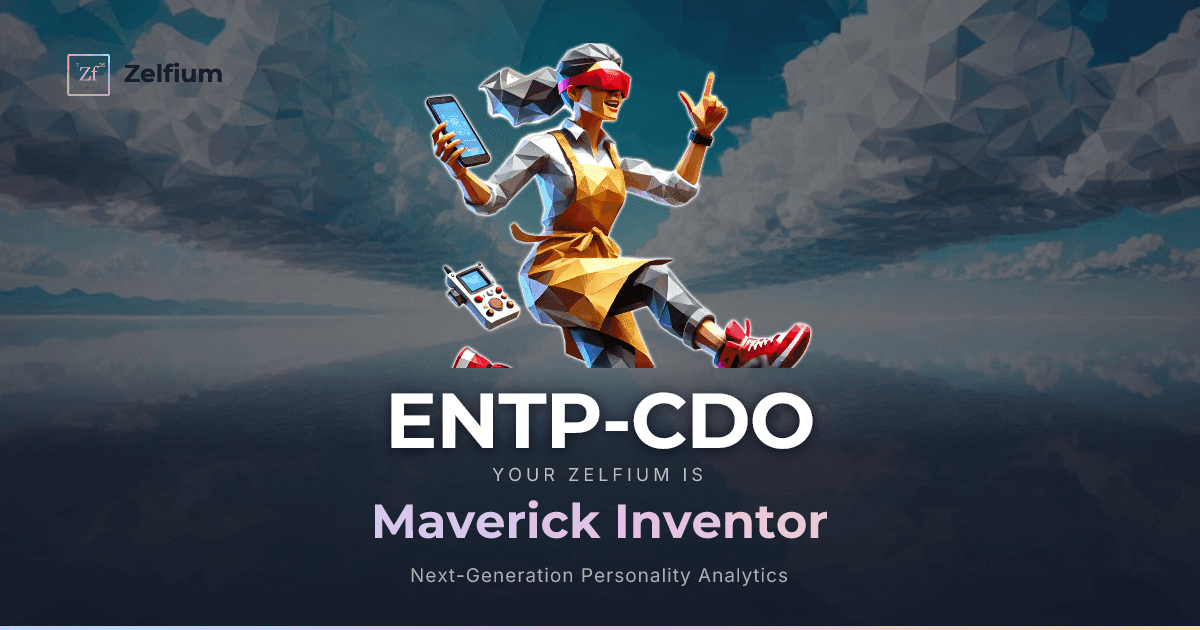
The Maverick Inventor
Most debaters need an audience. The ENTP-CDO would debate a mountain if the mountain had a position worth dismantling — and then walk straight over it to see what lies on the other side. This is what emerges when the ENTP's socially charged, convention-breaking intellect meets the CDO's maverick inner world, where insatiable curiosity, radical intellectual independence, and unshakable emotional confidence fuse into a force that creates its own weather. The result is a thinker who not only challenges every assumption in sight but does so with a self-assurance so deeply rooted that external resistance — social pressure, professional convention, the sheer inertia of "how things are done" — registers as interesting data rather than a reason to stop. Where a pure ENTP might enjoy the debate and then look around for allies, the ENTP-CDO does not need allies to proceed. The CDO's maverick independence means that the value of an idea is measured by its integrity, not by the number of people who endorse it. This combination produces someone who is simultaneously the most socially energizing person in the room and the least dependent on the room's approval.
The ENTP's four dimensions — extraversion, openness, thinking, and pioneering — create a mind that generates ideas in dialogue, thrives on intellectual combat, and finds the notion of premature closure physically uncomfortable. The CDO's three dimensions — curiosity, detachment, and optimism — create an inner world that charts its own course without hesitation, evaluates everything through an independent lens, and faces uncertainty with the confident expectation that it will prove interesting rather than threatening. When these two layers operate simultaneously, something powerful emerges: the extraverted provocateur gains an internal compass that never wavers.
The interaction between extraversion and detachment produces a distinctive social signature. The ENTP draws energy from engagement — from the friction of competing perspectives, the pleasure of reading a room, the live-wire sensation of an argument in motion. The CDO's detachment means that while all of this social energy is flowing, the ENTP-CDO is never captured by it. Consensus is observed and analyzed, not absorbed. The group's emotional pull is felt but not followed. This gives the ENTP-CDO a kind of social X-ray vision: fully engaged at the surface, completely independent underneath.
The CDO's curiosity amplifies the ENTP's openness into something almost reckless in its scope — but the recklessness is strategic. Both dimensions pull toward uncharted territory, but the CDO adds the critical element of self-direction. The ENTP-CDO does not explore what is fashionable — it explores what its own internal drive identifies as worth understanding. The result is an intellectual trajectory that other people find fascinating but could never have predicted, because it follows a compass that has no interest in following anyone else's map.
The most distinctive intersection is between thinking and optimism. The ENTP's analytical rigor produces honest — sometimes brutally honest — assessments. The CDO's optimism wraps those assessments in an unshakable confidence that problems are solvable and that the solver standing in front of them is up to the task. This is not optimism that softens the analysis; it is optimism that powers through it. The ENTP-CDO can look at a genuinely difficult situation, diagnose it with unflinching clarity, and immediately begin building the next approach — not because the difficulty is minimized, but because difficulty is simply what interesting problems look like.
The ENTP-CDO possesses a near-total immunity to intellectual intimidation. Where others defer to authority, convention, or the weight of popular opinion, this type evaluates every claim on its own merits and discards what does not hold up — regardless of who made it. The combination of the ENTP's argumentative skill with the CDO's autonomous judgment means this person can walk into any room, identify the dominant assumption, dismantle it, and propose an alternative — all without a moment's hesitation about whether the room wants to hear it. The courage is not performed; it is structural, arising naturally from a combination that genuinely does not weight social approval in its decision calculus.
There is also a remarkable capacity for pioneering in uncharted territory. The ENTP generates the possibilities, the CDO's detachment ensures those possibilities are evaluated honestly rather than enthusiastically, and the CDO's optimism provides the fuel to pursue the ones that survive scrutiny into territory where no playbook exists. This three-phase engine — generate, evaluate, advance — operates with an efficiency and fearlessness that makes the ENTP-CDO one of the most effective first-movers in any domain.
Finally, this combination produces an infectious confidence that is qualitatively different from charisma. The ENTP-CDO does not charm people into following — it convinces them by demonstrating, through repeated performance, that independent judgment produces better outcomes than groupthink. Over time, people around this type learn to trust contrarian positions not because they are comfortable but because they have watched the ENTP-CDO be right when everyone else was wrong. That track record becomes its own form of authority — earned, not inherited.
The deepest tension in the ENTP-CDO lives between the desire for social engagement and the radical independence that evaluates every social partner. The ENTP wants people — wants the friction, the laughter, the intellectual sparring. The CDO's detachment scans every potential partner with a clarity that is difficult to switch off, and many do not survive the scan. The result is a person who craves social intellectual stimulation but finds the pool of people who can provide it genuinely satisfying smaller than it should be. This is not arrogance — it is the structural consequence of having standards that are simultaneously high and non-negotiable.
A second tension exists between the forward momentum that all seven dimensions generate and the relationships left behind in its wake. Extraversion, openness, and pioneering pull forward. Curiosity, detachment, and optimism reinforce that pull. The combined velocity can be extraordinary — but velocity in one direction means distance from everything that is not moving at the same speed. The ENTP-CDO may look back periodically and discover that people who mattered have been left further behind than intended — not through cruelty, but through the simple physics of a life that moves very fast and rarely needs to slow down.
There is also a tension between optimism and the ENTP's analytical depth. The CDO's confidence that things will work out can occasionally override the ENTP's capacity for sitting with genuinely difficult conclusions. Not every problem is solvable on a timeline that optimism finds acceptable. The ENTP-CDO who learns to let a bleak analysis stand — without immediately pivoting to the plan, the workaround, the silver lining — discovers a deeper form of intellectual honesty that makes the eventual solutions more robust.
Growth for the ENTP-CDO is not about becoming less independent or more conforming. It is about recognizing that the maverick path, for all its power, has costs that detachment and optimism can make invisible. The debater's brilliance and the maverick's autonomy are genuine strengths — they do not need to be modulated. What needs development is the peripheral vision: the ability to notice who is waving from a distance, who has been outpaced, who might have offered something valuable if given the chance to keep up. The ENTP-CDO who builds the habit of occasionally looking back discovers something that neither curiosity nor independence could have predicted — that certain forms of insight are only available to those willing to slow down long enough to let someone else's perspective fully arrive. The maverick does not need to stop being a maverick. The growth is in discovering that the most powerful maverick is the one who chooses when to run alone and when to let someone run alongside.
The ENTP-CDO portrait drawn here is the "pure form" — what emerges when every pole swings fully in this direction. In reality, each of your dimensions carries a different intensity, and at every intersection, a unique chemistry unfolds. Even a slight tilt in one dimension creates an entirely different internal dynamic — that is the resolution of Zelfium's 7-dimension model.
Zelfium measures each of 36 facets on a 6-point scale. The number of possible patterns:
6³⁶
possible patterns
vs all humans ever born
880 trillion ×
~117 billion humans have ever lived — repeat that 880 trillion times and you still can't fill every pattern
vs stars in the observable universe
~50,000 ×
~200 sextillion stars in the observable universe — still not enough
vs grains of sand on Earth
~1 billion ×
~7.5 quintillion grains of sand — multiply by a billion
vs current world population
~1.3 quintillion ×
Line up 1.3 quintillion copies of today's 8 billion people to fill every type
More than 50,000 times the number of every star in the observable universe. That is the resolution of your personality.
So don't fit yourself into this description too tightly. ENTP-CDO is a compass showing the direction your personality leans — not a box that defines everything you are. The pattern woven by your 36 facets is singular in this universe. To discover that one-of-a-kind blend — to find your own ENTP-CDO — take the assessment.