
Loading...
Loading...
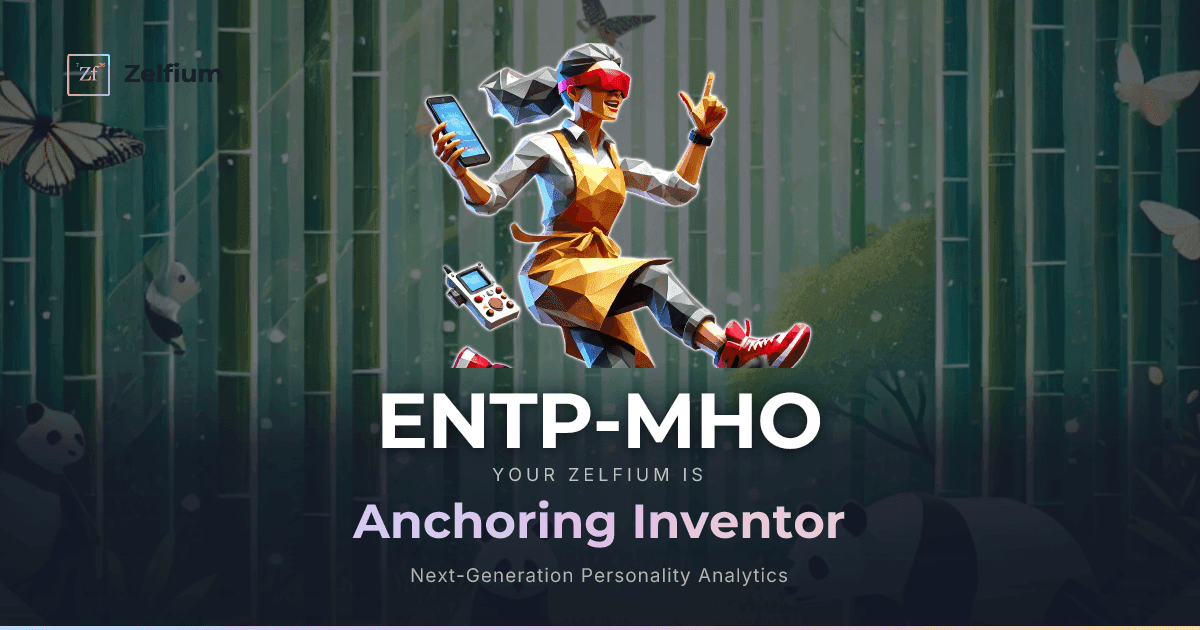
The Anchoring Inventor
The debater tears things apart. The anchor holds things together. The ENTP-MHO does both — tearing apart flawed ideas while holding the people who believed in them so steadily that they walk away not humiliated but galvanized. This is what emerges when the ENTP's intellectually adventurous, socially charged character meets the MHO's anchoring nature, where deep commitment to continuity, genuine empathy, and resilient optimism fuse into a presence that people instinctively trust even when it is challenging them. The result is a debater who builds as much as they deconstruct — someone whose intellectual restlessness is grounded by a warmth so steady and an optimism so reliable that the people around them feel not just intellectually stimulated but genuinely held. Where a pure ENTP might lose interest after the argument is won, the ENTP-MHO stays — because the person matters more than the point, and lasting impact matters more than the flash of insight.
The ENTP's four dimensions — extraversion, openness, thinking, and pioneering — produce a mind that thrives on novelty, thinks in public, and treats every status quo as a draft rather than a final version. The MHO's three dimensions — maintaining, harmony, and optimism — produce an inner world that cherishes what has been built, feels deeply for the people nearby, and carries an unshakable confidence that difficulties will resolve. When these two orientations share a single person, something distinctive emerges: the revolutionary develops patience.
The interaction between openness and maintaining is where the most creative tension lives. The ENTP's openness pulls toward new ideas, new frameworks, unexplored territories. The MHO's maintaining dimension asks a question that pure novelty-seekers rarely consider: "Is this new thing actually better than what we already have?" This question does not kill innovation — it refines it. The ENTP-MHO does not chase ideas for the thrill of newness; innovation is measured against the standard of whether it genuinely improves upon what exists. The result is a kind of innovation that others trust more readily, because it comes with an implicit promise that nothing valuable will be discarded carelessly.
Extraversion and harmony together create a social warmth that gives the ENTP's challenging style a safety net most debaters lack. The ENTP engages with intellectual fearlessness; the MHO's harmonious dimension ensures that the engagement is wrapped in enough relational care that people feel dared rather than attacked. There is a distinctive quality to how the ENTP-MHO holds disagreement: the argument is vigorous, but the relationship is never in question. People can engage fully because they know the floor beneath them will not give way.
The most transformative intersection is between pioneering and optimism. The ENTP's pioneering nature keeps things open, resists premature closure, and is always ready to pivot. The MHO's optimism adds a quality that pioneering alone does not have: endurance. The ENTP-MHO does not just start things — this type sustains them through the long middle where novelty has faded and what remains is the patient work of making something real. Optimism provides the fuel to keep going when the intellectual excitement has worn off, and this stamina is something that people who have watched ENTPs abandon projects find surprising and deeply reassuring.
The ENTP-MHO possesses an unusual capacity to sustain innovation over time. Most ENTP-type minds excel at the spark — the initial insight, the reframe, the provocation that opens new territory. The MHO background gives this type something rarer: the staying power to shepherd an idea from inception through the unglamorous work of implementation, maintenance, and incremental improvement. The combination of intellectual creativity with the MHO's patient commitment to what has been started means ideas are not just brilliant — they are durable.
There is also a remarkable capacity for social cohesion during times of change. The ENTP pushes for evolution, which inherently destabilizes. The MHO holds the human fabric together while the evolution happens. This dual capacity makes the ENTP-MHO exceptionally valuable in any context where change is necessary but trust is fragile — where the challenge is not just having the right idea but implementing it without losing the people whose cooperation makes it possible.
Finally, the combination of the ENTP's analytical sharpness and the MHO's optimism produces a form of problem-solving that is both honest and energizing. The analysis names the real issue without sugarcoating. The optimism frames the path forward with genuine confidence that the issue is workable. People leave conversations with the ENTP-MHO feeling that they understand the problem better and believe more strongly that they can solve it — a combination that most advisors and leaders struggle to produce.
The most significant tension in the ENTP-MHO is between the desire to explore and the desire to nurture. The ENTP wants to venture into unfamiliar intellectual territory — to question, to disrupt, to follow ideas wherever they lead. The MHO wants to protect what has been built and ensure that the people nearby feel stable and cared for. When these impulses collide, the ENTP-MHO can feel stuck between two versions of responsibility: the responsibility to pursue truth wherever it leads and the responsibility to preserve the relationships and structures that truth might unsettle.
A second tension lives between the ENTP's direct, challenging communication style and the MHO's instinct to harmonize. The ENTP sees the flaw and wants to name it immediately. The MHO senses how the naming will land and sometimes delays the truth to protect the emotional equilibrium of the group. Over time, this delay can accumulate into a backlog of unsaid things — insights that were too honest for the moment, critiques that were held back to preserve comfort. The ENTP-MHO who learns that temporary discomfort is sometimes the price of lasting trust discovers a more complete form of both honesty and care.
There is also a tension between optimism and analytical depth. The MHO's resilient confidence that things will work out can occasionally prevent the ENTP from sitting with the full weight of a genuinely difficult diagnosis. Not every situation improves with time, and not every problem yields to patient optimism. The growth edge is learning to let hard truths breathe — to resist the urge to immediately reassure — so that the eventual solution is built on honest ground rather than premature comfort.
Growth for the ENTP-MHO is not about becoming more disruptive or more stable. It is about learning to hold both impulses with equal respect and to deploy them with judgment. The debater's sharpness protects the community from complacency; the anchor's warmth protects the community from fear. Neither force is more important than the other, and the ENTP-MHO who learns to calibrate them — knowing when the group needs a challenge and when it needs reassurance, when to push and when to hold — becomes something rare: a person who is both the most intellectually honest presence in the room and the one everyone trusts to hold things together. That combination is not common. It is exactly the kind of leadership that communities need but almost never find — intelligence that serves belonging, and belonging that gives intelligence its deepest purpose.
The ENTP-MHO portrait drawn here is the "pure form" — what emerges when every pole swings fully in this direction. In reality, each of your dimensions carries a different intensity, and at every intersection, a unique chemistry unfolds. Even a slight tilt in one dimension creates an entirely different internal dynamic — that is the resolution of Zelfium's 7-dimension model.
Zelfium measures each of 36 facets on a 6-point scale. The number of possible patterns:
6³⁶
possible patterns
vs all humans ever born
880 trillion ×
~117 billion humans have ever lived — repeat that 880 trillion times and you still can't fill every pattern
vs stars in the observable universe
~50,000 ×
~200 sextillion stars in the observable universe — still not enough
vs grains of sand on Earth
~1 billion ×
~7.5 quintillion grains of sand — multiply by a billion
vs current world population
~1.3 quintillion ×
Line up 1.3 quintillion copies of today's 8 billion people to fill every type
More than 50,000 times the number of every star in the observable universe. That is the resolution of your personality.
So don't fit yourself into this description too tightly. ENTP-MHO is a compass showing the direction your personality leans — not a box that defines everything you are. The pattern woven by your 36 facets is singular in this universe. To discover that one-of-a-kind blend — to find your own ENTP-MHO — take the assessment.