

Loading...
Loading...
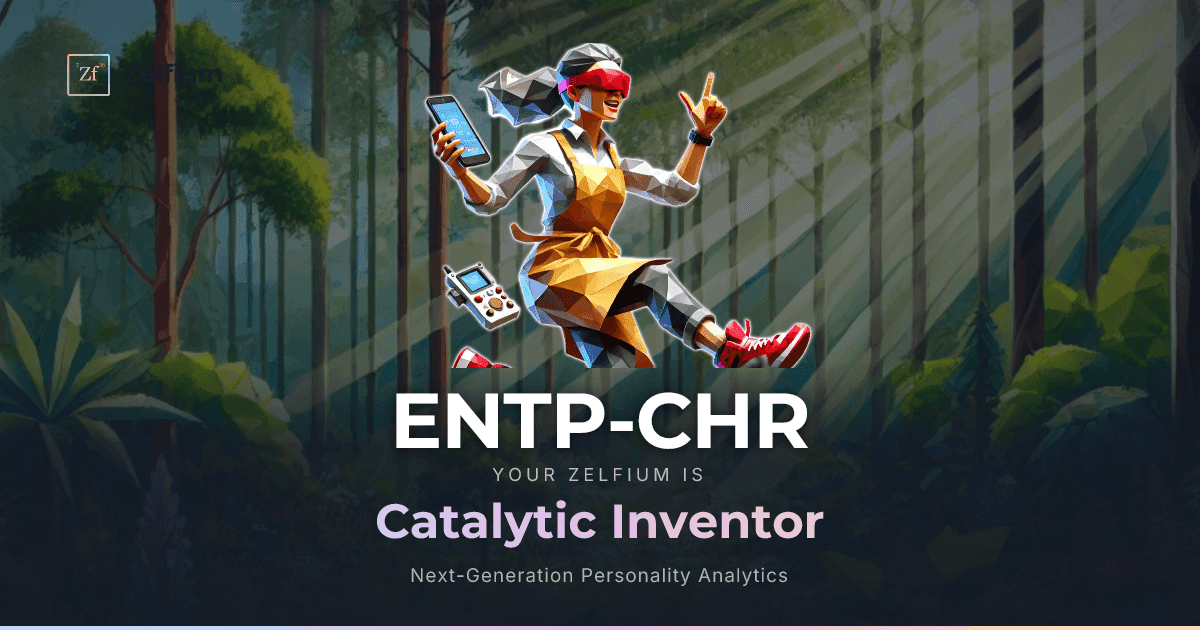
The Catalytic Inventor
Most debaters dismantle ideas for the thrill of it. The ENTP-CHR dismantles them because somewhere, someone is living inside a broken system and does not yet have the language to explain why it hurts. This is what happens when the ENTP's electrically social, pattern-hunting intellect — a mind that thinks by talking, argues to discover, and treats every convention as a hypothesis to be stress-tested — meets the CHR's catalytic inner world, where restless curiosity, deep empathy, and acute emotional sensitivity fuse into an almost involuntary drive to make things better for the people who need it most. The result is a thinker who does not merely spot the flaw in the argument but feels, with startling intensity, why that flaw matters to the human beings affected by it. Where a pure ENTP might win the debate and move on, the ENTP-CHR cannot. The CHR background ensures that intellectual victory is never the endpoint — it is the starting material for something that actually changes a life. That single redirection transforms a brilliant contrarian into a force that people trust with both their ideas and their vulnerabilities.
The ENTP's four dimensions — extraversion, openness, thinking, and pioneering — create a mind that accelerates through dialogue, leaps between conceptual frameworks, and resists premature closure with a kind of joyful defiance. The CHR's three dimensions — curiosity, harmony, and responsiveness — create an inner world that is perpetually growth-oriented, deeply attuned to other people's emotional states, and sensitive to a degree that most extraverts never experience. When these two layers coexist in the same person, something counterintuitive emerges: the social provocateur develops an emotional conscience.
Extraversion still governs the rhythm. The ENTP-CHR needs people, needs conversation, needs the friction of disagreement to generate its best thinking. But the CHR's harmonious dimension means that the debate is never purely intellectual sport. Even while disassembling someone's position with surgical precision, a part of this person is tracking how the other feels — registering the shift in posture, the tightening of the jaw, the moment when the argument stops being stimulating and starts becoming painful. This is not a compromise between sharpness and softness. It is a deepening of the ENTP's social intelligence: the analytical edge remains, but it now operates with a radar that most debaters lack entirely.
The CHR's curiosity dimension amplifies the ENTP's already voracious openness, but in a specifically human direction. Where the ENTP is drawn to abstract patterns and structural flaws, the CHR's curiosity asks why those flaws matter to real people living inside them. The two forms of curiosity spiral together: intellectual discovery reveals emotional stakes, and emotional awareness opens intellectual questions that pure abstraction would never surface.
The most distinctive interaction, however, lives between the ENTP's thinking dimension and the CHR's responsiveness. Thinking demands logical rigor and is willing to follow evidence into uncomfortable territory. Responsiveness floods the system with emotional signal — the unspoken frustration in a colleague's voice, the inner question of whether one's own cleverness is serving or wounding. In many people, these forces would collide destructively. In the ENTP-CHR, they develop a remarkable partnership: responsiveness supplies the data that thinking structures, and thinking gives responsiveness a framework that prevents it from becoming overwhelming. The result is insight that is simultaneously razor-sharp and deeply human — a mind that can construct a logical argument for why someone's pain is systemic and then feel compelled to do something about it.
The ENTP-CHR possesses a rare capacity to name problems that others sense but cannot articulate — and to do so in the middle of a conversation, in real time, with an audience that walks away both challenged and cared for. This is the person who reframes an entire discussion not to show off but because the original framing was quietly hurting someone, and nobody else noticed. The combination of the ENTP's pattern recognition and rapid verbal processing with the CHR's emotional sensitivity means this type detects the gap between what a system claims to do and what the people inside it actually experience — and broadcasts that gap in a way that makes action feel possible rather than overwhelming.
There is also an unusual ability to build trust across divides. The ENTP's intellectual fearlessness attracts people who crave honesty, while the CHR's warmth ensures that honesty lands as care rather than attack. People sense they will receive a rigorous truth delivered with genuine concern for how it affects them. This makes the ENTP-CHR an exceptional mediator, advocate, or thought partner in environments where both boldness and empathy are needed.
Finally, the CHR's catalytic nature gives the ENTP's ideas social momentum. Insights do not stay in the realm of intellectual exercise. The harmonious dimension drives a need to share discoveries in ways that empower rather than impress, and the responsive dimension ensures the message is calibrated to how the listener will receive it. The ENTP-CHR does not just think brilliantly — this type thinks in a way that moves people to act.
The deepest tension in the ENTP-CHR is between the love of intellectual combat and the sensitivity to its emotional cost. The ENTP thrives on debate — on pushing ideas to their breaking point and relishing the wreckage. The CHR feels every wince, every defensive withdrawal, every moment where the conversation shifts from exhilarating to exhausting for the other person. These two experiences happen simultaneously, and the ENTP-CHR can find itself in a painful loop: the mind is alive with argumentative energy, but the emotional radar is signaling that the person across the table has had enough. Learning to sequence these faculties — knowing when to press and when to pause — is the central developmental task.
A second tension lives between the ENTP's pioneering restlessness and the CHR's responsiveness. Pioneering wants to keep all options open, to chase the next fascinating question. Responsiveness keeps raising alarms — about risks not yet addressed, about people who might be left behind in the rush toward novelty, about whether the current enthusiasm is built on solid ground. The ENTP's natural momentum can feel checked by the CHR's caution, creating an internal friction between the exhilaration of speed and the weight of awareness.
There is also a tension around energy management. The ENTP draws energy from social engagement while the CHR's responsiveness absorbs emotional signal from every interaction. A stimulating evening of debate that charges the ENTP may simultaneously deplete the CHR, leaving the person energized intellectually but emotionally drained. Recognizing this dual accounting system — and building recovery rhythms that honor both — is essential for the ENTP-CHR to sustain the full intensity of who they are.
Growth for the ENTP-CHR is not about arguing less or feeling less. It is about learning which conversations deserve the full deployment of both gifts and which ones call for restraint. The debater's fire and the catalyst's sensitivity are not contradictions — they are complementary instruments that become extraordinary when played in the right order. There will be moments when the sharpest possible challenge is exactly what someone needs, and moments when the most powerful thing is simply to listen without solving. The ENTP-CHR who learns to read which moment is which discovers something remarkable: a mind that can dismantle any argument and a heart that can hold any person is not a paradox. It is, perhaps, the most persuasive form of intelligence there is — one that changes minds precisely because it first earns the right to be heard.
The ENTP-CHR portrait drawn here is the "pure form" — what emerges when every pole swings fully in this direction. In reality, each of your dimensions carries a different intensity, and at every intersection, a unique chemistry unfolds. Even a slight tilt in one dimension creates an entirely different internal dynamic — that is the resolution of Zelfium's 7-dimension model.
Zelfium measures each of 36 facets on a 6-point scale. The number of possible patterns:
6³⁶
possible patterns
vs all humans ever born
880 trillion ×
~117 billion humans have ever lived — repeat that 880 trillion times and you still can't fill every pattern
vs stars in the observable universe
~50,000 ×
~200 sextillion stars in the observable universe — still not enough
vs grains of sand on Earth
~1 billion ×
~7.5 quintillion grains of sand — multiply by a billion
vs current world population
~1.3 quintillion ×
Line up 1.3 quintillion copies of today's 8 billion people to fill every type
More than 50,000 times the number of every star in the observable universe. That is the resolution of your personality.
So don't fit yourself into this description too tightly. ENTP-CHR is a compass showing the direction your personality leans — not a box that defines everything you are. The pattern woven by your 36 facets is singular in this universe. To discover that one-of-a-kind blend — to find your own ENTP-CHR — take the assessment.