

Loading...
Loading...
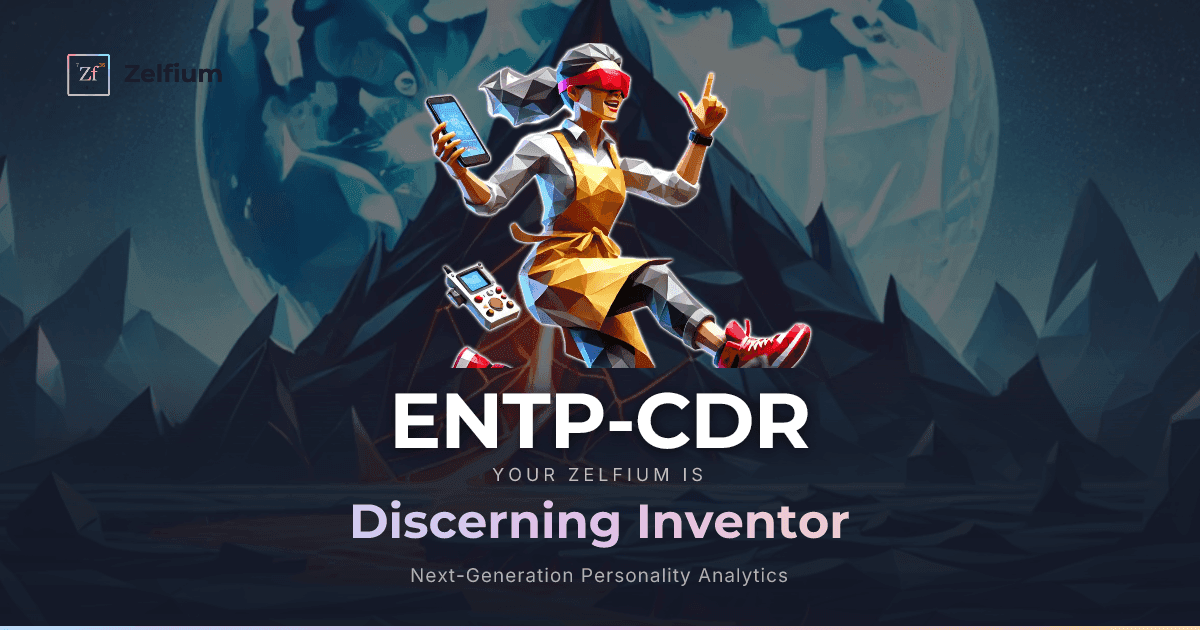
The Discerning Inventor
Most debaters challenge ideas in public. The ENTP-CDR challenges them in public and simultaneously runs a private audit that most people will never see — an internal scanning system so finely calibrated that it catches not only the flaw in someone else's argument but the flaw in its own enthusiasm for finding it. This is what happens when the ENTP's socially charged, pattern-breaking intellect meets the CDR's discerning inner world, where relentless curiosity, fierce intellectual independence, and acute perceptual sensitivity converge into a capacity for seeing through things that borders on the uncanny. The result is a debater who does not just argue well but perceives at a resolution most people cannot access — detecting the structural fault line beneath a confident presentation, the hidden assumption that everyone else accepted without examination, the risk that has not yet materialized but is already casting a shadow. Where a pure ENTP might move on after winning the argument, the ENTP-CDR stays to examine whether the victory itself was built on solid ground.
The ENTP's four dimensions — extraversion, openness, thinking, and pioneering — produce a mind that thinks aloud, generates possibilities at extraordinary speed, and treats intellectual friction as fuel. The CDR's three dimensions — curiosity, detachment, and responsiveness — produce an inner world that explores without needing anyone's permission, evaluates without social contamination, and registers subtle signals that most extraverts drown out with their own noise. When these two layers coexist, something paradoxical emerges: the most socially energized debater in the room is also running the most solitary internal analysis.
The interaction between extraversion and detachment is the most immediately visible tension — and the most productive one. The ENTP draws energy from people, from conversation, from the live friction of competing ideas. The CDR's detachment steps back from that energy just enough to evaluate it honestly. This produces a distinctive rhythm: engage, then assess. Argue, then audit. The ENTP-CDR can be fully present in a spirited debate and simultaneously notice that the group is converging on an answer because it feels good rather than because it is right. That dual vision — participation and observation operating in the same moment — is something most people cannot sustain.
The CDR's curiosity dimension and the ENTP's openness reinforce each other into a force of intellectual exploration that is both broad and deep. But the CDR adds a crucial quality: independence of direction. Where the ENTP's openness might follow whatever intellectual current is most stimulating in the moment, the CDR's curiosity has its own compass. It does not explore because the crowd finds something interesting — it explores because the internal drive to understand has identified something that does not yet make sense.
The most charged intersection lives between the ENTP's extraversion and the CDR's responsiveness. The ENTP's social mode is expansive — generating energy, drawing people in, creating intellectual excitement. The CDR's responsiveness is absorptive — taking in emotional signal, registering shifts in atmosphere, detecting things that are not being said. These two processes run simultaneously, and the ENTP-CDR experiences a uniquely layered version of every social interaction: the surface conversation and the subsurface reality, perceived at the same time, with full clarity on both channels.
The ENTP-CDR possesses a diagnostic precision that is rare in someone so socially engaged. This is not the quiet analyst who needs solitude to see clearly — this is someone who can perceive the hidden architecture of a situation while actively participating in it. The combination of the ENTP's rapid verbal intelligence with the CDR's perceptual sharpness means this type can name the real issue in a group discussion — the one everyone is circling but nobody has articulated — with a directness that cuts through posturing and a timing that suggests the insight was effortless, though it was not.
There is also a distinctive intellectual integrity. The CDR's detachment ensures that the ENTP's love of argument does not degenerate into performance. The ideas defended are defended because they survive internal scrutiny, not because they sound impressive. People learn that when the ENTP-CDR takes a position, it has been stress-tested from angles they have not considered — and that makes the position worth taking seriously even when it is uncomfortable.
Finally, the ENTP-CDR has an unusual capacity for strategic foresight. The ENTP generates possibilities; the CDR's responsiveness catches which of those possibilities carry hidden risks. The result is strategic thinking that accounts for threats most people would not see until they arrived. This combination makes the ENTP-CDR invaluable in environments where the cost of being wrong is high — where what matters is not just having ideas, but having ideas that will actually survive contact with reality.
The deepest tension in the ENTP-CDR is between the need for social energy and the need for perceptual solitude. The ENTP comes alive in conversation — ideas sharpen through dialogue, energy builds through interaction. But the CDR's responsiveness means that every interaction carries a perceptual cost: signals absorbed, risks catalogued, emotional undercurrents registered. The ENTP-CDR can spend an evening in brilliant debate and arrive home carrying not only intellectual stimulation but a backlog of unprocessed sensory data that demands quiet time to sort through. The social self and the analytical self need different environments to function, and building a life that serves both is a central challenge.
A second tension exists between the ENTP's instinct to share ideas and the CDR's instinct to withhold judgment until the analysis is complete. The ENTP wants to think out loud, to test ideas in real time against other minds. The CDR wants to be certain before speaking — because responsiveness has shown too many times what happens when a half-formed assessment lands on someone who was not ready for it. This push-pull between expressive thinking and cautious precision can create moments of internal conflict where the ENTP-CDR is visibly formulating and simultaneously hesitating.
There is also a tension around trust. The CDR's detachment evaluates people with a clarity that does not always produce charitable conclusions. The ENTP's extraversion wants to engage broadly, to find intellectual sparring partners everywhere. But the CDR's perceptual sharpness means that many potential partners are seen through before the conversation has progressed past the surface — and the number of people who survive that scan is smaller than the ENTP's social appetite would prefer. Learning to engage generously even with imperfect partners, while maintaining the internal clarity that makes the CDR's analysis so valuable, is a balancing act that demands ongoing attention.
Growth for the ENTP-CDR is not about seeing less or socializing less. It is about learning to trust the integration of these two powerful systems — the social and the analytical, the expansive and the vigilant — without either one overriding the other. The debater's energy and the discerner's precision are not competing forces; they are the same intelligence operating on different channels. The ENTP-CDR who learns to let these channels inform each other rather than interrupt each other discovers a remarkable capacity: the ability to read any room with both warmth and X-ray vision, to engage with people fully while understanding them accurately, and to produce insights that are not only brilliant but durable — because they have survived the most demanding critic the ENTP-CDR will ever face, which is the one that lives inside.
The ENTP-CDR portrait drawn here is the "pure form" — what emerges when every pole swings fully in this direction. In reality, each of your dimensions carries a different intensity, and at every intersection, a unique chemistry unfolds. Even a slight tilt in one dimension creates an entirely different internal dynamic — that is the resolution of Zelfium's 7-dimension model.
Zelfium measures each of 36 facets on a 6-point scale. The number of possible patterns:
6³⁶
possible patterns
vs all humans ever born
880 trillion ×
~117 billion humans have ever lived — repeat that 880 trillion times and you still can't fill every pattern
vs stars in the observable universe
~50,000 ×
~200 sextillion stars in the observable universe — still not enough
vs grains of sand on Earth
~1 billion ×
~7.5 quintillion grains of sand — multiply by a billion
vs current world population
~1.3 quintillion ×
Line up 1.3 quintillion copies of today's 8 billion people to fill every type
More than 50,000 times the number of every star in the observable universe. That is the resolution of your personality.
So don't fit yourself into this description too tightly. ENTP-CDR is a compass showing the direction your personality leans — not a box that defines everything you are. The pattern woven by your 36 facets is singular in this universe. To discover that one-of-a-kind blend — to find your own ENTP-CDR — take the assessment.