

Loading...
Loading...
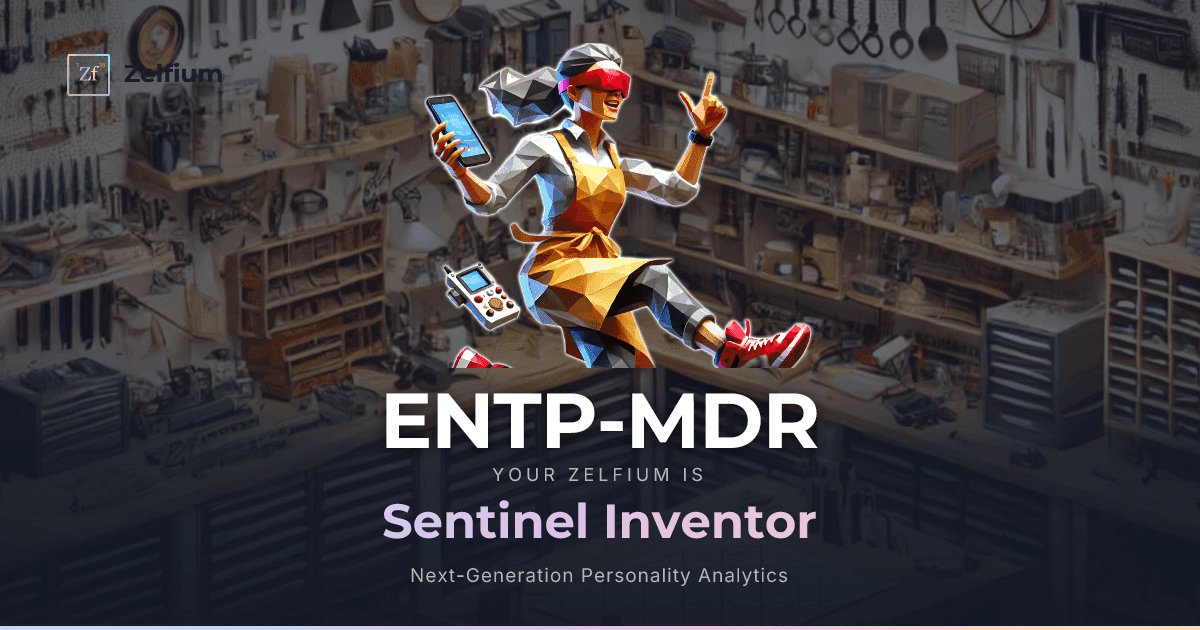
The Sentinel Inventor
The debater loves to take things apart. The sentinel knows exactly which things cannot afford to break. The ENTP-MDR is the rare mind that does both at once — dismantling ideas with intellectual enthusiasm while simultaneously monitoring, with forensic precision, which load-bearing structures must survive the demolition. This is what emerges when the ENTP's socially energized, convention-defying intellect meets the MDR's sentinel nature, where deep respect for proven systems, ruthless analytical independence, and a high-resolution sensitivity to emerging threats converge into a presence that challenges everything except quality. The result is a debater whose iconoclasm is disciplined by expertise — someone who does not question things for sport but because the existing answer has been tested and found wanting by a standard more rigorous than most people are comfortable applying. Where a pure ENTP might enjoy the intellectual fireworks and move on, the ENTP-MDR remains to verify that nothing essential was damaged in the blast.
The ENTP's four dimensions — extraversion, openness, thinking, and pioneering — create a mind that generates ideas through social friction, leaps between domains, and treats certainty as a temporary state that the next good argument might dissolve. The MDR's three dimensions — maintaining, detachment, and responsiveness — create an inner world that prizes what has been proven, evaluates without sentimentality, and scans the environment for emerging problems with the tireless attention of a systems monitor. When these two orientations share a single person, something unexpected emerges: the intellectual provocateur acquires quality control.
The interaction between openness and maintaining creates the most structurally interesting dynamic. The ENTP's openness hungers for novelty — new frameworks, new approaches, new angles of attack on old problems. The MDR's maintaining dimension applies a demanding filter: "Is this new thing actually better, or merely newer?" This filter does not suppress innovation — it refines it into something that has been stress-tested against existing reality. The ENTP-MDR does not adopt new ideas because they are exciting; new ideas must earn their place by demonstrating superiority over what already works. The result is a form of innovation that carries unusual credibility, because it has been examined by the same mind that will ultimately be responsible for its consequences.
Extraversion and detachment create a distinctive interpersonal dynamic. The ENTP draws energy from social engagement and uses dialogue as a thinking tool. The MDR's detachment steps back from the social warmth just enough to maintain analytical clarity. The ENTP-MDR can be fully engaged in a lively discussion and simultaneously observe, with cool precision, that the group is reaching an emotional consensus rather than an evidence-based one. This dual operation — participating warmly while evaluating coldly — gives the ENTP-MDR a unique role in any group: the person who is part of the conversation and apart from it at the same time.
The most charged intersection lives between the ENTP's pioneering restlessness and the MDR's responsiveness. Pioneering pushes forward, eager to try, willing to risk. Responsiveness catches every potential failure mode, every structural weakness, every place where moving too fast might create problems that moving slowly would have avoided. In the ENTP-MDR, every bold idea is immediately subjected to a risk analysis so thorough that by the time the idea is acted upon, its vulnerabilities have already been addressed. This internal process — generate, scan, fortify — produces actions that are simultaneously creative and robust.
The ENTP-MDR possesses a rare combination of creative breadth and diagnostic depth. The ENTP generates ideas across domains; the MDR subjects each idea to the kind of rigorous examination that most people reserve for final review, not for the brainstorming phase. The result is that the ENTP-MDR's "rough ideas" arrive already partially hardened — already tested against the question "What could go wrong?" This makes this type an extraordinary asset in any environment where the cost of failure is real: strategy, engineering, policy, risk management, or any domain where being creative and being right need to coexist.
There is also a distinctive form of authority that this combination builds over time. The ENTP's social engagement ensures visibility; the MDR's track record of accurate assessment ensures credibility. People learn that the ENTP-MDR's critiques are not contrarian performances — they are precisely targeted observations from someone who has already considered the angles that others have missed. This earned authority is unusually resilient because it is based not on personality but on accumulated accuracy.
Finally, the ENTP-MDR has an exceptional capacity for identifying and solving problems that are invisible to others. The ENTP's openness sees possibilities that a more conventional mind would miss; the MDR's responsiveness detects threats that a more optimistic mind would dismiss. Together, they create a scanner that catches both the opportunities and the dangers that live in the space between what is and what could be. This comprehensive perceptual range makes the ENTP-MDR a natural strategist — someone who sees the full board.
The deepest tension in the ENTP-MDR is between the desire to explore and the compulsion to secure. The ENTP wants to push into uncharted territory, to test ideas against reality, to see what happens when assumptions are broken. The MDR wants to ensure that the territory already held is not compromised — that the foundation is sound, that the risks are managed, that quality has not been sacrificed in the rush toward novelty. These two impulses create a distinctive oscillation: bursts of creative exploration followed by intensive periods of verification and fortification. When this rhythm is conscious and managed, it produces work of exceptional quality. When it is not, it can produce a frustrating cycle of starting and stopping that looks like indecision from the outside but is actually the ENTP and the MDR taking turns at the controls.
A second tension lives between the ENTP's social expressiveness and the MDR's analytical reserve. The ENTP wants to share ideas in progress, to think out loud, to invite others into the process. The MDR is reluctant to expose an analysis before it is complete — because incomplete analysis, once shared, can create expectations and commitments that the evidence may not ultimately support. The ENTP-MDR may find itself caught between the impulse to engage and the standard of thoroughness, sometimes withholding insights not because they are uncertain but because they have not yet been verified to the MDR's exacting standard.
There is also a tension around vigilance fatigue. The MDR's responsiveness scans for threats continuously. The ENTP's openness generates new possibilities — including new possible threats — continuously. These two processes, running in parallel, can produce an exhausting state of alertness in which the mind is never at rest: always scanning, always assessing, always preparing for the scenario that has not yet materialized. The ENTP-MDR who learns to set down the scanner periodically — trusting that not every risk requires immediate action — discovers a form of rest that makes the vigilance itself more sustainable and more precise.
Growth for the ENTP-MDR is not about becoming less rigorous or more spontaneous. It is about learning to trust the integration of the two systems — the creative and the critical, the expansive and the vigilant — so that neither one paralyzes the other. The debater's openness and the sentinel's precision are not competing forces; they are complementary instruments that, when played together, produce insight of unusual depth and reliability. The ENTP-MDR who learns to let these instruments inform each other rather than override each other discovers something powerful: a mind that can see what is possible and what is dangerous — simultaneously, accurately, and without flinching — is not exhausting. It is the most complete way of being intelligent. And the world needs it more than it typically knows how to ask for.
The ENTP-MDR portrait drawn here is the "pure form" — what emerges when every pole swings fully in this direction. In reality, each of your dimensions carries a different intensity, and at every intersection, a unique chemistry unfolds. Even a slight tilt in one dimension creates an entirely different internal dynamic — that is the resolution of Zelfium's 7-dimension model.
Zelfium measures each of 36 facets on a 6-point scale. The number of possible patterns:
6³⁶
possible patterns
vs all humans ever born
880 trillion ×
~117 billion humans have ever lived — repeat that 880 trillion times and you still can't fill every pattern
vs stars in the observable universe
~50,000 ×
~200 sextillion stars in the observable universe — still not enough
vs grains of sand on Earth
~1 billion ×
~7.5 quintillion grains of sand — multiply by a billion
vs current world population
~1.3 quintillion ×
Line up 1.3 quintillion copies of today's 8 billion people to fill every type
More than 50,000 times the number of every star in the observable universe. That is the resolution of your personality.
So don't fit yourself into this description too tightly. ENTP-MDR is a compass showing the direction your personality leans — not a box that defines everything you are. The pattern woven by your 36 facets is singular in this universe. To discover that one-of-a-kind blend — to find your own ENTP-MDR — take the assessment.